Private Label vs White Label: Which Is Better for Business (2026)
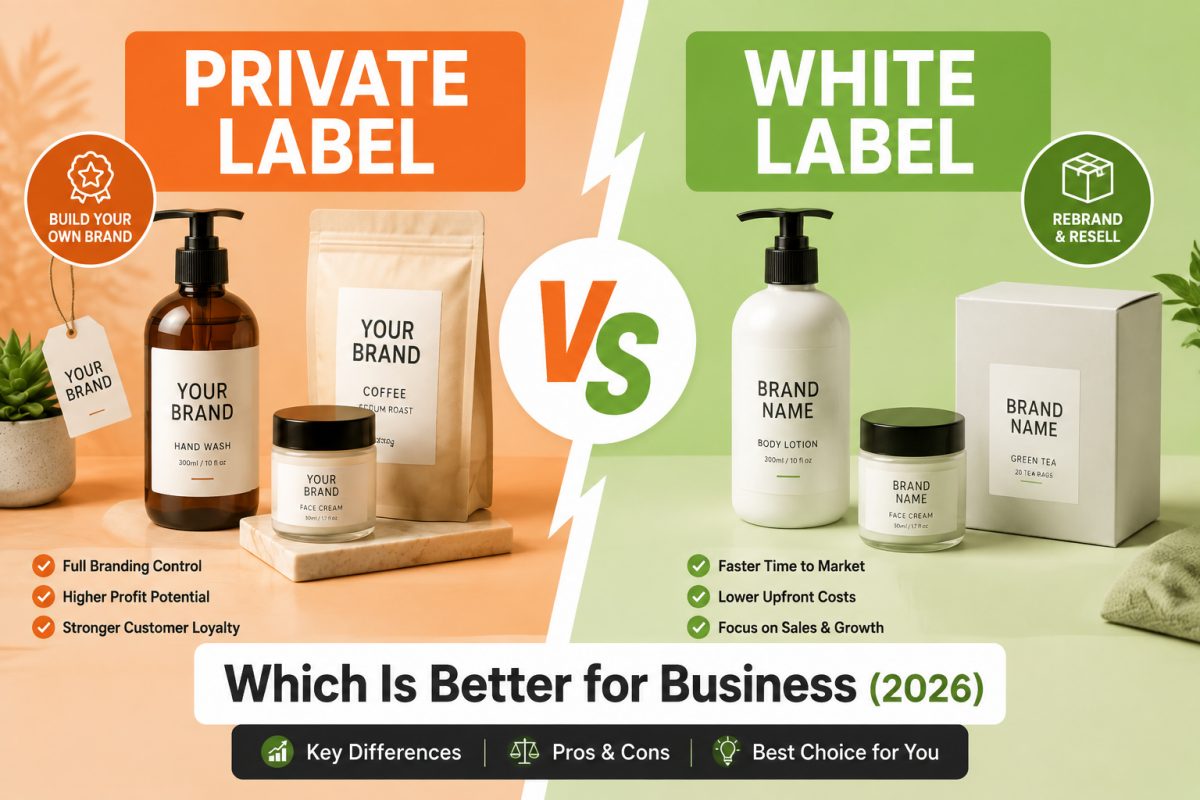
We previously discussed choosing between Etsy and Shopify to launch an e-commerce business. Today, we'll explore whether to choose a white label or a private label model for your online store. While both models allow you to sell products under your own brand, they differ significantly in terms of product ownership, customization options, investment, and long-term growth potential.
In this guide, we will analyze in detail the key differences between private label and white label models, compare their advantages and limitations, and help you determine which model best suits your business objectives.
What is a Private Label?
Private label brands allow your store or brand to partner with third-party manufacturers to produce high-quality products. These customized products, bearing your exclusive brand identity, are sold exclusively by you. You can negotiate with manufacturers to have greater control over product specifications, materials, packaging, labeling, and the overall customer experience. The manufacturer handles production, while the brand manages product positioning and marketing strategies. In short, private label brands sell products that other sellers cannot offer , helping businesses differentiate themselves and escape low-profit, homogeneous competition.
How Private Label Works
The private label process typically begins with a company identifying market opportunities and defining its target product type. Unlike purchasing existing products, businesses work closely with manufacturers to develop product versions that align with their own vision.
For example, a clothing brand might collaborate with a manufacturer to produce oversized hoodies using specific fabric blends, unique color schemes, and custom woven labels. While the garments are manufactured in a factory, the brand owns the design direction and sells the finished products under its own brand. Because these products are exclusive to that brand, competitors cannot buy and resell the exact same items.
Pros of Private Label
- Exclusive products are more likely to stand out.
- A stronger brand image
- Greater pricing power
- Higher customer loyalty
- Long-term competitive advantage
Cons of Private Label
- High initial investment
- Higher minimum order quantity (MOQ)
- Longer time to market
- There is a risk of inventory backlog.
- More involvement in supply chain management is needed

What is White Label?
White label manufacturing refers to the practice of selling standardized products manufactured by a company under your own brand. You don't need to develop a unique product from scratch; you simply purchase off-the-shelf products and customize only certain brand elements, such as logos, labels, or packaging. Even if sold under multiple different brands, the product itself remains essentially unchanged. In other words, the same product, manufactured by an OEM, can be sold by multiple retailers, each using their own brand. Because the product is already developed and the production process is mature, OEM manufacturing offers entrepreneurs a faster and more economical way to start a business.
How White Label Works
Sellers can start selling simply by selecting the products they need from the manufacturer's catalog. You can apply your own brand on the labels or packaging , a step usually handled by the supplier, allowing you to focus on marketing, customer acquisition, and business growth.
For example, suppliers might provide blank mugs, T-shirts, or water bottles for multiple brands to customize with their own logos or designs. While each business may have a different marketing approach, the underlying products usually come from the same manufacturer.
Pros of White Label
- Lower start-up costs
- Faster time to market
- Most do not have a minimum order quantity requirement.
- Ideal for product testing
- It works very well when used in conjunction with print-on-demand.
Cons of White Label
- The product's core functionality has limited customization potential.
- Severe homogeneous competition
- Limited control over product quality
- Potential price pressures
Private Label vs White Label: Quick Comparison
The following comparison guide will help you quickly understand the key differences between white label and private label brands:
| Feature | Private Label | White Label |
|---|---|---|
| Product Ownership | Exclusive | Shared |
| Product Design | Fully customizable | Limited |
| Branding | Full branding | Logo & Packaging |
| MOQ | Higher | low |
| Startup Cost | Higher | Lower |
| Time to Market | Longer | Faster |
| Competition | Lower | Higher |
| Profit Margin | Higher potential | Moderate |
| Best For | Established brands | Beginners |
| Risk | Higher | Lower |

Private Label vs White Label: 7 Key Differences Explained
White label and private label models differ significantly in product development, manufacturing, brand building, and fulfillment. These differences can impact your startup budget, time to market, profit potential, and ability to build a unique brand. Here are seven key factors to consider when comparing and choosing between private label and white label models.
Product Customization
When you adopt a private label model, you can collaborate with manufacturers to customize details such as material, color, size, composition, function, construction, packaging, and labeling to meet your specific needs. For example, a private label apparel manufacturer producing hoodies can choose specific fabric weights, cuts, sewing techniques, color schemes, and label designs. These differences in specifications can significantly differentiate the product from competitors.
In contrast, white label products offer less customization options because their base product is typically already developed by the supplier. Retailers can usually only personalize surface elements such as logos, graphics, print designs, labels, or packaging. For example, in a print-on-demand model, different retailers might use the same blank T-shirt as a base but print completely different designs on it.
Branding Opportunities
Both models allow businesses to sell under their own brands, but they differ in the depth of brand building. Because private label products are developed specifically for a particular company, businesses can maintain brand consistency in product quality, design, packaging, labeling, and customer experience. This makes it easier for companies to establish a distinctive market position and justify higher pricing.
The white label model typically focuses on how existing products are presented. Sellers can only differentiate themselves through different visual designs, product photography, packaging, brand storytelling, customer service, and marketing campaigns. However, this doesn't mean white label companies can't build strong brands. Many successful white label companies distinguish themselves through clear market segmentation, impressive marketing strategies, and high-quality content. Nevertheless, the lack of product uniqueness remains their biggest disadvantage.
Manufacturing Costs
significant upfront investment because manufacturers must adjust their production processes to meet the specific requirements of the brand owner. For startups with limited funds, these costs can pose a barrier to entering the private label market.
Related costs may include:
- Product Development
- Sample making and modification
- Custom materials
- Packaging Design
- molds or tooling equipment
- Product Testing
- Minimum order quantity requirements
In contrast, white-label products typically have lower launch costs because suppliers have already completed product development and established mature production processes. Companies can directly choose to sell existing products without investing heavily in R&D, testing, or production line construction.
If a white-label sales model using print-on-demand is adopted, merchants do not even need to purchase goods in advance; they only need to produce after the customer places an order. This model further reduces upfront costs.
Inventory Requirements
Private label manufacturers typically have minimum order quantity requirements. This means you must purchase and maintain inventory before you can sell the products. You also need to manage warehousing, inventory levels, packaging, shipping, and returns yourself, or outsource order fulfillment to a third-party logistics provider. While this model allows businesses to better control product supply and delivery time, it also comes with inventory risk. If market demand is lower than expected, the company may face product backlog issues.
Order fulfillment under the white label model is typically more flexible. Some suppliers allow businesses to order in small quantities, while others offer dropshipping or print-on-demand services. In the print-on-demand model, products are only produced after an order is received; subsequently, the supplier is responsible for printing, packaging, and shipping the products directly to the customer.
Speed to Market
White label products can be launched much faster than private label products. Because white label suppliers already have ready-made products, you simply choose one, add your own brand or design, create a product listing, and can add the new product to your online store and start selling within a day. This speed advantage allows you to quickly respond to seasonal events, social media trends, and ever-changing customer preferences. Furthermore, you can test multiple product ideas without investing in large-scale production.
If you choose the private label model, you will need to research customer needs, develop product specifications, compare different manufacturers, order samples, review quality, modify products, and arrange mass production. The entire process can take weeks or even months.

Profit Margins
Generally, private label products have higher profit margins, but profitability depends on more than just the business model itself. When ordering in bulk, the unit cost of private label products may be relatively low. Their uniqueness also gives the brand greater pricing power, as consumers find it difficult to compare prices for the exact same product across different sellers. However, private label businesses must take into account factors such as development costs, bulk inventory, warehousing, transportation, returns, and slow-moving inventory. High gross margins do not equate to high net margins; in other words, you must effectively control costs across various intermediary stages to achieve high profits.
The unit cost of white-label products is higher than that of mass-produced proprietary products. Furthermore, due to the market saturation with similar products, sellers may face more intense price competition, which will further squeeze profit margins.
Business Risk
Private label brands involve higher financial and operational risks. Companies often need to invest in product development and inventory preparation before they know for sure whether consumers will buy. Manufacturing defects, supplier delays, inaccurate demand forecasts, or changes in market trends can all lead to significant losses. Furthermore, depending on the product category, companies may also bear regulatory and quality control responsibilities. For example, companies selling cosmetics, food, children's products, or electronics typically need to meet specific testing and compliance requirements.
White label models lower many of these barriers because the products are readily available and often support small-batch orders. Print-on-demand models further reduce risk by eliminating the pressure of inventory buildup. Furthermore, a company's business performance often depends heavily on the quality of its suppliers' products and their reliability in fulfilling obligations.
Which Business Model Is Right for You?
The most suitable business model for you depends on your budget, business goals, industry, and growth strategy. Understanding your current stage of development will help you choose a business model that balances opportunity, investment, and risk.
If you're a beginner
For new sellers , the white label model is often a more pragmatic choice because it allows you to start selling directly without the complex processes and financial pressure of developing a product from scratch. When opening your first online store, the biggest challenges often lie not in manufacturing, but in understanding your customers, testing product ideas, and finding a profitable market.
For example, a startup entrepreneur just entering the apparel industry can use white-label on-demand printing services to test various designs, market segments, and product types without having to purchase large amounts of inventory upfront. If a product performs well in the market, more resources can be invested to expand the product line or develop exclusive products. Once market demand has been validated and a customer base has been built, transitioning to private-label products becomes a natural next step.
If you're building a premium brand
If your goal is to build a premium brand with unique products and strong customer loyalty, then a private label is often the more ideal choice. Premium brands are often built on differentiation. Customers are willing to pay a premium for products that have something unique—whether it's superior materials, exclusive design, exquisite craftsmanship, or a more compelling brand story. A private label model is more suitable if you meet the following criteria:
- Has a clear brand positioning
- Understand your target customers
- Pursuing long-term brand value
- Capable of investing in product research and development
- The aim is to compete through uniqueness rather than price advantage.
If you're running a Print-on-Demand business
For print-on-demand printing businesses, the white-label model is the most suitable starting point. The on-demand printing model allows entrepreneurs to sell customized products without stocking inventory. Products are not pre-produced but made only after a customer places an order. The supplier handles production, packaging, and shipping, while you can focus solely on design, branding, and marketing.
On-demand printing sellers also use existing products and then incorporate their own creative designs or brand elements. Common on-demand printing products include:
- Custom T-shirts
- hoodie
- mug
- Tote bag
- poster
- Home Decor
- Accessories
Discover more best-selling white-label products: What is a White Label Product? The 15 Best White Label Products to Sell
If you already have an audience
If you already have strong customer demand, a private label model can help you create exclusive products, thereby deepening your relationship with your audience. For example, creators with a loyal fan base can develop customized merchandise lines that reflect their personal brand, providing fans with a unique product experience.

How to Start Your White-label Brand with PeaPrint
PeaPrint empowers sellers to easily create and sell their own branded products, offering both low start-up costs and automated order fulfillment. Browse the PeaPrint product catalog to start designing your own branded products immediately.
Here are the steps to get started:
- Create a free PeaPrint account.
- Visit PeaPrint's product catalog to find the right product.
- Use the product creation tool to upload your designs, logos, and more to build your own product line.
- Connect your store and sync with platforms like Shopify and Etsy to publish your product listings.
- Start selling now. Once an order is received, PeaPrint will handle printing, packaging, and shipping on your behalf.
For entrepreneurs, creators, and online sellers, PeaPrint offers a simple way to turn ideas into scalable white-label businesses.
FAQs
Is print on demand considered white label?
Yes, print on demand (POD) is generally considered a type of white label business model. In a traditional white label model, a supplier creates ready-made products that businesses can sell under their own brand. Print on demand follows a similar approach, but with one major difference: products are only manufactured after a customer places an order.
Is private label more profitable than white label?
Private-label products may offer higher profit potential, but higher potential profit does not always translate to higher actual profit. Private-label operations typically require significant upfront investment, including costs for product development, inventory procurement, manufacturing, and warehousing. If sales fall short of expectations, unsold inventory can erode profitability.
Can I switch from white label to private label later?
Yes, many successful businesses start with white label products and gradually transition to private label as they grow. Starting with white label allows entrepreneurs to test product ideas, understand customer preferences, and build an audience without making a large investment. Once a business identifies popular products and has consistent demand, it can invest in developing exclusive products with more customization.
Private label vs white label, which is better for beginners?
For most beginners, white label is usually the better starting point because it requires less investment, has a faster launch process, and involves fewer operational challenges. When starting an online business, the biggest challenge is often validating demand rather than manufacturing products. White label allows beginners to test different products, niches, and marketing strategies without purchasing large amounts of inventory or managing complex production processes.