Etsy vs Shopify: Which Is Better for Online Sellers (2026)
You've probably struggled with this question for a long time. Etsy vs. Shopify , two e-commerce platforms with drastically different operating models, are the first choice for many new sellers. They each have their advantages and disadvantages, and everyone has different opinions on them. That's why we felt it necessary to write this article about Etsy . A comparison between Shopify and Shopify helps you understand what factors are truly important to you when choosing a platform, ensuring you start your online business on the right platform.
Etsy Overview
Etsy is an online marketplace focused on handmade, vintage, and creative goods. Buyers can browse products from thousands of independent sellers . You can also join Etsy and open your own shop to compete with these sellers.
Pros
- Instantly reach a large group of buyers
- Setting up a store is very simple and requires no technical skills.
- Large platforms trusted by buyers
Cons
- Competition in popular categories can be very fierce.
- Your store has very little room for customization and lacks personality (not suitable for brand building).
- Various expenses accumulate quickly
Shopify Overview
Shopify is the most popular e-commerce website building tool. You can purchase a domain name and build your own store, setting your own rules without being bound by marketplace platforms. Furthermore, you have complete control over your store and customer data.
Pros
- Complete control over your store's appearance and operation
- You have a very high degree of freedom; you can sell any legal product.
- An excellent plugin ecosystem allows for the customization of unique shopping experiences.
Cons
- If you don't have a ready-made customer base , you'll be responsible for attracting customers.
- It takes more time and effort to build than Etsy.
- It takes longer to make the first sale.
- A monthly fee is required.

Etsy vs Shopify : 7 Key Things for Choosing a Platform
Pricing and Fee Structure
Etsy fees explained :
Etsy doesn't charge a monthly fee, but its other fees accumulate quickly. Etsy charges $0.20 per item for listing, 6.5% commission per transaction, plus a 3% + $0.25 payment processing fee. This means that profit margins for low-priced items will be significantly reduced.
Regarding product listing fees: There is a $0.20 listing fee per item, valid for only 4 months. If you wish to continue listing after the expiration date, you will need to pay an additional $0.20. Therefore, if your store has a large number of products, these small renewal fees can become a significant expense over time.
Shopify fees explained
Unlike Etsy, Shopify uses a subscription model, with monthly fees ranging from $39 to $399 depending on the plan. Aside from the subscription fee, it doesn't take a cut of your sales, making costs manageable for sellers with stable sales.
However, if you use other third-party payment gateways to receive credit card payments, you will incur an additional transaction fee of 0.2% to 2%. Most sellers choose to use Shopify Payments to avoid this extra cost.
Shopify fees may also include expenses for purchasing premium themes and other applications; most sellers opt for premium themes to customize their stores. Generally, themes cost around $100-$300, and applications cost around $20-$50 per month.
Ease of Use
For new sellers, ease of use is crucial. Most people don't want to waste weeks figuring out the platform before even selling a single item. Opening a store on Etsy is simple: you just need to register an account, set up your store, and add products to start selling—the whole process takes only a few hours.
Using Shopify takes more time because you need to build a real website. You first need to choose a theme, configure your domain, set up a credit card payment gateway, and install the Shopify app. While the drag-and-drop editor is easy to use even without a technical background, the setup process still takes a considerable amount of time. This is why Shopify has a steeper learning curve.
Etsy's advantage lies in ease of use, while Shopify 's advantage lies in having more control over the final result.
Design and Customization
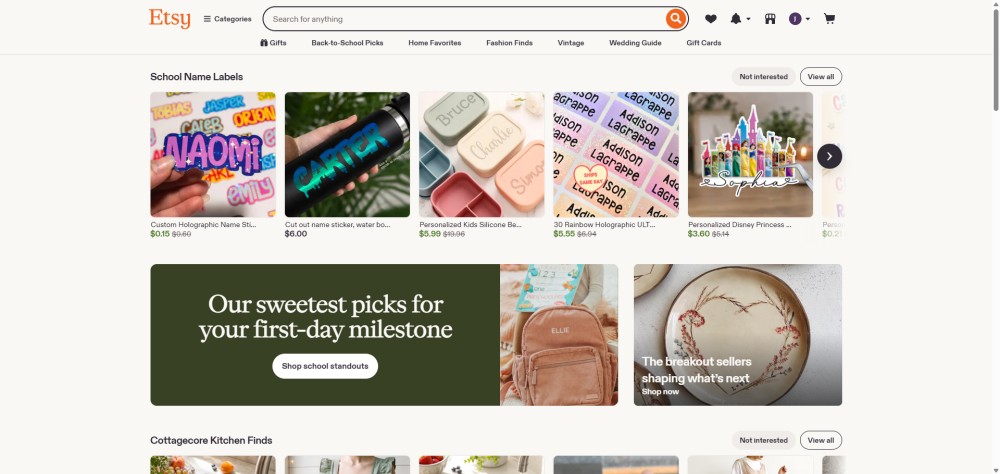
Etsy stores all have the same layout: a banner, a logo, and a short "About Us" page. Beyond that, there's no room for design or customization, making each store look almost identical and lacking personality. To make your store stand out, you must focus on your products.
Shopify offers a high degree of freedom, allowing you to customize fonts, colors, layouts, and more. You can create your store exactly how you envision it, which is extremely beneficial for building a brand image. This is because you're not just listing products; you're expressing your brand's tone and vision through a meticulously crafted store. While it requires more effort to set up, it's a perfect choice for sellers planning to build a long-term brand.

eCommerce Features and Integrations
Etsy's sales process is very simple: you list your products, buyers purchase them, and Etsy processes the transaction. In terms of e-commerce functionality, Etsy offers a cleaner, marketplace-centric sales experience. It includes most of the essential features sellers need, such as product listings, order management, coupons, advertising, payments, and basic sales analytics. However, some third-party applications can support tasks such as product listing optimization, inventory management, and print-on-demand.
Shopify offers a more comprehensive e-commerce infrastructure. In addition to the features supported by Etsy, Shopify merchants can install apps to connect their stores to external services or add specific functionalities. Features such as abandoned cart recovery and product upselling are available on Shopify but not on Etsy.
SEO and Marketing Tools
Etsy stores and products also rely on search engine rankings to appear before customers. However, the Etsy search engine is limited to the Etsy platform; your product title, tags, and description determine your ranking within the platform. Etsy product information doesn't easily rank in external search results. Therefore, Etsy SEO is primarily aimed at gaining more exposure within the platform.
Shopify allows you to control the meta title, meta description, and URL structure of each page. You can also run a blog and gradually build organic traffic. Shopify's comprehensive plugin ecosystem provides many SEO tools that Etsy lacks, helping you gain more and more stable Google search exposure on your SEO journey.
Audience and Target Customers
Etsy's biggest advantage over Shopify is its built-in traffic; Etsy is a high-traffic platform. It attracts approximately 454.6 million visitors globally each month, with buyers actively seeking handmade, vintage, or unique products. Selling on Etsy allows you to showcase your products to a massive customer base without spending huge sums on advertising or SEO. This is extremely attractive to new sellers.
Shopify doesn't have a built-in audience; all visitors need to be attracted through SEO, social media, or advertising. However, Shopify's advantage lies in its applicability to a wider range of products. As long as the product is legal, you can sell it, so your customers aren't limited to a single type of buyer.
Scalability
I can tell you definitively that Etsy is a great starting point, but its growth potential is limited. It's the best choice for beginners who want to see results quickly. However, on Etsy, you must follow its rules, otherwise your product listings may be removed or your account suspended. Its scalability is limited unless you open multiple stores.
Shopify scales to meet your needs. You can upgrade your plans as your business grows, add features as your business expands, and no one can shut down your store overnight. This means you have complete control over your store; the customers you attract through SEO or social media, and the fan traffic you build, belong entirely to your store. They are not shared with competitors, nor are they transferred due to third-party platform algorithms or store updates.

Shopify vs Etsy by Business Type
Each seller's business type may be different. If you are still unsure how to choose, the following content will introduce the applicable scenarios for each of the two platforms based on the products you sell and your current stage of e-commerce development.
For part-time entrepreneurs and beginners: Etsy is especially suitable for stay-at-home moms and college students who want to run a small business part-time rather than full-time. It allows for quick startup, low upfront costs, and stable traffic that can generate orders quickly, making it the easiest platform for beginners to get started.
For established e-commerce businesses: Shopify's robust scalability and comprehensive plugin ecosystem ensure that large enterprises and brands have greater control over handling high volumes of sales. Furthermore, higher-tier plans offer lower transaction fees.
For sellers of unique handcrafted goods: Selling unique handcrafted goods on Etsy has a natural advantage because your target customers are right there, actively seeking out novel and unique items. If your business grows rapidly, you can later choose Shopify to build your own brand.
For apparel brands: If you're looking to build a long-term apparel brand, Shopify has a clear advantage in areas such as visual identity, user data, repeat purchases, content marketing, and long-term asset accumulation. Furthermore, apparel typically involves sizes, colors, styles, collections, and seasonal new arrivals. Shopify is better suited for establishing clear category structures.
Print-on-demand sellers: Shopify and Etsy are both excellent options for small businesses selling custom designs . Etsy offers instant reach, while Shopify provides better margin protection. Many print-on-demand sellers operate on both platforms and use PeaPrint to handle order fulfillment for both channels.
When Etsy is The Better Choice
If you're looking for a part-time job or extra income, then Etsy is for you. You can quickly start your business and begin testing your business ideas and product concepts without a large investment. If you're an artist or craftsperson looking to sell your handmade creations, it perfectly matches the search needs of Etsy's customers. In short, if you don't want to deal with a lot of tedious setup before you start selling, Etsy is the right choice.
Even experienced sellers can leverage Etsy's large user base to generate additional revenue. You can either open a store on Etsy or run a Shopify main store simultaneously.
When Shopify is The Better Choice
For ambitious sellers willing to invest capital and build a long-term brand, Shopify is the top choice. This gives you complete control over your online store, preventing high transaction fees from becoming a burden even as your sales grow. You also have more flexible marketing strategies to choose from, such as email marketing, membership programs, and branding. You can customize every aspect of the customer experience and sell across multiple channels without being restricted by platform rules.
Hybrid mode: Using both Etsy and Shopify
Which is better, Shopify or Etsy? Many sellers don't just choose one platform; they operate both simultaneously. And many successful businesses started with Etsy and then expanded to Shopify to build their brand.
The idea is very simple:
- Use Etsy to get more people to discover you.
- Save money with Shopify .
Etsy boasts a massive customer base, making it a great platform to test your niche, see which products sell well, and gather early reviews. Think of it as a low-risk launchpad for your e-commerce journey, acquiring your first customers through Etsy. However, when you're ready to truly take control, building a complete brand identity through Shopify, independent of third-party platforms, is the optimal growth path.
Many sellers drive Etsy customers to their Shopify stores for repeat orders. The method is simple: once someone buys your item on Etsy, include a small card with your website address and a small discount in the packaging. This generates a steady stream of repeat customers and significantly increases your profits.

Shopify vs Etsy for Print-on-demand Sellers
Both platforms are commonly used by print-on-demand sellers and both function well in the print-on-demand business. However, they differ in overall sales experience, cost structure, and growth potential, differences that you should fully understand before making a decision.
Etsy print on demand
Print-on-demand services inherently offer customized and personalized products, and the Etsy marketplace brings together a large number of buyers specifically seeking unique and customized items. This perfectly aligns with the advantages of print-on-demand. Moreover, print-on-demand requires no upfront investment, and Etsy's low-cost store setup allows many entrepreneurs without large budgets to successfully launch their businesses.
The current challenge for Etsy print-on-demand is the increasing influx of sellers, leading to increasingly fierce competition. New sellers need to conduct thorough niche research and create high-quality designs to achieve stable revenue.
Shopify print on demand
Shopify stores give print-on-demand sellers greater control over their brand, customer experience, and pricing. It's easy to create unique niche brands targeting a specific audience by relying on consistent design. These brands typically have more loyal customers and higher profit margins. Furthermore, they don't need to compete in a fiercely competitive market, generating stable orders through repeat customers. In addition, you're not bound by platform rules, allowing you to drive more traffic to your store through flexible marketing strategies such as social media.
For print-on-demand sellers, PeaPrint offers integration with Shopify and Etsy. You can connect PeaPrint directly to your Etsy or Shopify store to automate order processing, allowing you to focus on business growth.
Conclusion
Etsy and Shopify. It largely depends on your current business situation. They're not competitors; they solve different problems. For start-up sellers, Etsy is a better starting point. From a long-term development and brand-building perspective, Shopify is the better choice. For on-demand print sellers, both platforms are suitable and can be operated simultaneously.
Frequently asked questions
Is Shopify better than Etsy ?
Neither platform is inherently superior; they each have their own advantages. For sellers looking to build a long-term, independent brand, Shopify is a better choice than Etsy; however, for beginners needing market traffic, Etsy might be more suitable. Shopify gives sellers greater control over their stores, while Etsy is easier and faster to get started with.
What is the difference between Etsy and Shopify?
The main difference is that Etsy is an e-commerce marketplace platform with its own built-in traffic, while Shopify is an independent e-commerce platform where you need to drive traffic yourself. Etsy helps you sell products in your existing marketplace, while Shopify helps you build an e-commerce business that you control.
Can I sell using both Shopify and Etsy at the same time?
Yes. In fact, many successful sellers use Shopify and Etsy as part of the same business strategy. Etsy serves as a marketplace, helping customers discover your products, while Shopify acts as your brand's online store, giving you complete control over the shopping experience and customer relationships. To avoid manually updating products and orders on both platforms, many sellers use on-demand printing or inventory management applications like PeaPrint to sync data between Shopify and Etsy.