What Is Cotton All-Over Print — and Can You Really Print on 100% Cotton?
Most people who search this question already know the answer they expect.
All-over print means polyester. That has been true for as long as the technique has existed at commercial scale, and it is still true of almost every product in almost every print-on-demand catalogue.
So the real question is narrower, and more useful: can all-over print actually work on cotton, or is "cotton AOP" a relabelled polyester shirt with a better product page?
It works. But not on the same production line, not with the same ink, and not at the same cost. This article explains what cotton all-over print is, why the answer used to be no, how it is done now, and how to tell a genuine one from a relabelled one in about three minutes.
Key takeaways
- All-over print means the pattern is printed onto fabric before the garment is cut and sewn — not printed onto a finished shirt.
- The reason AOP became synonymous with polyester is dye sublimation, which only bonds to synthetic fibre. That is a materials constraint, not a marketing choice.
- Cotton AOP uses a different route: prepared cotton, DTG printing onto flat panels, then cut and sew.
- A "100% cotton" claim needs checking, because cotton-rich, cotton-spandex and faux cotton all appear on product pages that look identical at a glance.
- The categories where cotton AOP changes the sale are baby clothes, next-to-skin tees and structured shirts. It is the wrong choice for activewear, swim and outerwear.
- Base cost in our range runs from $5.96 (baby swaddle) to$14.53 (men's shirt); production takes 2–4 days and transit 10–15 days.
What cotton all-over print actually is
Start with the order of operations, because everything else follows from it.
In ordinary garment decoration, the shirt exists first. A blank tee is manufactured, shipped to a printer, placed on a platen, and printed inside a rectangle on the chest. The print is an addition to a finished object.
All-over print reverses that. The fabric is printed first, as flat panels. Those panels are then cut to pattern and sewn into a garment. By the time the shirt exists, the print is already inside it.
That difference sounds technical. It isn't — it changes what you are buying. A DTG shop sells a decoration service applied to a blank it purchased. An all-over print shop sells a garment it manufactured. One has a blank supplier behind it; the other has a cutting table and a sewing floor.
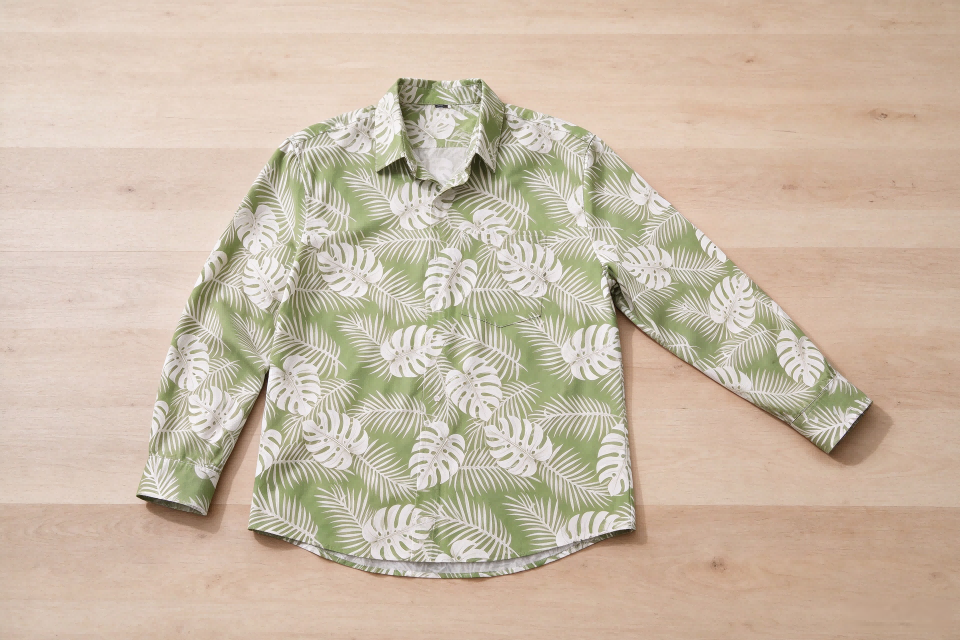
Coverage is the visible consequence. There is no print boundary, because there is no rectangle. The pattern crosses the placket, wraps the sleeve, and continues across the back. On a well-made garment, the only interruptions are the seams themselves.
What cotton changes is not the coverage. It is the material the coverage happens on, and therefore the printing method used to achieve it. A cotton all-over print shirt and a polyester all-over print shirt look similar in a photograph. They are made in completely different ways, and they behave differently against skin.
Why the answer used to be "no"
The standard method for all-over print is dye sublimation. Understanding it explains the entire category.
Sublimation printing starts by printing the design onto transfer paper. That paper is then pressed against fabric at high temperature. Under heat, the solid dye turns directly into a gas — it sublimates, skipping the liquid phase — and that gas penetrates the fibres. As the fabric cools, the dye solidifies inside the material.
The result is genuinely good. The colour becomes part of the fibre rather than sitting on top of it, so it does not crack when stretched and does not build up a visible layer. This is why sublimated polyester feels smooth and prints with high detail.
But the bond only forms with synthetic fibres. Polyester accepts the dye. Cotton does not — its molecular structure gives the dye nothing to attach to. So the pigment stays on the surface, and the first wash takes most of it away.
That single property shaped an entire industry. If you want all-over print at scale, the path of least resistance is polyester: cheaper fabric, faster production, simpler equipment. So the catalogues filled up with polyester, and within a few years "all-over print" and "polyester" had become the same phrase in most buyers' minds.
It is worth being clear about what this is and isn't. It is not a case of factories cutting corners. Cotton all-over print, done with sublimation, genuinely does not work — not badly, but not at all. The limitation is physical. The only way around it is to stop using sublimation.
How cotton all-over print is actually made
Cotton all-over print exists, and it is produced commercially. But it cannot run on a sublimation line, so it runs on a different one. There are three stages.
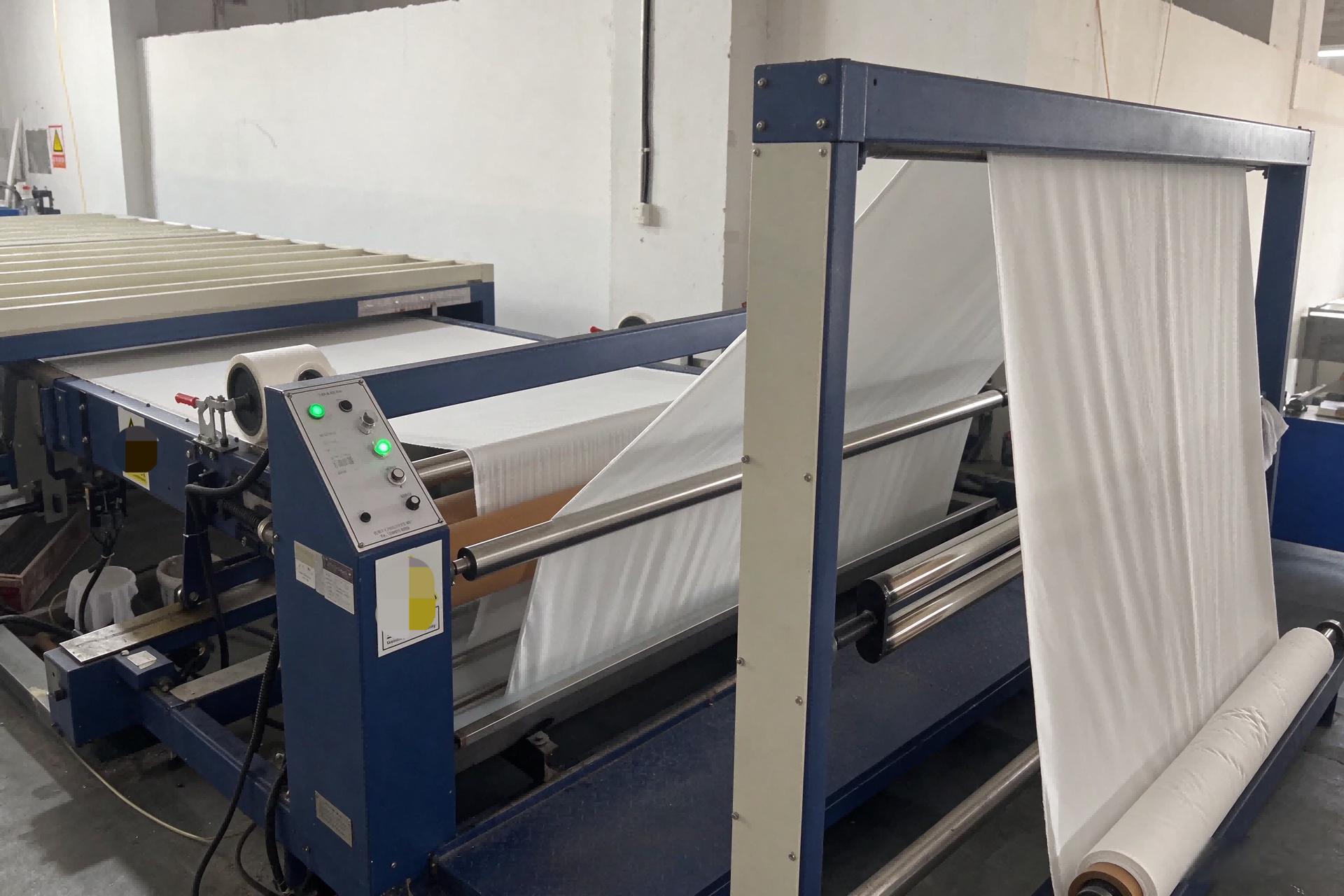
Stage one: prepare the fabric.
Untreated cotton wicks. Ink applied to it spreads sideways into the fibres, which softens edges, fills in fine detail, and turns solid black into something closer to charcoal. On a small test piece you can work around this. At production volume you cannot.
So the cotton is prepared before it goes near a print head. This stage gives the fibre a surface that holds ink where it lands. Without it, the print looks washed out before the garment is even sewn.
Stage two: print the panels.
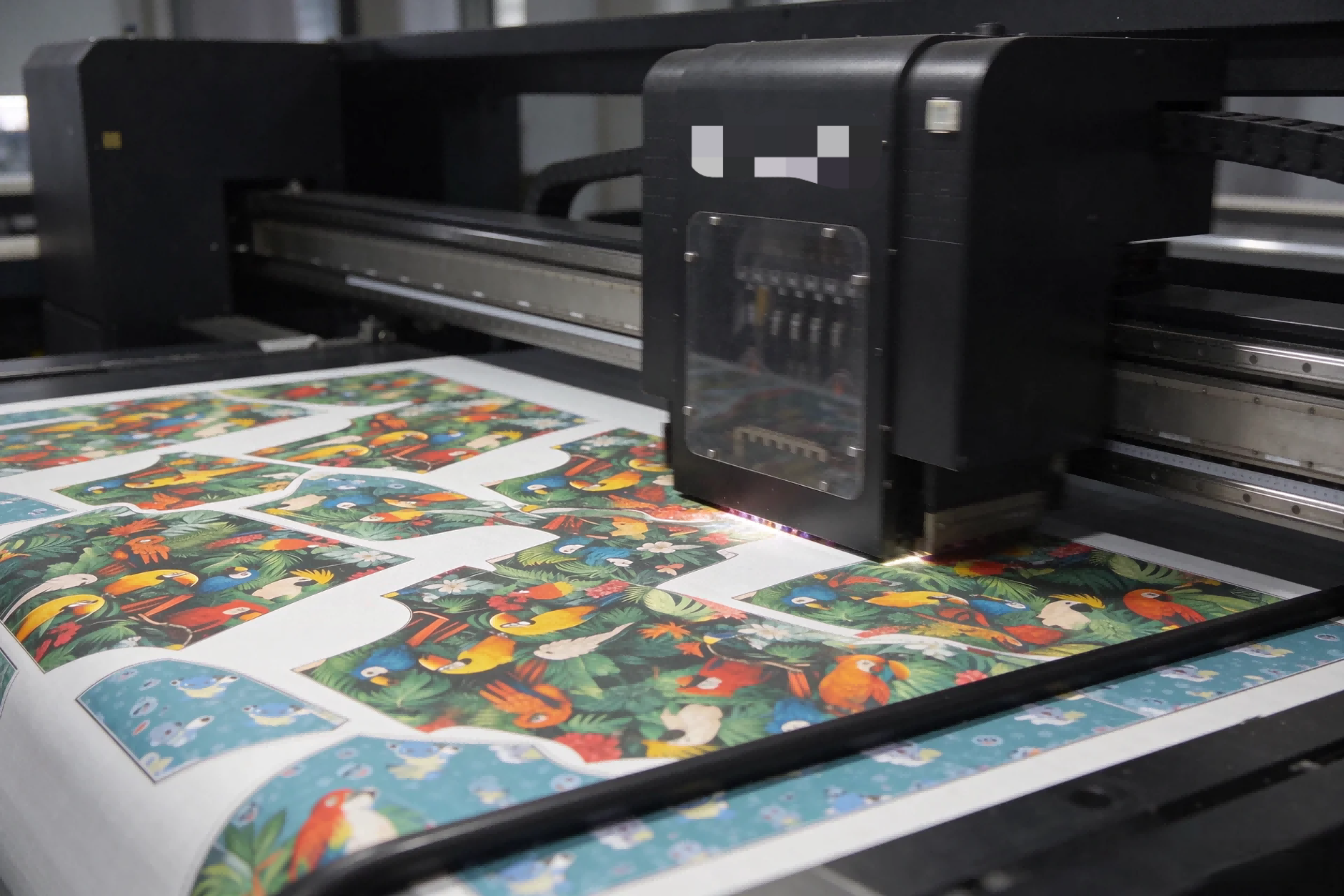
What gets printed is not a roll of fabric. It is the individual panels that will become the front, the back, the sleeves, the collar and the placket.
Each panel is printed flat, positioned so that the pattern will line up when the pieces are joined. This is a batch process, not a continuous one: change the design and the line stops, re-aligns, tests, and starts again.
Stage three: cut and sew.
The printed panels are cut to pattern and sewn into a finished garment. Because printing happened first, the pattern is continuous across the assembled piece — the placket carries the print, the collar carries the print, the sleeves carry the print.
This is also where the quality is decided. A print can be perfect and the garment still fail, because the panels were cut or aligned badly and the pattern steps at the side seam.
Why it costs more.
Three things: cotton costs more per metre than polyester; there are more stages, each with labour and machine time; and panel printing has lower throughput than roll-to-roll. None of that shows up in a photograph. All of it shows up in the invoice, which is why the technique is uncommon rather than universal.
What it looks like up close.
Because pigment sits in the fibre rather than forming a film over it, the weave remains visible through the colour. Under magnification, a cotton print reads as coloured fabric. A sublimated polyester print reads as a smooth surface with colour inside it.
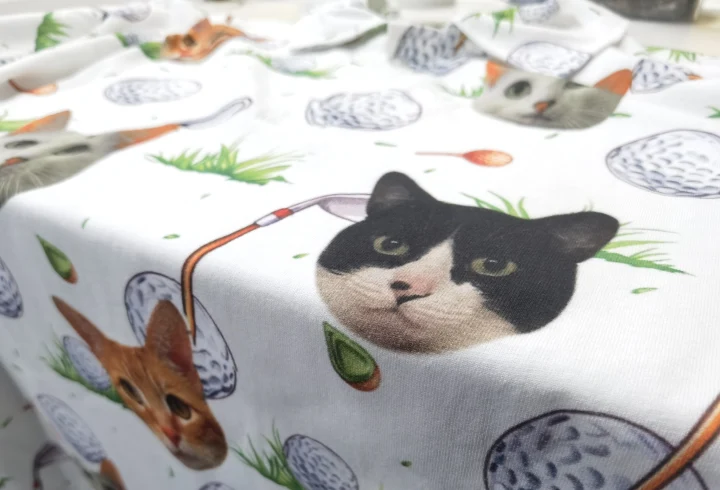
The edges of shapes are also slightly soft rather than razor-sharp. That is a characteristic of pigment on a textured surface, not a defect — and it is one of the ways you can tell the two processes apart under a lens.
What "100% cotton" means on a label
This is where most sourcing mistakes happen, because the vocabulary is not standardised and several phrases sound like guarantees when they aren't.
| Label wording | What it usually means |
| 100% cotton | All cotton. This is the only phrase that means what it says. |
| Cotton-rich | Mostly cotton. Frequently 90/10 or 80/20 with polyester. |
| Cotton blend | Any ratio. Ask for numbers. |
| Cotton-spandex / cotton-elastane | Cotton plus a small percentage of stretch fibre, usually 3–5%. |
| Combed cotton | A spinning process that removes short fibres. It says nothing about content. |
| Faux cotton | A synthetic engineered to feel like cotton. Not cotton at all. |
Two of these are worth dwelling on.
Combed cotton is not a fibre claim. It describes how the yarn was prepared. A 60% cotton / 40% polyester shirt can be made from combed cotton. The phrase appears on product pages because it signals softness, and buyers reasonably but incorrectly read it as purity.
Faux cotton is a warning sign. The word "faux" is doing exactly what it says. If a product is described this way, it is a synthetic made to imitate cotton's hand feel — which may be a perfectly good product, but it is not what a parent is looking for when they filter for cotton.
The practical rule: ask for composition percentages in writing, not for a product name. Any supplier who cannot give you a percentage is either unsure or hoping you won't ask.
There is also a legitimate middle ground. A cotton-rich blend prints well, drapes well, and costs less. It is a reasonable product for plenty of categories. It simply is not the same product as 100% cotton, and it should not be marketed as such — particularly in babywear, where the fibre is the purchase condition rather than a preference.
What it gets used for
Cotton all-over print is not a universal upgrade. It makes sense in categories where the material is felt against skin or where the garment has structure worth printing across. Outside those, polyester is usually the better answer.
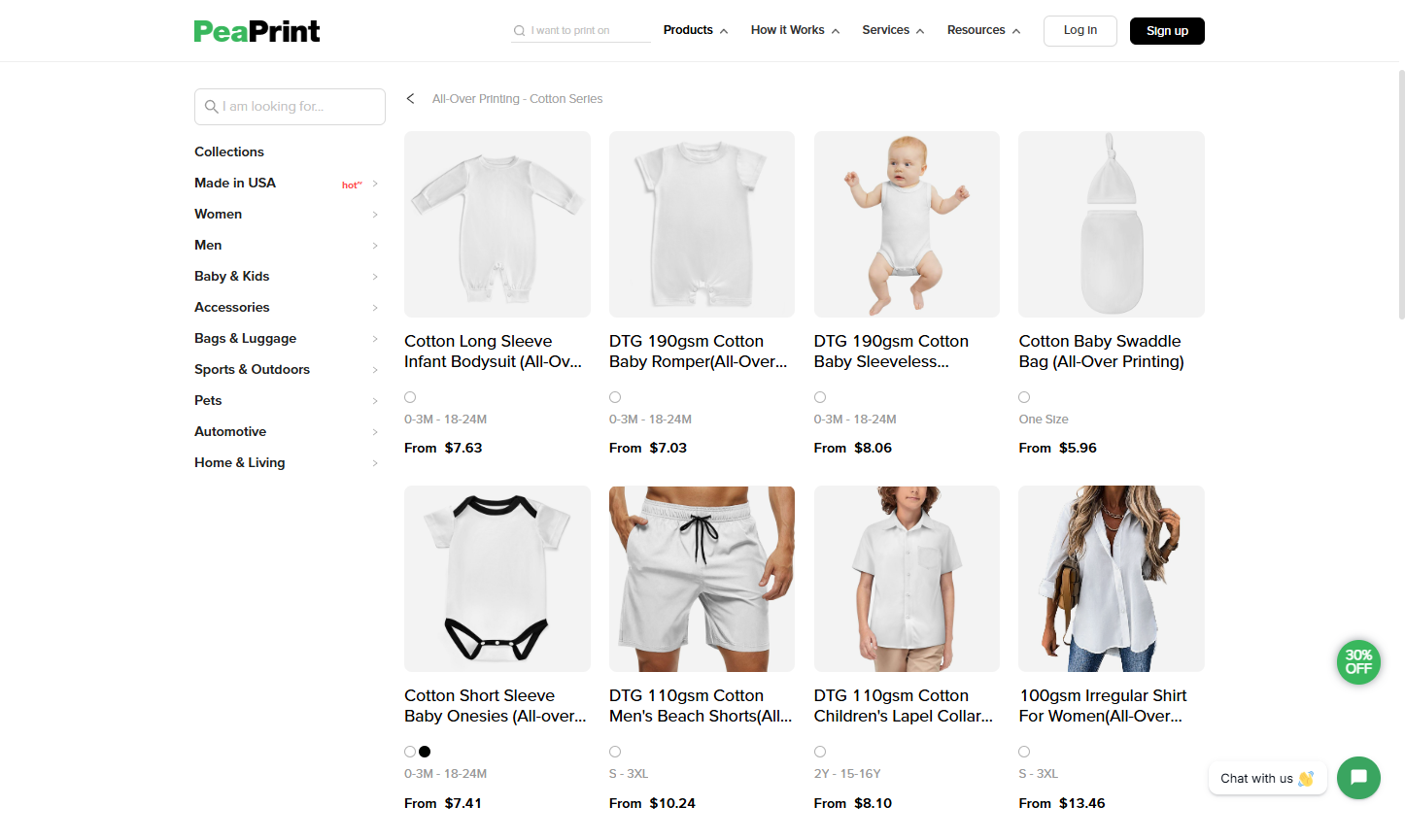
Baby and kids. This is the category where cotton changes the sale rather than improving it. A parent shopping for a newborn applies one filter before any other: what is it made of. A polyester all-over print fails that filter immediately, regardless of how good the artwork is.
Our range covers five styles in the 0–3M to 18–24M size band:
| Product | Weight | Base cost |
| Short-sleeve onesie | 83g | $7.41 |
| Sleeveless romper | 88g | $8.06 |
| Short-sleeve romper | 93g | $7.03 |
| Swaddle bag | 113g | $5.96 |
| Long-sleeve bodysuit | 125g | $7.63 |
Adult basics. Short-sleeve tees (208g, $9.99), half-sleeve tees (263g,$9.99) and zip polos (203g, $10.84). The selling point here is not softness in the abstract — it is that a cotton shirt does not cling to your back an hour into a warm day.
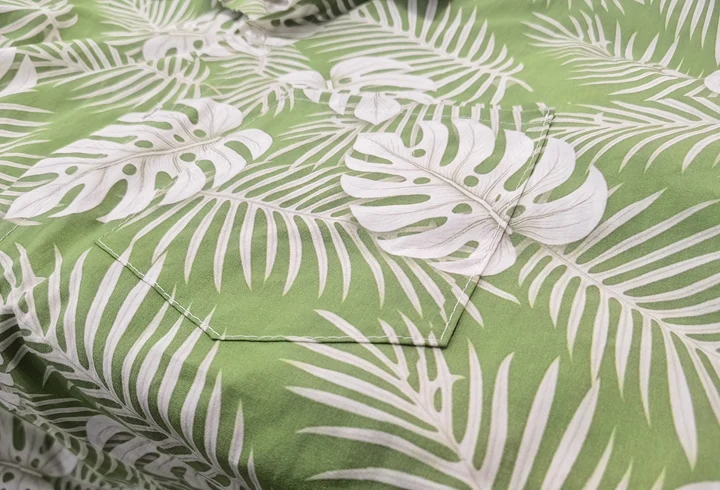
Structured garments. This is where cut-and-sew all-over print looks most different from a chest print. Button-down shirts (214g, $11.31), lapel-collar shirts (249g,$14.53) and beach shorts (183g, $10.24) are assembled from printed panels, so the placket, collar and pocket all carry the pattern. On a cheaper product, those parts are cut from plain fabric in a matching colour, and the difference is obvious the moment someone looks closely.
What it is not for. Activewear, swim and outerwear. Polyester is lighter, dries faster, holds stretch better and costs less. A cotton swimsuit is a worse product, not a premium one. We would rather say that plainly than take the order.
Three-minute verification
If you are looking at a product page and trying to work out whether "cotton all-over print" is genuine, five checks will get you most of the way there.
1. Ask for the fibre composition. In percentages. A product described as cotton-rich is usually a blend.
2. Ask which process was used. Dye sublimation bonds to synthetic fibre only. A supplier offering "sublimated 100% cotton all-over print" is describing something that cannot exist. Ask about the fibre and the process as two separate questions, then check whether both answers can be true at once.
3. Look at a side seam. On a properly made garment, the pattern continues across the join, with the seam line visible but the design uninterrupted. On a poorly made one, the pattern steps sideways at the seam. This single check tells you more about the factory than any specification sheet.
4. Look at a solid black area. Black is the hardest colour to print on cotton: too little ink and it reads grey, too much and the fabric goes stiff. If a supplier's black looks grey in daylight, the process is under control in the wrong direction.
5. Ask for a macro photograph. Not a mockup — a photo. If the weave is visible through the colour, you are looking at pigment in the fibre. If the surface is smooth and continuous, you are probably looking at polyester.
None of these require a laboratory. All of them can be done from a sample and a phone camera, and any supplier confident in their process will send you both.
FAQ
Can you really print all-over on 100% cotton?
Yes — with prepared cotton, DTG printing onto flat panels, and cut and sew. Not with dye sublimation, which is why the answer used to be no. The technique has existed for years; what has changed is that it is now available at print-on-demand volumes rather than only in bulk manufacturing.
Is cotton all-over print more expensive than polyester AOP?
To produce, yes. Cotton costs more per metre, there are more production stages, and panel printing has lower throughput than roll-to-roll. Whether it costs you more depends on the supplier and the production location, which is a separate question from the one about materials.
Will the print fade?
Pigment on cotton behaves differently from sublimation dye, but differently is not the same as badly. A small amount of colour release during the first wash is normal for pigment printing and is not a defect. After that, how a print ages depends mostly on how it is washed: cold water, inside out, hang dry. Heat — hot water and tumble drying — is what shortens a print's life.
What is the minimum order?
One piece. A single unit costs the same as any order under fifty — there is no small-batch penalty. From fifty pieces up, pricing gets better still.
How long does it take?
Production takes 2–4 days. Transit runs 10–15 days from our China facility. Shipping is paid by the buyer at checkout, and it varies with weight — roughly $8–14 for a single garment on the standard line.
Is it machine washable?
Yes. Cold water, inside out, mild detergent, hang dry. Avoid chlorine bleach and high-heat drying. Detailed care guidance is covered in a separate article.
Print it on cotton, then decide.
Upload a design, order one piece, and check the seam and the black for yourself. One piece costs the same as forty-nine.
[Start designing on Peaprint →]