The Margin Math of Cotton All-Over Print
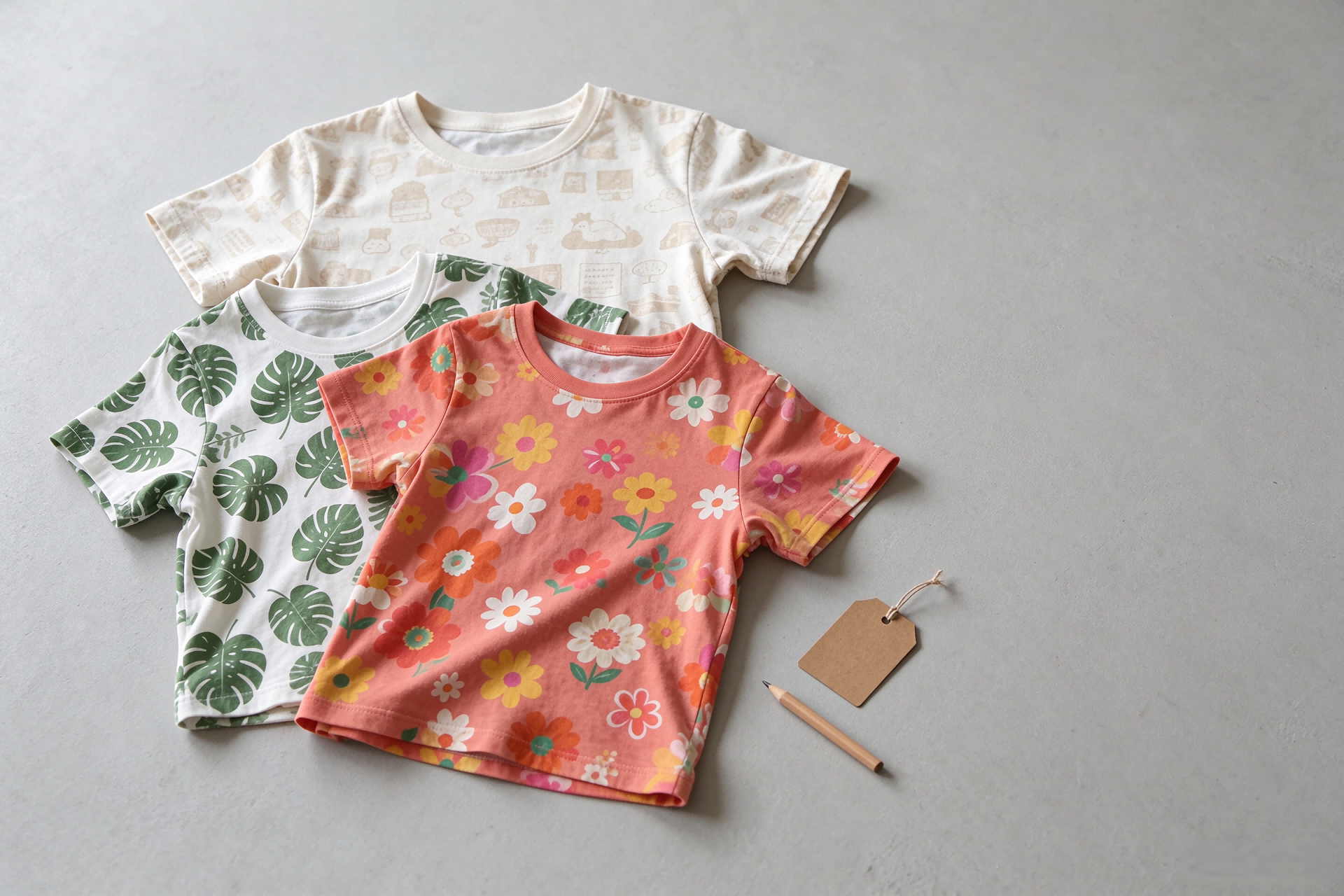
Most sellers compare suppliers by base cost. It is the number on the invoice, the one that appears in every product page and every comparison table, and it feels like the answer.
It isn't. Base cost is one line of four, and the other three — shipping, platform fees, and who absorbs returns — decide whether a product makes money. Get them wrong and a 60% cheaper supplier turns out to be a 20% cheaper supplier, or no cheaper at all.
This article runs the numbers for cotton all-over print: what the market charges, what the product costs, and what is actually left at three different retail prices.

Key takeaways
- Cotton all-over print tees retail at $31–35 from independent brands (four listings sampled, November 2026).
- Base cost in our range runs $5.49–$14.53; a 190gsm adult tee is $9.99.
- Printful's all-over cotton crew neck is $24.47–24.89** before its **$0.40 holiday surcharge.
- Etsy fees are not 6.5%. They are 6.5% plus 3% plus $0.25 plus$0.20, charged on the item and the shipping — roughly 10–11% of the order.
- At $35 retail, a platform-based seller keeps about **$5.40** per unit. At $31, about **$1.78**. At $28, they lose money.
What the market actually charges
Four cotton all-over print tops, sampled from live listings:
| Source | Product | Retail |
| allover.art | Women's oversized cotton AOP tee | $35.00 |
| allover.art | Second style, same construction | $35.00 |
| Etsy (UK) | Cotton AOP shirt | £26 ≈ $33.00 |
| CustomYourself | 100% cotton AOP longline shirt | $30.99 |
That is a narrow band — $31 to$35 — and it isn't arbitrary. The floor is set by what the product costs to make and ship from a domestic facility, plus platform fees, plus a margin the seller can live on. When the cheapest credible input is $24-plus, retail has nowhere to go but up.
This matters for anyone entering the category: you are not competing against a $15 product. You are competing against a$33 product with a $24 cost base. That is a very different game.
What the product costs
Our base costs, per unit, 1–49 pieces:
| Product | Weight | Base cost |
| Women's thong | 76g | $5.49 |
| Baby short-sleeve onesie | 83g | $7.41 |
| Baby short-sleeve romper | 93g | $7.03 |
| Adult short-sleeve tee | 208g | $9.99 |
| Men's long-sleeve tee | 253g | $11.27 |
| Men's button-down shirt | 214g | $11.31 |
| Men's lapel-collar shirt | 249g | $14.53 |
Two things to note before the comparison.
Print is included. These are not blank prices with decoration added later. A full-coverage print on a cut-and-sew garment is the product.
The range is wide because the garments are different. A thong and a lapel-collar shirt are not the same product at different prices; they are different products. Comparing a $5.49 thong to a$24 tee and calling it "4× cheaper" is arithmetic, not analysis.
For the rest of this article we will use the adult tee at $9.99, because it is the closest direct comparison to a standard all-over print tee.
The competitor cost, checked
Printful is the largest platform in this category, so it is the honest benchmark.
| Item | Price (Nov 2026) |
| All-over print cotton crew neck | $24.47 |
| All-over print oversized cotton tee | $24.89 |
| All-over print tee, polyester (sublimation) | from ~$22.50 |
| Holiday surcharge, US orders, 15 Oct 2026 – 17 Jan 2027 | +$0.40 per order |
Use **$24.87** as the working cost for the comparison below:$24.47 base plus the seasonal surcharge that is currently in force.
Even ignoring the surcharge, the gap is not small. A cotton tee at $24.47 against$9.99 is $14.48 per unit — money that either goes into the customer's price, into the seller's margin, or disappears into the gap between them.
The fee line nobody models correctly
This is where most margin calculations go wrong, including most of the ones published by platforms.
Etsy's fee stack in 2026:
| Fee | Amount | Charged on |
| Listing | $0.20 | per listing, per four months |
| Transaction | 6.5% | item price plus shipping |
| Payment processing (US) | 3% + $0.25 | item price plus shipping |
The common shorthand is "about 9.5%". That is wrong in two ways.
First, the percentages stack. 6.5% plus 3% is 9.5%, and then the fixed charges sit on top.
Second — and this is the expensive one — fees apply to shipping. If the buyer pays $10 shipping, Etsy takes its cut of that$10 as well. Since shipping on a China-produced garment runs $8–14, this adds roughly$0.80–$1.30 per order that most sellers never account for.
Worked example, $35 item plus$10 shipping:
- Order total: $45.00
- Transaction 6.5%: $2.93
- Processing 3% + $0.25:$1.60
- Listing: $0.20
- Total fees: $4.73 — 10.5% of the order
At $31 plus$10 shipping the fee is $4.35. At$28 plus $10,$4.06.
The comparison, at three prices
Same product, same retail price, same fee structure. Only the base cost differs.
| Retail | Order total | Fees | Printful-based seller | PeaPrint seller |
| $35 | $45 | $4.73 | $5.40 | $20.28 |
| $31 | $41 | $4.35 | $1.78 | $16.66 |
| $28 | $38 | $4.06 | −$0.93 | $13.95 |
Read the third row twice.
At $28 — a 20% discount off the market's top price — a seller building on a$24.87 base cost loses $0.93 on every order. Not "makes less". Loses money. The discount that looks like a competitive move is actually a subsidy the seller pays out of their own pocket.
The same discount costs our seller $6.33 of margin, and leaves$13.95.
This is the whole argument in one table. It is not that our product is better in the abstract, or that cheaper is inherently better. It is that the same product at the same price leaves a different amount of money on the table, and that difference is large enough to change which pricing strategies are available to you.
Price war? Only one side can afford it.
What else eats the margin
The fee stack is not the only cost. Four more things come out of the seller's pocket, and ignoring them is how a healthy-looking 60% margin becomes a 30% one.
Returns and reprints. A print defect is not just the refund — it is the refund plus the original production cost plus the return shipping, and possibly a negative review. Budget 3–5% of revenue for apparel, more in the first months while you are learning the product.
Advertising. Etsy Ads or offsite ads can take 10–15% of revenue for a new shop. This is the single largest variable and the one most often left out of margin tables.
Discount codes and sales events. Etsy pushes sellers into frequent promotions. Every 10% discount comes straight off margin, as the table above shows.
Fixed costs. Shop subscriptions, design tools, mockup software, sample orders. These do not scale with revenue, which means they hurt most in the first year.
The same math on a baby product
The tee is the cleanest comparison, but the baby range is where the arithmetic gets more interesting — and more dangerous.
Baby romper, 93g, $7.03 base cost. Retail$28, shipping $8 (lighter parcel).
- Order total: $36.00
- Etsy fees: $3.87 (6.5% + 3% +$0.25 + $0.20)
- Gross margin: $17.10
That is 61% of the retail price, which looks excellent until you look at what the customer paid: **$36 for a baby romper**. At that price you are competing with boutique brands selling organic cotton at$32–38, and with mass-market brands at $12–18. You are not the cheap option and you are not the premium option — you are in the middle, which is the hardest place to be.
Three things follow from that.
The fibre has to be the reason someone pays. A parent buying a $36 romper is not buying the cheapest option; they are buying 100% cotton with a print their child will wear. If the listing does not say "100% cotton" in the first line, the price makes no sense to a shopper.
Returns matter more on cheap items. A $7.03 product returned costs you the product, the outbound shipping you already paid, the refund, and the platform fee you do not get back. On a$28 sale that is survivable; on a $5.49 thong it can wipe out three other orders.
Bundles outperform single units. Shipping is roughly fixed per order at these weights, so a two-piece set spreads it across more revenue. A three-piece baby set at $68 carries almost the same shipping as a single romper at$28.
That last point is not a marketing trick — it is the direct consequence of a fixed cost sitting next to a variable one.
Net, not gross
Everything above is gross margin. Here is what happens when the other costs arrive.
Take the $35 tee, gross margin$20.28. Now apply realistic operating costs for a shop in its first year:
| Cost | Assumption | Amount |
| Gross margin | — | $20.28 |
| Returns and reprints | 4% of revenue | −$1.40 |
| Advertising | 10% of revenue | −$3.50 |
| Discounts (average) | 5% off list | −$1.75 |
| Net margin | $13.63 |

39% net. Still a good apparel business. But it is not the 62% that the gross table implies, and the gap is not a rounding error — it is a third of the profit.
Run the same deductions on a platform-based seller's $5.40:
| Cost | Amount |
| Gross margin | $5.40 |
| Returns and reprints | −$1.40 |
| Advertising | −$3.50 |
| Net margin | $0.50 |
Fifty cents a unit. That is the number that decides whether someone can afford to run ads at all. A seller at $0.50 net cannot outbid a seller at$13.63 for the same click, which compounds: less traffic, fewer sales, higher ad spend per sale.
This is how the gap widens over time rather than staying constant.
Percentage versus dollars
One more trap, because it is the one that makes sellers choose the wrong product.
A $9.99 base cost against a$35 retail price looks like a 71% margin before fees. A $24.87 base cost against the same$35 looks like 29%. On a dashboard sorted by margin percentage, the second product looks like a weaker business.
But margin percentage is a ratio, and ratios cannot pay for ads, samples, or your time. Dollars can.
Compare two products in the same shop:
| Cotton tee | Cotton romper | |
| Retail | $35 | $28 |
| Gross margin | $20.28 | $17.10 |
| Gross margin % | 58% | 61% |
The romper has the better percentage and the worse dollar figure. If you sort by percentage, you build a catalogue of cheap items with thin absolute returns — and then discover that customer acquisition costs the same regardless of what you sell.
Sort by gross profit per order, not by percentage. It is the number that survives contact with ad spend.
What this article does not include
Three omissions, stated plainly, because a margin table that hides its assumptions is worse than no table.
The cost of time. Two to four weeks in transit means your cash is tied up longer than a domestic supplier's. For a seller turning inventory quickly, that has a real cost that does not appear in any of the numbers above.
Sampling costs. Budget for at least three samples before you commit to a design: one to check the print, one to check the fit, one to wash. That is $30–50 before your first sale.
Your own time. Not a cash cost, but it is the reason most one-person shops fail to scale past a few hundred orders a month.
FAQ
Why is the base cost so much lower than the platforms?
Because the price reflects where the garment is made and how many hands it passes through, not a lower fibre specification. The cotton is 100% cotton at 190gsm, the same weight class as the comparison product. What is absent is the domestic facility, the multi-layer supply chain, and the platform margin.
Does a low price mean low quality?
It can. The way to check is a sample: look at the side seam, a solid black area, and the hand feel across a large printed area. Those three checks find most problems before you list the product.
Can I make more by pricing higher?
Yes, to a point. At $39 instead of$35, a platform-based seller makes $9.03 and our seller makes$23.91 — but conversion falls as you move above the market band. The band exists because buyers comparison-shop.
Who pays shipping?
The buyer, at checkout. It does not come out of your margin, but it does affect conversion and it does increase the platform fee, as shown above.
Is there volume pricing?
Yes. One to forty-nine pieces cost the same per unit; from fifty pieces the price drops. That is useful for testing (one piece, no penalty) and for scaling (a real volume price).
Does this math hold outside Etsy?
The structure holds; the fee line is what changes. Same $35 item, same$9.99 cost, different channel:
| Channel | Fee on a $35 order | Notes |
| Shopify (Basic, Shopify Payments) | 2.9% + $0.30 ≈$1.32 | plus $29–39/month subscription |
| Etsy | ≈ $4.73 incl. shipping | no subscription |
| eBay | 13.6–15% ≈ $4.76–5.25 | varies by category and store tier |
| Amazon (Clothing) | 17% over $20 ≈$5.95 | plus fulfilment if FBA |
Two things follow. Per-sale, Shopify is by far the cheapest — which is why sellers with volume move there once the subscription stops being the dominant cost. And the higher the fee, the more it punishes cheap items: at 17% on Amazon, a $5.49 thong has almost no margin left before you have paid for anything else.
The gap between a $9.99 cost and a$24.87 cost survives on every one of these channels. What changes is whether the product is worth listing at all.
What margin should I target?
There is no universal number, but there is a floor worth respecting.
A common starting rule is retail at roughly 3× landed cost — enough to cover fees, ads and returns and still leave something. For apparel sold with paid traffic, most shops need 55–65% gross margin to fund acquisition and stay profitable after returns.
Below 40% gross, advertising stops being optional and starts being impossible: at a $10 gross margin you cannot outbid anyone for a click and still make money on the sale.
At $35 with a$9.99 cost, the gross margin is 58% before the costs in the net table — inside the healthy band, with room to discount. That headroom is the practical difference between a product you can promote and one you can only list.
Do these numbers hold in 2027?
Not necessarily. Platform prices and fees change several times a year, and Printful's surcharge alone shifts the comparison by $0.40. Re-run the arithmetic with current numbers before making a sourcing decision.
Run your own numbers.
Take your retail price, subtract the base cost, subtract the real fee (including shipping), and see what is left. That number — not the base cost — is what decides whether a product is worth selling.