How to Start a Print on Demand T-Shirt Buiness

The market for Print-on-Demand T-shirts is becoming increasingly competitive, and many beginners may find it difficult to make money selling custom tees. In light of this, this guide breaks down the entire business process into 6 clear, actionable steps to help novices avoid common mistakes in the early stages. If you want your POD T-shirt business to succeed, this article is well worth an in-depth look!
Why Sell Print-on-Demand T-Shirts?
As the demand for personalized clothing expands, the market for custom T-shirts is growing year by year. The global custom printed T-shirt market is expected to reach approximately $9.82 billion by 2030, with an average annual growth rate exceeding 11%. A growing market means profitability; any individual entrepreneur can build their own niche T-shirt brand through POD.
Whether you are looking for a flexible side hustle or are determined to develop a long-term career in POD apparel, the T-shirt business is an excellent choice.
Another reason people are diving into the POD clothing industry is that you don't have to take on much risk or upfront investment. You don't need to purchase expensive equipment or hold inventory, nor do you need to worry about packaging and shipping. You only need to focus on creating designs that customers love, and leave the rest to your print on demand supplier.
Custom T-shirts are also increasingly being used by businesses as a modern branding strategy to promote their companies, products, or services. This means your customers are not just individual consumers, but can also be small businesses looking to create unique designs for their teams or clients.
Simply put, the POD model allows you to start small, grow according to your plan, and enter a booming market without investing too much.
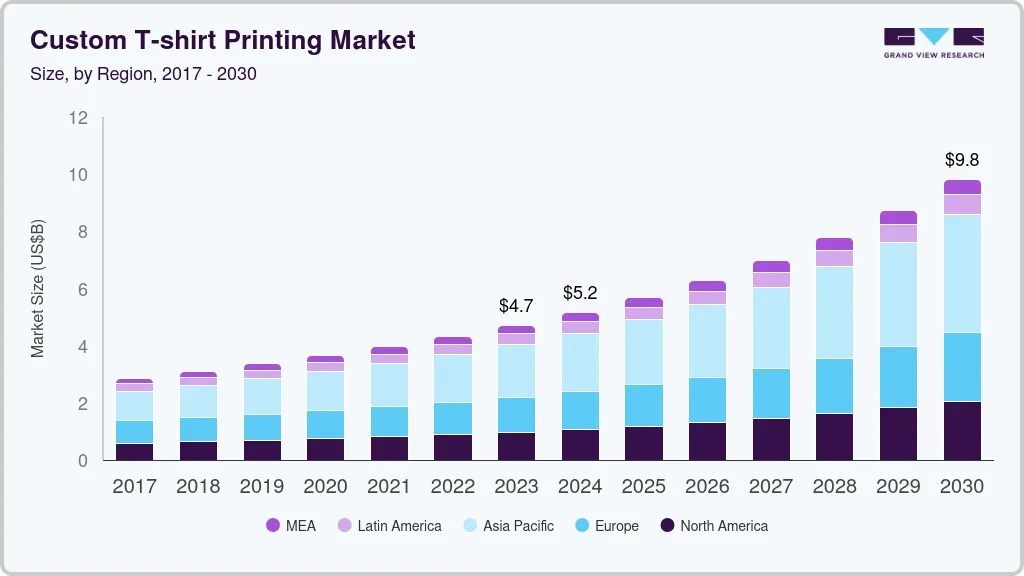 (Image Source: Grand View Research )
How to Sell Print-on-Demand T-Shirts in 6 Steps?
By following these 6 steps, you will find that starting a print on demand t-shirt business is not as difficult as you might imagine.
1. Pick a T-Shirt Niche
The best way to make your T-shirts stand out is to choose a niche. Topics like pets, music, plants and gardening, memes, and internet culture all have fixed audiences. Focusing precisely on a specific target audience is easier than trying to find customers in a vast crowd. Furthermore, if your designs are targeted, your store will appear more trustworthy to consumers.
When choosing a niche, I recommend considering where your passion lies. Write down five things you are most passionate about, and you will have five niche ideas. You can also try combining them to find your unique market.
You can also look for inspiration in your own wardrobe or those of your family and friends. Don't be afraid to try micro-niches; although the audience may not be large, you'll find it easier to differentiate yourself from competitors.
2. Create Designs People Love
This sounds difficult, but you will find it much easier once you understand one principle: "A good design doesn't have to be fancy; it just needs to be meaningful to your audience". You can browse best-seller lists to see what designs are currently trending and think about whether you can create a design with your brand's unique flair based on these pop culture elements. You can also check social media groups related to your niche to see what people are discussing. Starting from your audience's interests, check what styles they are saving on Pinterest or Instagram.
You can first use Placeit or the built-in mockup generators on POD platforms to see how your design looks on a blank T-shirt before going live to see market feedback. Remember: Great design is the heart of every POD T-shirt.
3. Choose a Reliable Print-on-Demand Platform
A reliable print on demand platform can save you time and effort while improving your profit margins. When choosing a good POD partner, you should compare these key points:
- Printing quality
- Printing costs
- Shipping regions
- Turnaround time
- Integration capabilities
- Customer service response time
Some platforms allow you to add your own brand labels and packaging, while others focus on increasing product profit margins. Think about what you want: quality, shipping speed, custom branding, or profit margins. Making a choice early based on your brand positioning can avoid the hassle of switching platforms later. Additionally, ensure the platform can integrate with your store to reduce manual operations in product publishing and production.

4. Build Your Online T-Shirt Store
Visually, your store should convey a sense of cleanliness, friendliness, and trustworthiness. A seminal study led by Google's research team confirmed that online stores with low visual complexity can significantly boost conversion rates.
You must use clear imagery and provide detailed product descriptions and sizing guides to instill confidence in buyers. If your brand or products possess unique attributes, such as the use of eco-friendly fabrics or limited-edition designs, highlight them using straightforward slogans. Add an FAQ section to your store to address customers' most pressing questions, such as those regarding shipping costs, turnaround times, and return policies. By cultivating the image of a professional seller, your store can effectively increase conversion rates while simultaneously minimizing product returns.
5. Promote Your Shirts Using a Combination Strategy
Now that you're ready, you need to wait for customers to find you. You need a combination of strategies to promote your custom tees. Advertising is one of the fastest and most effective ways; you can start with small-scale, low-cost ads to test your designs, then scale up once you find high-performing products.
Utilize visual social media like TikTok, Pinterest, and Instagram to attract engagement and increase brand exposure. Post interesting, shareable content such as design inspiration, behind-the-scenes footage, and customer photos.
If you have additional budget, you could also consider collaborating with micro-influencers within your specific niche. By doing so, you stand a high probability of achieving higher engagement rates at a lower cost.
6. Continuously Optimize Design and Sales Strategies
Truly successful print on demand businesses are created through continuous improvement, learning, and adjustment. Keep an eye on which designs and styles get the most clicks and sales. Find the commonalities in these designs to provide inspiration and direction for your next creation.
Read customer reviews, especially the negative ones, as they hold a wealth of insights into areas where your store and products can be improved. Do not overlook your customers' sentiments; only by catering to their needs can your T-shirt business truly flourish.
At the same time, do not forget to experiment with different pricing and promotional strategies; sometimes, a simple, casual experiment or adjustment can transform your side hustle into a consistently profitable business.
The PeaPrint Difference: Increase Profit per T-Shirt
We have no intention of hiding the truth: basic printed T-shirts can be one of the lowest-margin products in POD. Therefore, increasing the profit per shirt becomes increasingly important. PeaPrint’s difference lies in its ability to boost your custom T-shirt profit margins. If you use PeaPrint, you will find that for the same quality, PeaPrint's product costs are much lower than other suppliers, leaving plenty of room for your pricing.
Headquartered in China, PeaPrint has unparalleled advantages in custom clothing, with a wide variety of styles and a cost-effective global supply chain. To increase profit, you must also consider:
- Market fees
- Shipping
- Bulk discounts
- Ad budgets
- Pricing strategies
- Brand premium
Many beginners lose money because their advertising costs exceed their revenue. When your ad strategy becomes ineffective, stop the spend. Driving sales through beautiful products and effective SEO strategies can also lower marketing costs and improve profit margins.
How to Stand Out on Different Sales Platforms?
Etsy - Provide truly visually appealing products
Etsy buyers don't want cookie-cutter designs; they seek a vibe, a personalized gift, or a piece of art that reflects their personality. Since Etsy's core philosophy is "handmade and boutique," visual presentation is crucial.
- Use high-quality lifestyle photos as covers; do not use default white-background mockups.
- Add keywords to titles, tags, and attribute fields to match search intent.
- Stick to one clear niche theme per shop to resonate with potential audiences.
- Use consistent lighting and color schemes for a unified shop style.
- Provide excellent customer service to boost shop ratings.
On Etsy, powerful visuals combined with matching search keywords are the key to making your products and designs stand out.
Shopify - Craft an Authentic Brand Experience
Selling on Shopify is like being on an island; you have no built-in audience, but you have total control. Your goal is to build a real brand and absolute trust.
- Tell a clear brand story with consistent visuals and tone.
- Prominently display return policies and customer reviews with photos.
- Add social media accounts and ensure brand consistency.
- Ensure the website loads quickly (within 3 seconds).
- Build email and SMS lists using the Shopify ecosystem.
To sell T-shirts on Shopify, you must build a trustworthy brand image.
Amazon Merch - Dominate Search Intent and Sales Velocity
Amazon is not a social platform, but rather a massive and highly competitive search engine. Users searching on the site typically arrive with strong purchasing intent. Therefore, you must ensure that your products are easy to find and rank highly in search results.
- Strategically incorporate long-tail keywords into your product titles and listings, while avoiding language that sounds robotic.
- During the launch phase, consider setting a competitive price point to secure those crucial initial orders.
- Utilize high-quality lifestyle images to attract clicks.
- Leverage A+ Content to boost conversion rates through contextualized, lifestyle-oriented visuals and copy.
- Run advertising campaigns to gain additional exposure and test the viability of new products.
When selling on Amazon, visibility and conversion rates are the keys to success.
POD Marketplaces - Maximize Output and Capture Hyper-Specific Audiences
Platforms like Redbubble and Teepublic are intensely competitive because the barrier to entry is virtually zero. To stand out in this environment, you need to cast a wide net while simultaneously targeting highly passionate niche communities with precision.
- Algorithms favor active accounts; therefore, you must continuously upload a high volume of designs to boost your search rankings.
- Focus on a strong niche market to build sustained visibility.
- Utilize every available tag slot, but ensure that your tags are highly relevant to your specific niche.
- Apply successful page design layouts across dozens of different sub-niches to maximize your reach.
- Keep a close watch on trends related to seasons, events, and pop culture.
In POD marketplaces, your focus should be on relevance and impact.
Social Commerce - Turn Engaging Videos into Instant Sales
We are firmly in the era of video-first shopping. On social media platforms, people typically aren't actively searching for T-shirts; they might stumble upon your video by chance, instantly resonate with its content, whether emotionally or through humor, and then make an impulse purchase. Therefore, your content must be eye-catching.
- Utilize short-form videos that evoke emotion.
- Connect your designs to current events, trending audio clips, or upcoming major cultural and sporting events.
- Film "try-on" videos to help people visualize how they would look wearing your T-shirts.
- Share styling inspiration for your various designs.
- Incorporate community hashtags and participate in trending challenges to boost your visibility.
- Leverage native shopping integrations to allow users to make purchases without ever leaving the app.
On social media platforms, you need to let your content serve as the salesperson.
Sell Custom T-Shirts Online With PeaPrint
Selling custom T-shirts with PeaPrint is incredibly simple. We offer a selection of hundreds of men's and women's shirts, whether your brand focuses on heavyweight cotton tees, polo shirts, or vintage and trendy styles, PeaPrint has the products to meet your needs. All our T-shirts are affordably priced and of excellent quality, making them perfect for personal use, gifting, or online retail.
Beyond product costs, another major advantage of PeaPrint is our built-in design tool; you can either directly upload your own artwork or edit your designs online. Once your design is complete, simply place an order or connect your online store to start selling immediately.
Speaking of store integration, PeaPrint connects seamlessly with Etsy, Shopify, WooCommerce, and Amazon, allowing you to effortlessly manage orders, production, and shipping—thereby significantly boosting your operational efficiency.
As for shipping, PeaPrint's network of partners and logistics centers spans the globe, enabling us to provide fast, worldwide delivery.

Expert Tips on Selling Print-on-demand T-shirts
We have witnessed many entrepreneurs build their ventures from scratch, growing them from humble beginnings into thriving enterprises. The following advice comes from Derom, a print-on-demand expert at PeaPrint, specifically for beginners venturing into the world of print-on-demand T-shirts:
- Develop a clear learning plan, and make a habit of continuously studying the latest marketing strategies and updating your design concepts.
- Never stop releasing new designs; constantly test your creations and actively gather customer feedback.
- Avoid overinvesting when you are just starting out; for the most part, free tools are more than sufficient to meet your operational needs.
- Start small, and work continuously to refine your store and optimize your sales processes.
- Be patient with yourself and your store; with a clear market positioning—combined with persistent effort—success is inevitable.
FAQs
Is selling print-on-demand T-shirts still profitable in 2026?
Yes, the market continues to offer significant opportunities for profit. The global custom T-shirt printing market is projected to reach approximately $9.82 billion by 2030, maintaining an annual growth rate of over 11%. While competition is increasing, individual entrepreneurs can succeed by building niche brands and focusing on specific target audiences like pets, music, or internet culture.
How much does it cost to start a print-on-demand business?
One of the primary advantages of this model is the minimal financial risk and upfront investment. You do not need to purchase expensive printing equipment or hold physical inventory. In the beginning, most free tools are sufficient to meet your operational needs. Your main costs will typically involve small-scale advertising to test your designs and any specialized design software you choose to use. Read our content to learn more about print-on-demand costs.
Do I need a business license to sell print-on-demand products?
Although this guide focuses on operational-level settings, it emphasizes the importance of starting small and scaling up gradually in accordance with your own strategic plan. While it may be possible to launch a POD business in some regions without a business license, to cultivate a professional and trustworthy seller image—and as your "side hustle" gradually evolves into a stable and profitable enterprise—you should consult relevant local regulations to ensure that your brand remains fully compliant with legal standards as it expands.