How to Launch Your Etsy POD Store in 30 Days
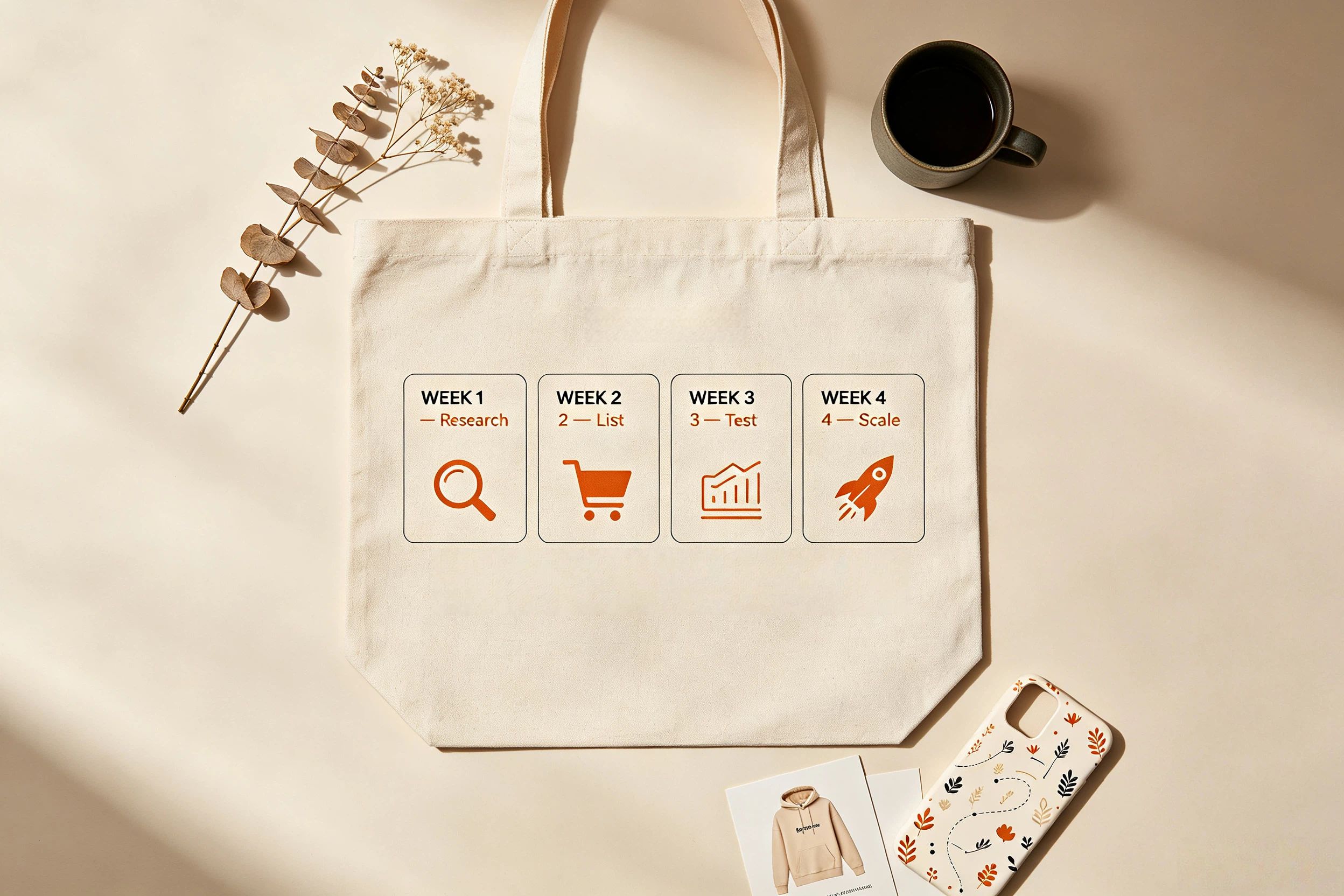
If you've been thinking about starting an Etsy print-on-demand store but feel overwhelmed by where to start, here's some good news: you can go from zero to your first sale in 30 days — if you follow a clear plan.
The bad news? Most sellers fail not because their designs are bad, but because they have no rhythm. They open a store, upload a few random products, wait a week, see zero sales, and quit.
This 30-day plan solves that. It tells you exactly what to do each week — from keyword research to your first sale — so you're never wondering "what next?"
Here's the data: you can create your first listing in a single weekend. But getting your first sale? That typically takes 3 to 8 weeks of consistent effort. The sellers who stick to a weekly rhythm are the ones who actually break through.
Let's get started.
Why You Need a 30-Day Plan
Etsy's Seasonal Windows Are Tight
Etsy trends don't last forever. The window to catch a rising trend is usually just 4 to 6 weeks. Miss the start, and you'll be competing for scraps while early sellers capture all the momentum.
A 30-day plan ensures you're not guessing. It gives you a structured rhythm — research one week, list the next, test the next, optimize the next. By the time the trend peaks, your products are already ranking.
Most Sellers Fail Because They Have No Rhythm
Here's what failure looks like: you open a store, upload five random t-shirts, wait a week, see zero sales, and assume print on demand doesn't work.
That's not a POD problem. That's a no-rhythm problem.
A 30-day plan forces you to:
- Show up consistently (even when sales are slow)
- Test systematically (so you know what works and what doesn't)
- Iterate quickly (kill what fails, double down on what works)
What This Plan Solves
| Problem | How This Plan Solves It |
| "I don't know what to sell" | Week 1: Keyword & trend research |
| "I don't know how to list properly" | Week 2: Minimum viable listings |
| "I don't know if my listings are any good" | Week 3: Content & traffic testing |
| "I don't know which products to keep" | Week 4: Data-driven淘汰 & optimization |
| "I don't know what to do next" | The plan repeats monthly |
The Data Behind the Timeline
It takes about one weekend to create your first listing. But your first sale? That's usually 3 to 8 weeks away. Why? Because Etsy's algorithm needs time to understand your products, collect data (clicks, favorites, add-to-carts), and decide where to rank you.
A 30-day plan gives the algorithm exactly what it needs — consistent signals that your store is active and your products are relevant.
The key insight: The first week isn't about sales. It's about planting flags. Week 2 is about volume. Week 3 is about proof. Week 4 is about pruning. By Day 30, you've built a system that works — not just a store that exists.
Week 1: Keyword Research and Product Selection
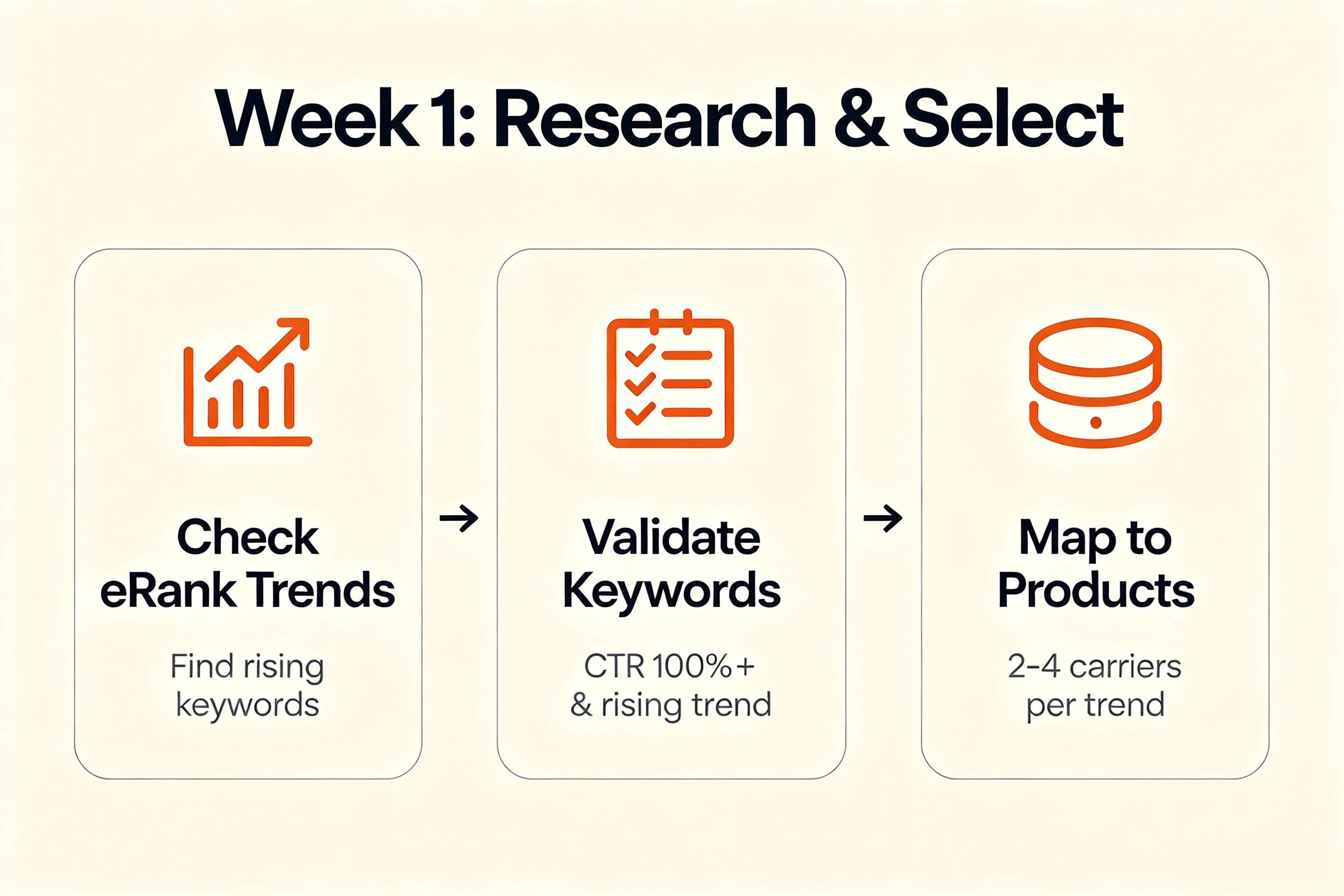
Your first week is about data, not design. Don't open Canva. Don't upload anything. Just research.
Step 1: Check eRank Monthly Trends
Start with eRank's Monthly Trends report. Look at these categories:
- POD Shirts — the baseline category
- Home Decor — blankets, pillows, wall art
- Bags — tote bags, backpacks
- Phone Cases — consistent year-round demand
For each category, note:
- Which keywords are rising (not just high-volume)
- Seasonal patterns (Halloween in July? Christmas in June?)
- CTR signals (click-through rate above 100% = strong buyer intent)
Step 2: Record Candidate Long-Tail Keywords
Create a simple spreadsheet with these columns:
| Keyword | Category | Search Volume | CTR | Competition | Trend Direction | Notes |
| gothic floral zip up hoodie | Apparel | 150 | 135% | Medium | Rising | Fall trend |
| snow leopard personalized tote | Bags | 80 | 120% | Low | Rising | Animal print |
| personalized flannel blanket | Home | 90 | 110% | Low | Rising | Cozy trend |
Do not chase keywords with:
- CTR below 100%
- Flat or declining trend
- Extreme competition (unless you have a clear differentiator)
Step 3: Match Trends to PeaPrint Products
For each trend you validate, select 2 to 4 PeaPrint carriers:
| Trend | PeaPrint Carriers |
| Gothic Florals | AOP hoodie, phone case, tote bag, poster |
| Snow Leopard | AOP sweatshirt, tote bag, phone case, slip-on shoes |
| Cozy Home | Flannel blanket, pillow cover, bed sheet set, bath towel |
| Halloween long-tail | T-shirt, sweatshirt, tote bag, pillow cover |
| Early Christmas | Sweatshirt, family pajama set, flannel blanket |
Step 4: Create Master Visual Systems
For each product line, establish a master visual system before you start designing. This means:
- Color palette — 3-5 consistent colors across the line
- Typography — one or two fonts that define the aesthetic
- Pattern/Illustration style — vector art, watercolor, vintage engraving, etc.
- Logo or signature placement — if you have a brand mark
Why this matters: A cohesive visual system makes your entire store look professional. Customers who buy one product from a line are more likely to buy another if the designs feel connected.
Week 1 Deliverable: A spreadsheet with 5-8 validated trends, each mapped to 2-4 PeaPrint products, with a visual system defined for each line.
Week 2: Minimum Viable Listings
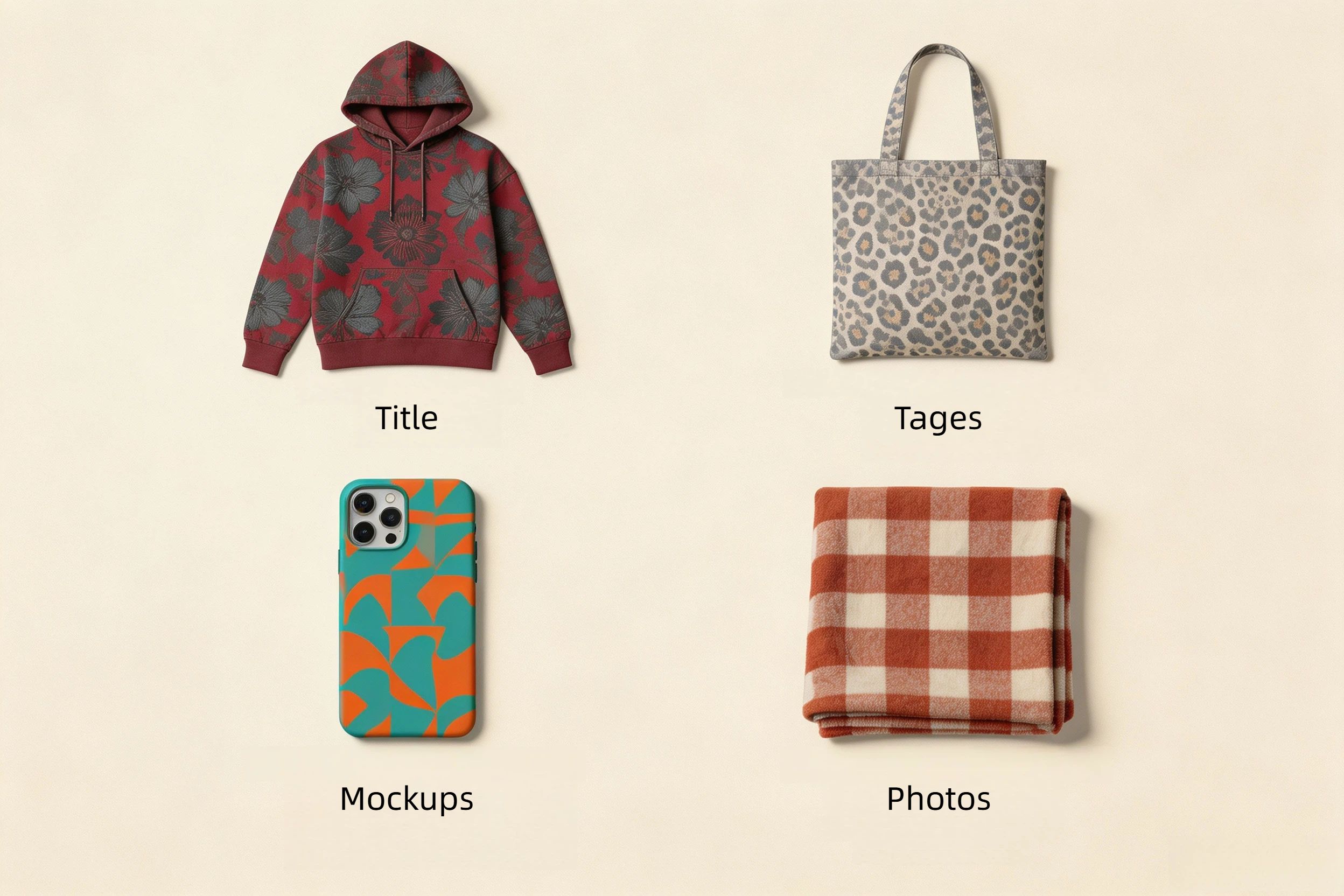
This is where you stop researching and start listing.
The Minimum Viable Listing Approach
Don't aim for perfection. Aim for good enough to test. You can always improve later — but you can't improve what you haven't launched.
For each product line, create 3 to 5 listings:
| Product Line | Example Listings |
| Gothic Bloom | (1) AOP hoodie, (2) phone case, (3) tote bag, (4) poster |
| Snow Leopard | (1) sweatshirt, (2) tote bag, (3) phone case, (4) slip-on shoes |
| Cozy Home | (1) flannel blanket, (2) pillow cover, (3) bed sheet set |
Prioritize PeaPrint's AOP Products
For Week 2, focus on PeaPrint's highest-impact carriers:
- AOP hoodie — premium price point, strong visual statement
- AOP tote bag — low competition, high visibility
- AOP phone case — everyday accessory, high repeat purchase
- Flannel blanket — home decor, high emotional appeal
Differentiate by Audience or Scenario
For each listing in the same product line, target a different audience or different scenario:
| Listing | Audience | Scenario |
| Gothic Bloom hoodie #1 | Women 18-35 | Dark academia aesthetic |
| Gothic Bloom hoodie #2 | Women 18-35 | Halloween alternative |
| Gothic Bloom hoodie #3 | Men 18-35 | Streetwear fashion |
Title Structure
Place 2 to 3 specific phrases at the start of each title:
Gothic Floral Hoodie — Dark Academia AOP Sweatshirt for Women, Vintage Moth Streetwear, Halloween Alternative
The first few words should include the product type and a primary keyword. Then add style descriptors, audience, and occasion.
Tag Strategy
Use all 13 Etsy tags with distinct long-tail combinations:
| Tag Category | Examples |
| Aesthetic | gothic floral, dark academia, cottagecore |
| Product | aop hoodie, zip hoodie, full print tee |
| Audience | gift for her, witchy aesthetic, alternative style |
| Season/Occasion | fall fashion, halloween alternative, winter aesthetic |
| Color/Style | burgundy rose, black floral, vintage engraving |
Week 2 Deliverable: 15 to 25 total listings across 5 product lines (3-5 per line).
Week 3: Content and Traffic Testing
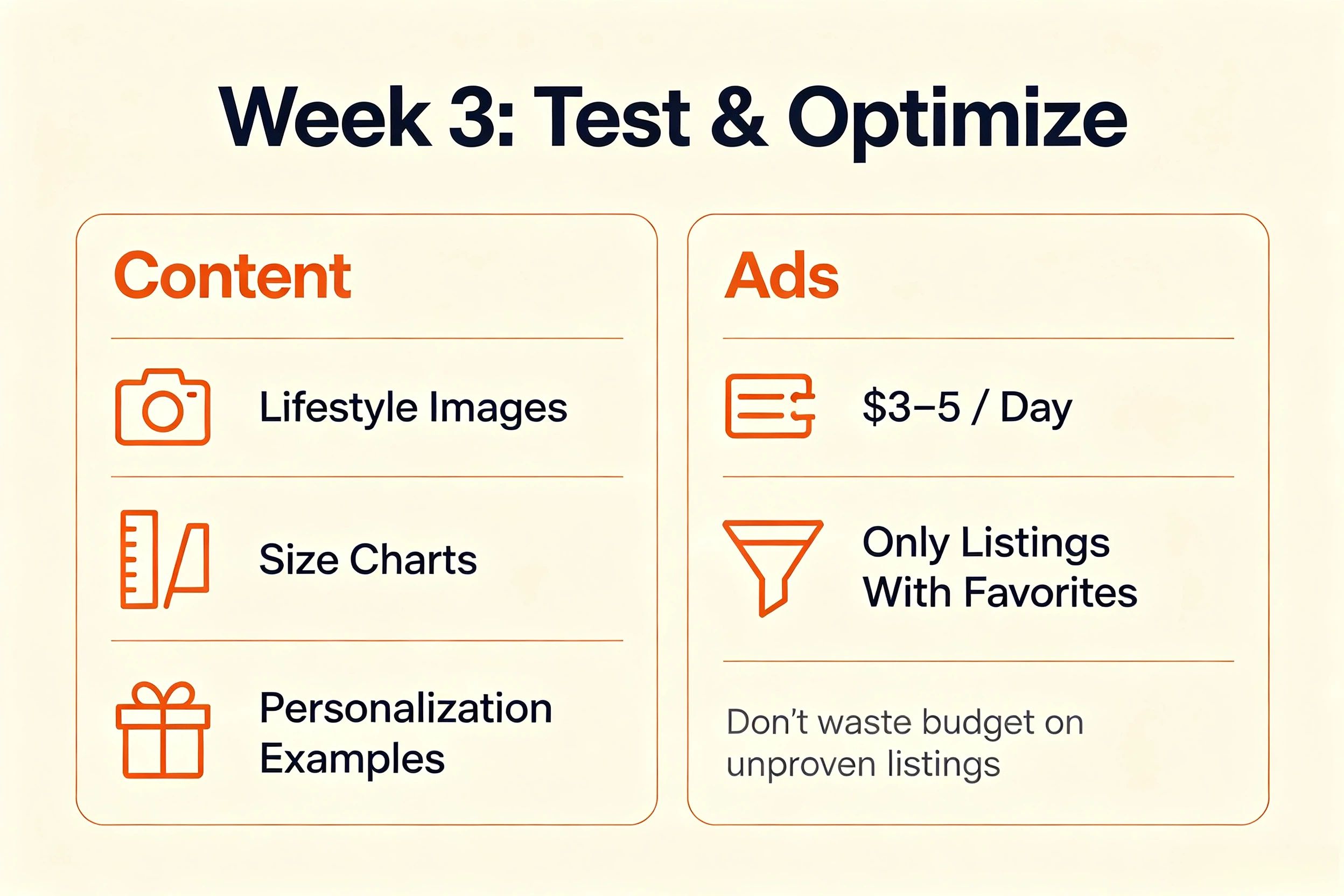
Now that your listings are live, it's time to give them visibility.
Create High-Impact Content
Your Etsy listing needs more than just product photos. Create these assets for your top listings:
| Asset | Why It Matters |
| Lifestyle scene images | Shows the product in use — customer imagines owning it |
| Detail images | Close-ups of the print, fabric texture, stitching |
| Size/reference images | Helps customers choose the right size |
| Personalization examples | Shows exactly what custom options look like |
| Scale/reference shots | Shows product size relative to everyday objects |
Content direction ideas for fall:
- Autumn aesthetic — warm lighting, cozy settings
- Reading nook scenes (for home decor and apparel)
- Gift presentation shots (for personalized items)
Test Etsy Ads (Small Budget)
Start with a tiny daily budget — $3 to $5 per day.
The rule: Only advertise listings that already have at least one of these signals:
- 1+ favorites (someone saved it)
- 1+ click (someone showed interest)
- 1+ add-to-cart (strongest signal)
Why this matters: Listings with zero engagement usually aren't ready for paid traffic. If organic visitors aren't clicking or favoriting, paid visitors won't either.
Ad targeting:
- Start with automatic targeting
- Review performance after 2-3 days
- Move to manual targeting for top performers
Week 3 Deliverable: 5-10 high-quality images per top listing, plus $3-$5/day ad budget running on your strongest 3-5 listings.
Week 4: Kill, Optimize, and Expand
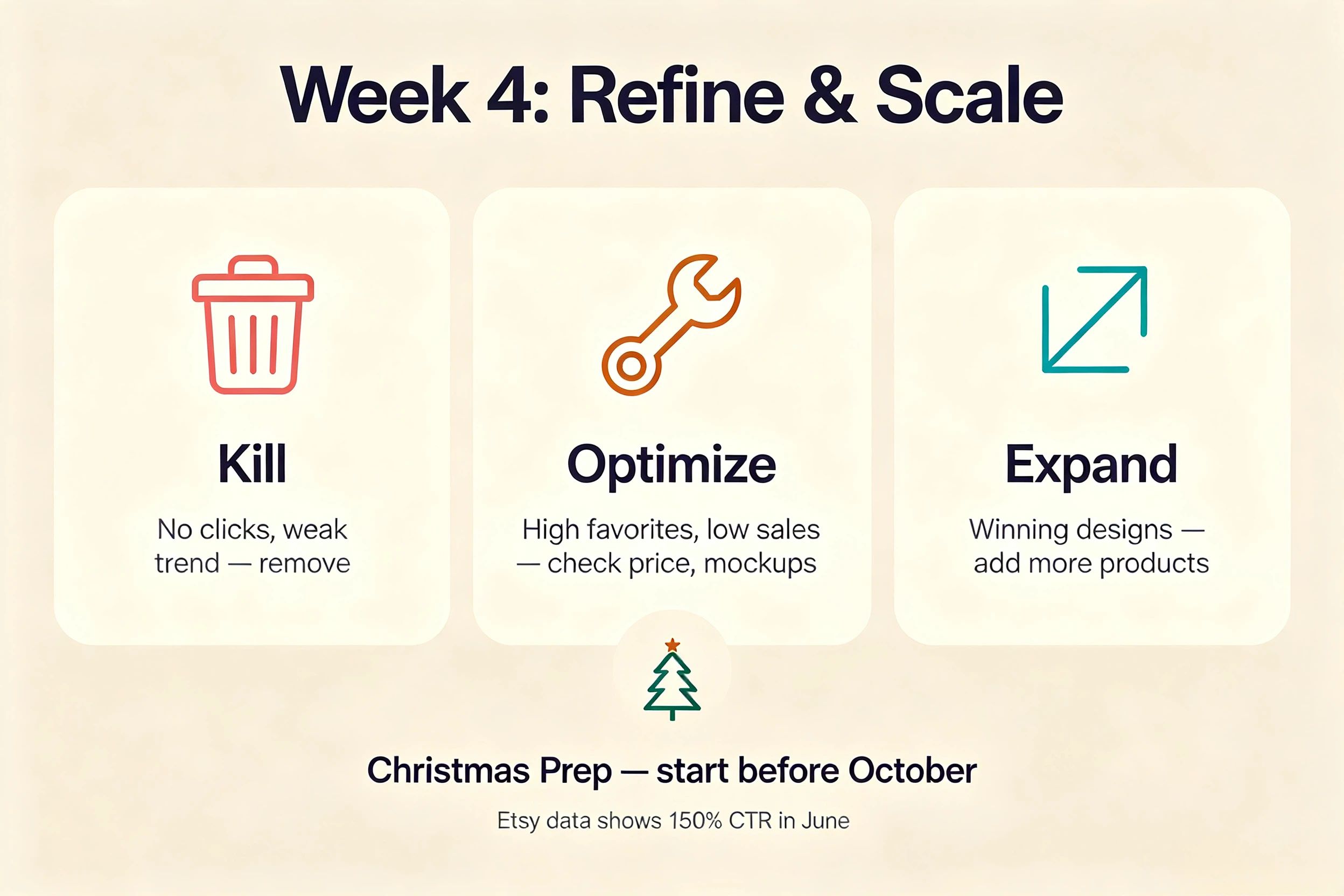
The final week is about deciding what stays and what goes.
Kill: Remove What Isn't Working
At the start of Week 4, review all 15-25 listings from Week 2:
| Signal | Action |
| No clicks, weak trend | 🗑️ Remove or replace |
| 0 favorites, 0 views | 🗑️ Remove — it's invisible |
| Low views, no clicks | ⚠️ Check title and tags |
| High views, low favorites | ⚠️ Check main photo |
Don't keep dead listings. Etsy's algorithm penalizes stores with lots of inactive products.
Optimize: Fix Low-Conversion, High-Engagement Listings
For listings with high favorites but low sales:
- Check pricing — Is it significantly higher than comparable listings?
- Check shipping times — Are you competitive?
- Check mockup quality — Does the main image look professional?
- Check customization flow — Is the personalization process clear?
Expand: Scale What's Working
For listings with sales or strong engagement, expand the product line:
- If a design sells well on hoodies, add tote bags, phone cases, and posters
- If a design sells well on one color, add other color options
Don't expand to new themes yet. Focus on depth within winning designs, not breadth across random products.
Christmas Prep (Urgent!)
If you're approaching September or October, Christmas product listings are already late.
eRank data shows Christmas keywords hit 150% CTR as early as June. Early birds are already shopping.
Your Christmas checklist:
- Personalized family Christmas shirts (2-3 design variations)
- Teacher Christmas sweatshirts
- Pet family Christmas blankets
- Family Christmas pajama sets
Goal: Get Christmas listings live before October ends. Earlier is better.
Week 4 Deliverable: Pruned listing count (10-15 strong listings), optimized top performers, and Christmas listings started.
Frequently Asked Questions
How much time do I need to invest each day?
2 to 3 hours of focused work daily. Week 1 requires more upfront research time; Week 2 is listing-heavy; Week 3 and 4 are lighter on time but require consistent checking of metrics and ad performance.
What keyword research tools should I use?
eRank Keyword Tool is the go-to for Etsy-specific data. Etsy Marketplace Insights (free in your shop dashboard) provides search data directly from Etsy. Use both for the most complete picture.
How many listings should I aim for in 30 days?
15 to 25 listings across 5 product lines. That's 3-5 per product line. Focus on variety of audience and scenario within each line, not random products.
What's the right Etsy Ads budget for testing?
$3 to $5 per day for 30 days — that's $90 to $150 total. Only spend this on listings that already have organic engagement (favorites, clicks, add-to-carts). Don't waste budget on unproven listings.
What if I don't get a sale in 30 days?
Don't panic. First sales typically take 3 to 8 weeks. Use the 30-day plan to build a system — not necessarily to make a sale. If you don't get a sale by Day 30, check:
- Keywords — are you targeting the right search terms?
- Mockup quality — do your photos look professional?
- Pricing — are you competitive?
The real win: You've built a process you can repeat every month. That's what leads to consistent sales.
Ready to Start Your 30-Day Etsy POD Journey?
The plan is clear. The steps are simple. The only missing piece is action.
But a 30-day plan is just a skeleton without the meat. To really make it work, you need two things:
- Real trend data to validate your product choices
- A complete execution toolkit with tracking templates and checklists
That's exactly why we created the full version.
Get the complete Etsy POD Launch Kit — includes the full 30-day execution spreadsheet, trend data from eRank, product recommendations for fall 2026, and a step-by-step tracking system.