How to Find Low Competition Etsy POD Keywords with Data

If you sell print on demand on Etsy, you've probably heard the same advice a hundred times: find a niche, use long-tail keywords, optimize your tags. But nobody tells you how to actually decide whether a keyword is worth pursuing. That's the gap this guide fills.
Etsy keyword research in 2026 isn't about guessing. It's about reading data and making a call. The sellers who win aren't the ones with the best designs. They're the ones who understand which keywords have real buying intent behind them.
This guide walks you through the exact framework. You'll learn which eRank metrics matter, how to filter out keywords that will never convert, and how to validate a keyword before you invest time in designing a product for it.
Etsy Search Is an Intent-Driven Shopping Engine
Etsy is not Google. That sounds obvious, but most sellers treat them the same way. They shouldn't.
Google is an information engine. People search for answers, definitions, and research. Etsy is a shopping engine. People search for products they're ready to buy. That difference changes everything about how you approach keywords.
When someone types "gothic hoodie" into Etsy, they're not looking for an article about gothic fashion history. They're looking for a hoodie they can add to their cart. When someone types the same phrase into Google, they might be researching a style, looking for inspiration, or trying to understand a trend.
Why Search Terms Matter More Than Design
Most new POD sellers spend 90% of their time on designs and 10% on keywords. That's backwards.
A beautiful design with the wrong keywords will sit invisible in Etsy search results. A mediocre design with the right keywords can generate consistent sales. The keyword is what connects your product to the buyer who's already searching for it.
This doesn't mean design doesn't matter. It means keywords get you in the door. Design is what convinces the buyer to click and purchase once they see your listing.
What Changed in Etsy SEO for 2026
Etsy's algorithm has shifted. It used to reward listings that matched exact search terms. Now it prioritizes relevance and conversion rate. That means:
- Keyword stuffing no longer works. A title packed with 20 tags that reads like spam will hurt you, not help you.
- Natural language matters. Etsy wants titles that real buyers would read and understand.
- CTR is a ranking signal. If buyers see your listing and don't click, Etsy stops showing it. If they click and buy, Etsy shows it more.
So the question isn't just "does this keyword have search volume?" It's "does this keyword attract buyers who will actually click and purchase?"
Understanding the eRank Metrics That Actually Matter
eRank is the most widely used keyword research tool for Etsy sellers. It gives you four core metrics. Here's what each one means and how to use it.
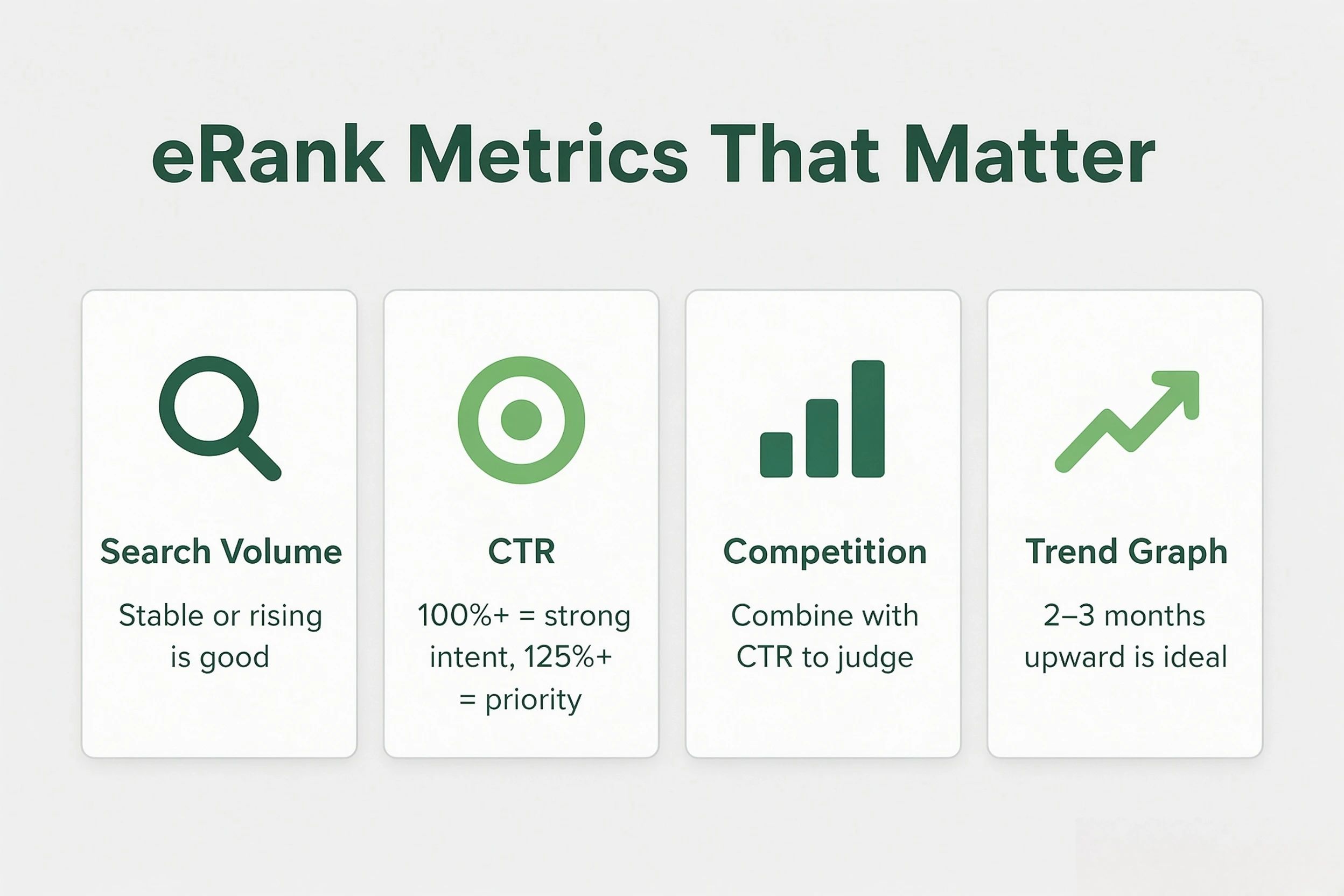
| Metric | What It Means | How to Judge It |
| Search Volume | How many times the keyword is searched per month | Stable or rising is good. Falling is a warning sign. |
| CTR | Click-through rate. How often buyers click listings for this keyword. | 100%+ means strong buying intent. 125%+ is a priority candidate. |
| Competition | How many listings are competing for this keyword. | Combine with CTR. High competition + low CTR = skip. |
| Trend Graph | Search behavior over the last 2–3 months. | A steady upward line is ideal. Flat is acceptable. Spiky is risky. |
How to Read CTR Like a Pro
CTR is the most misunderstood metric in Etsy keyword research. Here's the simplest way to think about it.
If a keyword has a CTR of 100%, it means buyers are clicking on listings at an average rate. There's decent interest.
If a keyword has a CTR of 125% or higher, it means buyers are clicking at an above-average rate. They're actively looking for this product. They're ready to buy.
If a keyword has a CTR below 80%, it usually means buyers are browsing without intent. They're window shopping. Even if search volume is high, conversions will be low.
Your priority list should start with keywords that have a CTR of 100% or higher, stable or rising search volume, and manageable competition.
When to Ignore High Search Volume
A keyword with 10,000 monthly searches sounds amazing. But if the CTR is 40% and the competition is dominated by established sellers with thousands of reviews, it's not a real opportunity.
High search volume with low CTR is a trap. It means people are searching, but they're not finding what they want. Either the market is confused, or the top listings are so dominant that no one else gets clicks.
Look for moderate search volume with strong CTR. That's where the real opportunities are.
Keyword Filtering Rules That Save You Time
Not every keyword deserves your attention. Use these rules to filter your list fast.
Rule 1: Never Judge Search Volume Alone
A keyword with 50 searches per month and a 150% CTR is worth more than a keyword with 5,000 searches and a 50% CTR. The first one converts. The second one just gets traffic.
Always look at search volume and CTR together. CTR tells you whether the traffic is valuable.
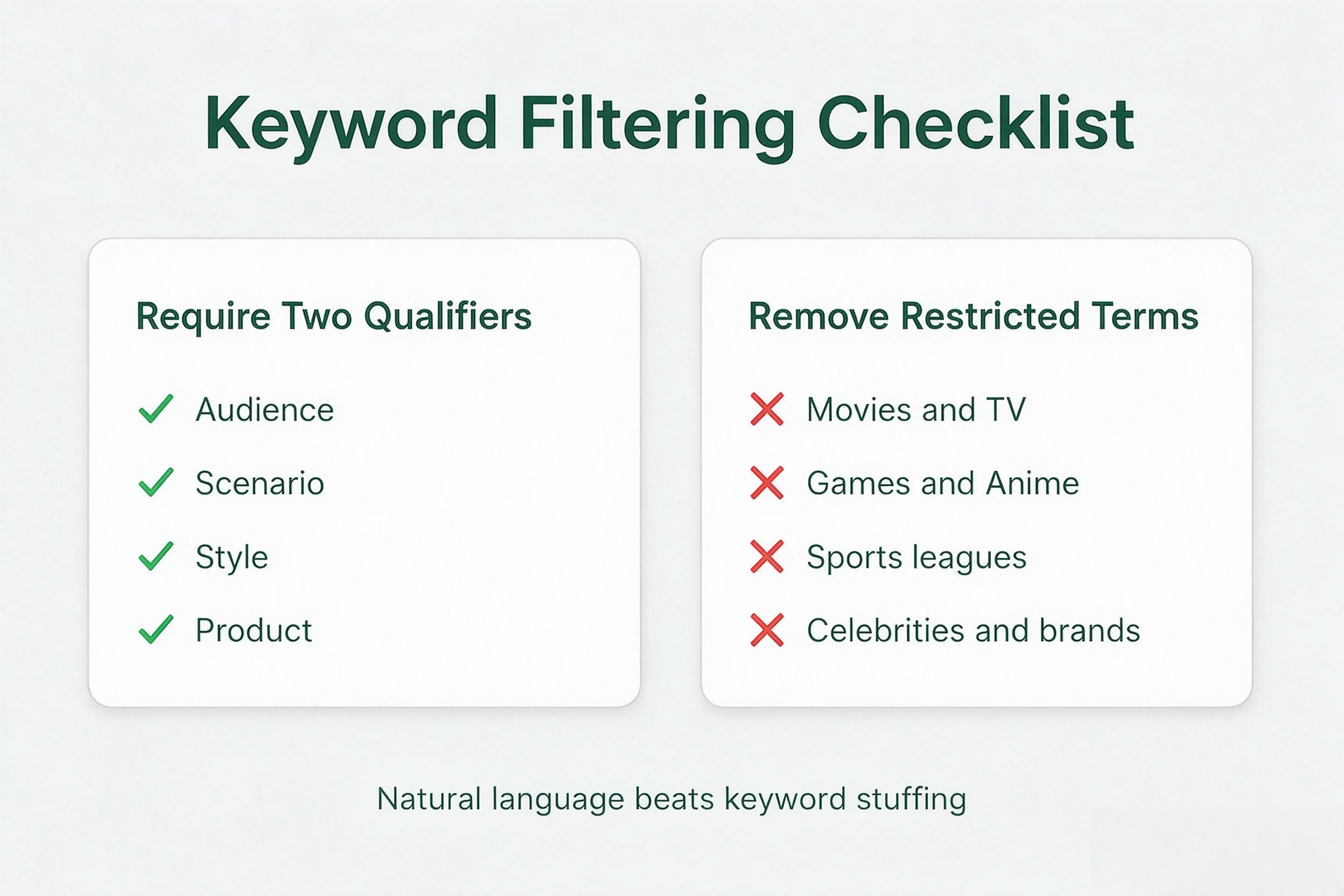
Rule 2: Require at Least Two Qualifiers
Your final product keyword should include at least two of these four qualifiers:
- Audience: Who is it for? (teacher, family, pet owner, nurse)
- Scenario: When or where will it be used? (Halloween, back to school, wedding)
- Style: What aesthetic does it follow? (gothic floral, snow leopard, minimalist)
- Product: What is it? (hoodie, tote bag, phone case, blanket)
For example, "gothic floral zip up hoodie" has style + product. "Teacher Halloween tote bag" has audience + scenario + product. "Personalized family Christmas pajamas" has audience + scenario + product.
A keyword with only one qualifier, like "hoodie" or "floral," is too broad. You'll never rank for it.
Rule 3: Remove All Restricted Terms
Anything tied to a movie, game, anime, sports league, celebrity, or brand is off-limits. These are IP minefields. Even if you see other sellers using them, don't. One takedown can shut down your shop.
Examples to avoid:
- "Harry Potter sweatshirt"
- "Disney family shirt"
- "Nike inspired hoodie"
- "Taylor Swift tote bag"
Create original designs with generic terms instead. "Wizard school sweatshirt" is safe. "Harry Potter sweatshirt" is not.
Rule 4: Write Titles for Buyers, Not Algorithms
Keyword stuffing used to work. It doesn't anymore. A title like "gothic hoodie gothic sweatshirt gothic gift dark floral hoodie" reads like spam. Etsy's algorithm recognizes it, and buyers scroll past it.
Write titles that sound natural. "Gothic Floral Zip Up Hoodie | Dark Botanical Sweatshirt | Witchy Gift for Her" is readable and keyword-rich at the same time.
Verified Long-Tail Keywords That Convert
Here are examples of product keywords that meet the criteria. They have two or more qualifiers, they're specific, and they align with current Etsy search trends.
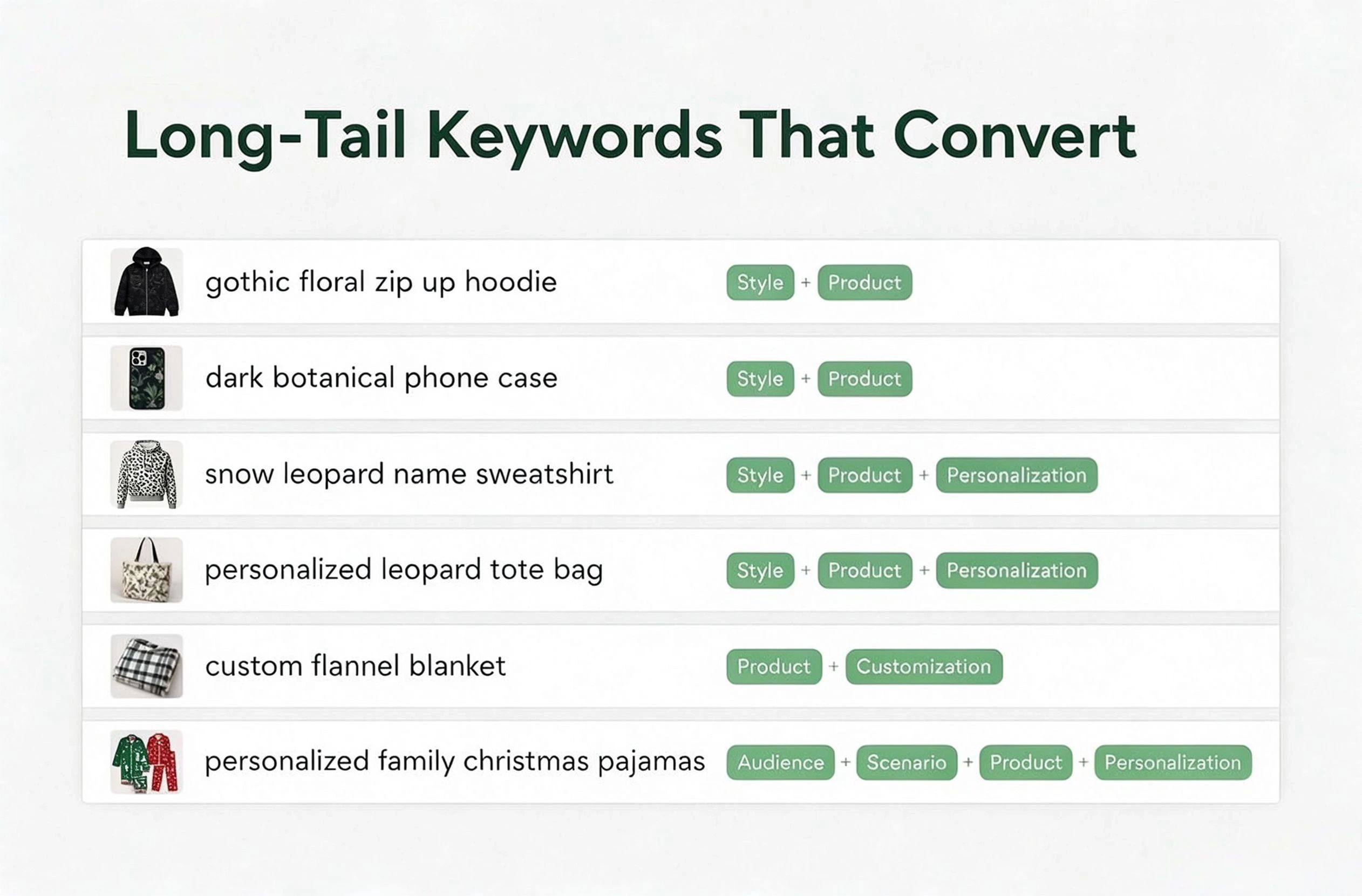
| Keyword | Qualifiers | Why It Works |
| gothic floral zip up hoodie | Style + Product | Specific aesthetic, clear product type, aligns with fall 2026 trend |
| dark botanical phone case | Style + Product | Niche aesthetic, high repurchase category, low competition |
| snow leopard name sweatshirt | Style + Product + Personalization | A-grade trend, personalization reduces competition |
| personalized leopard tote bag | Style + Product + Personalization | Strong gift intent, high perceived value |
| custom flannel blanket | Product + Customization | Cozymaxxing trend, gift-friendly, high margin |
| personalized family christmas pajamas | Audience + Scenario + Product + Personalization | Early Christmas trend, family matching demand |
These aren't random. Each one has a clear audience, a specific style or scenario, and a product type. They're searchable, rankable, and sellable.
The Keyword Validation Workflow
Here's the exact process you can follow every time you evaluate a keyword.
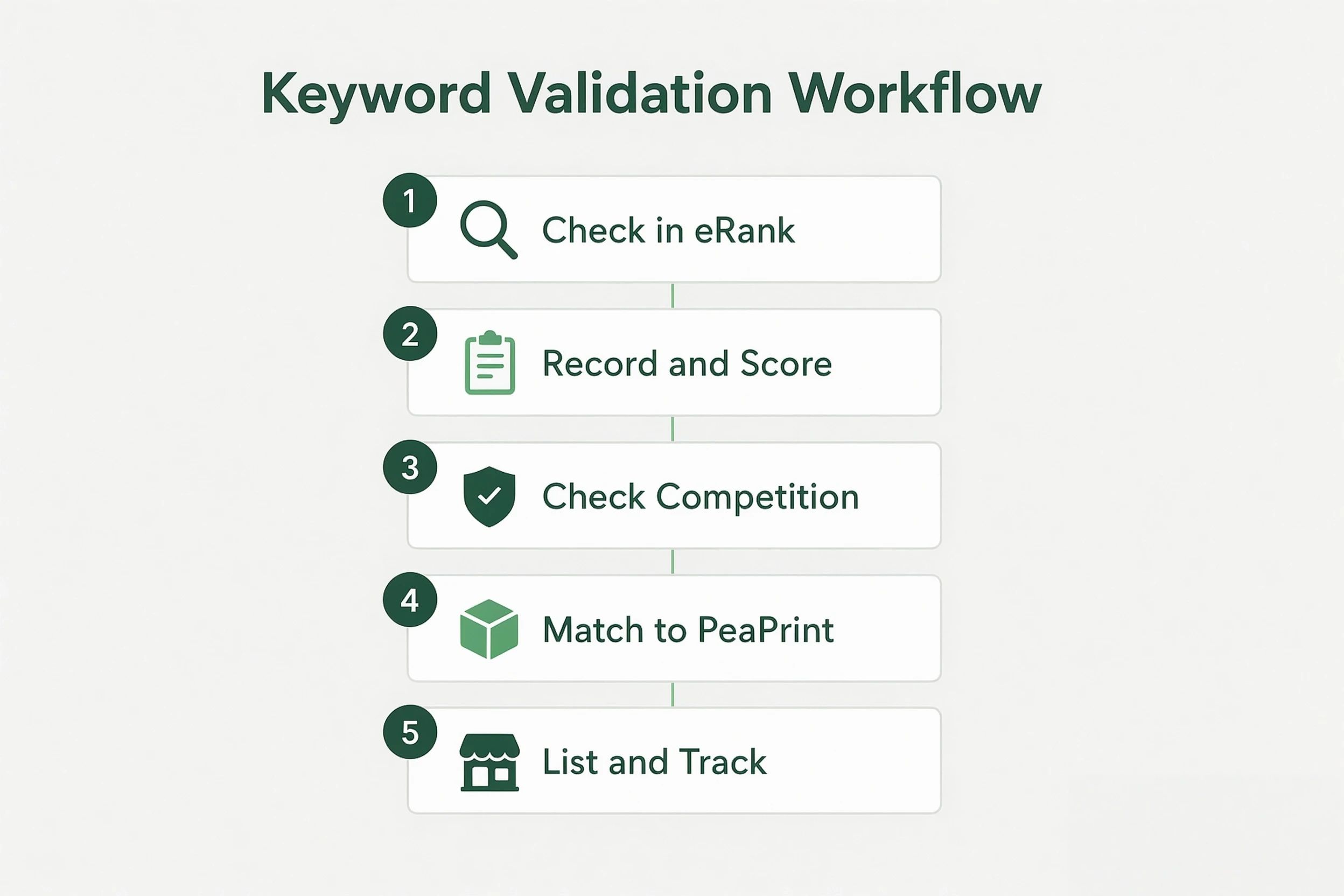
Step 1: Enter the Keyword in eRank Keyword Tool
Open eRank and type your candidate keyword into the Keyword Tool. You'll get search volume, CTR, competition, and a trend graph.
Step 2: Record the Data and Score It
Write down the numbers. Then apply the scoring system:
- CTR 125%+ → Priority candidate. Move to step 3.
- CTR 100–124% → Worth testing. Move to step 3.
- CTR below 100% → Deprioritize unless search volume is very high and competition is low.
- Trend falling → Skip unless it's a seasonal keyword approaching its peak.
Step 3: Check Competition Quality
Look at the top listings for that keyword. Are they established sellers with thousands of reviews? Or are they newer listings with moderate reviews? If the top results are weak, you have a real chance to rank.
Step 4: Match to a PeaPrint Product
Once the keyword passes validation, match it to a product on PeaPrint. If your keyword is "gothic floral zip up hoodie," choose an AOP hoodie. If it's "personalized leopard tote bag," choose an AOP tote bag.
Step 5: Order a Sample and List
Order one sample to verify quality. Then list on Etsy using the keyword in your title, tags, and description. Track performance and iterate.
Frequently Asked Questions
How much search volume is enough for an Etsy keyword?
There's no absolute number. A keyword with 50 monthly searches and a 150% CTR can be more valuable than a keyword with 5,000 searches and a 50% CTR. Look at search volume, CTR, and competition together. If CTR is strong and competition is manageable, even low-volume keywords can be worth pursuing.
Which is more important, CTR or search volume?
CTR is more important because it reflects buying intent. A keyword with high CTR means shoppers are actively clicking on listings. A keyword with high search volume but low CTR means people are browsing without buying. Prioritize CTR first, then use search volume to gauge market size.
How do I find low competition keywords on Etsy?
Use long-tail keywords that include at least two qualifiers: audience, scenario, style, or product. For example, "personalized leopard tote bag" is more specific than "tote bag." Also check the competition metric in eRank. If the top listings have low review counts and weak optimization, it's a low-competition opportunity.
What tools should I use for Etsy keyword research?
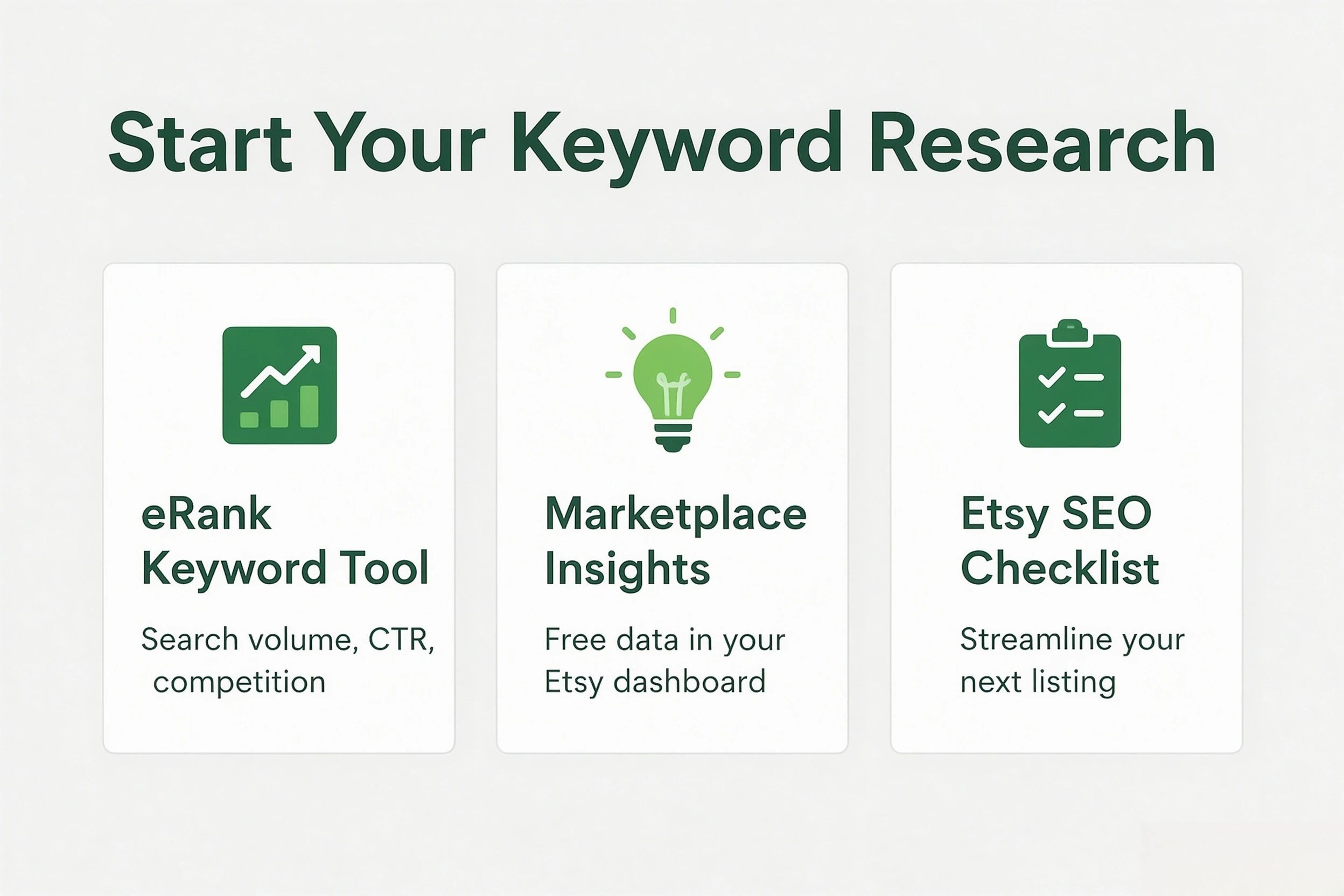
eRank Keyword Tool is the most widely used option. It provides search volume, CTR, competition, and trend data. Etsy Marketplace Insights, available free in your shop dashboard, also provides search data directly from Etsy. Use both for the most complete picture.
How long should my Etsy title be?
Keep your title under 140 characters. Put your most important keyword combination in the first 40 characters. Use natural language that reads well to buyers. Avoid keyword stuffing. A title like "Gothic Floral Zip Up Hoodie | Dark Botanical Sweatshirt | Witchy Gift for Her" is readable and optimized.
Ready to Start Using Data for Your Etsy Keyword Research?
Etsy keyword research in 2026 isn't about guessing. It's about reading data, applying filters, and making decisions based on what buyers are actually searching for.
You now have the framework. Use eRank to check search volume, CTR, competition, and trends. Apply the filtering rules. Require at least two qualifiers. Remove restricted terms. Write titles that read naturally. Then validate your keywords, match them to PeaPrint products, and list with confidence.
Start your keyword research with eRank today. Or grab our Etsy SEO checklist to streamline your next listing.