How to Sell Print On Demand Products Without a Website
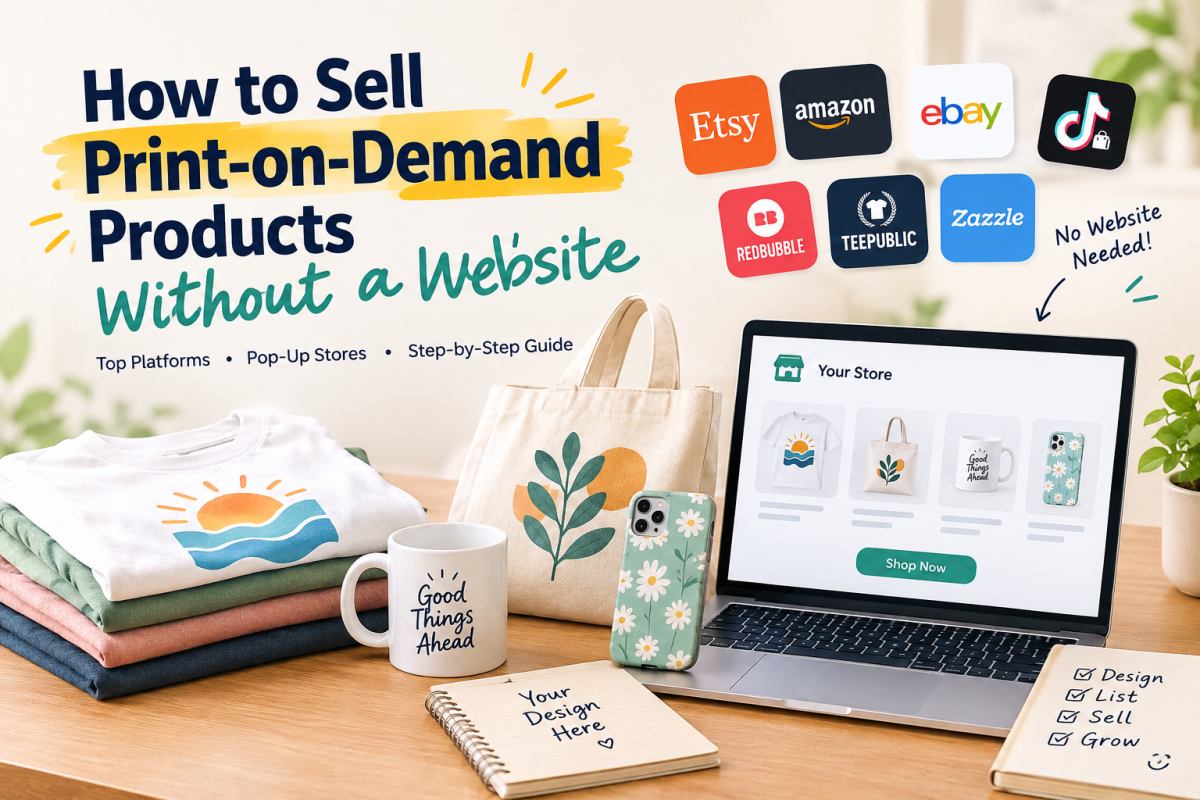
Starting a print-on-demand business does not necessarily mean building a website first. You do not have to spend weeks setting up Shopify, choosing a theme, connecting apps, and figuring out every part of ecommerce before you make your first sale. There are several ways to sell print-on-demand products without a website of your own.
Can You Sell Print-on-Demand Products Without a Website?
Yes. You can start a POD business without creating your own ecommerce website. The important thing to understand is that a website is only one way to sell. A marketplace can act as your storefront, while a hosted store can give you a product page and checkout without requiring you to build the technology yourself.
The basic process stays the same:
- Create a design
- List the product
- Customer places an order
- POD provider produces and ships it
For example, Etsy lets sellers work with production partners, including print-on-demand companies, when the products are based on the seller's original designs or buyer personalization. Etsy requires sellers to disclose production partners on applicable listings.
So, while you may not need your own website, you still need somewhere for customers to discover and purchase your products. You also need to think about product selection, pricing, design quality, customer expectations, and marketing. Skipping the website reduces your setup work, but it does not remove the need to build demand.
7 Ecommerce Platforms to Start a POD Business Without a Website
For beginners, marketplaces are one of the easiest ways to start selling POD products without a website. These platforms already have shoppers, product search, checkout, and seller tools, so you can focus more on your products and less on website development.
The main difference is that marketplace platforms can potentially expose your products to people who do not know your brand yet. A hosted storefront, on the other hand, usually works better when you can bring your own traffic.
1. Etsy
Etsy is one of the most familiar options for sellers who want to start a print-on-demand business without a website. It is particularly relevant for products built around personalization, gifting, and original designs.
You can use a POD provider as a production partner rather than manufacturing every order yourself. Etsy's current policy allows production partners to produce items based on your original designs, and you must disclose those partners on the relevant listings. Etsy does not allow sellers to simply resell commercially available products as handmade or original creations.
Etsy also comes with selling costs. Its current fee structure includes a $0.20 listing fee and a 6.5% transaction fee, with payment processing and other potential fees depending on the seller and service used.
2. Amazon Merch on Demand
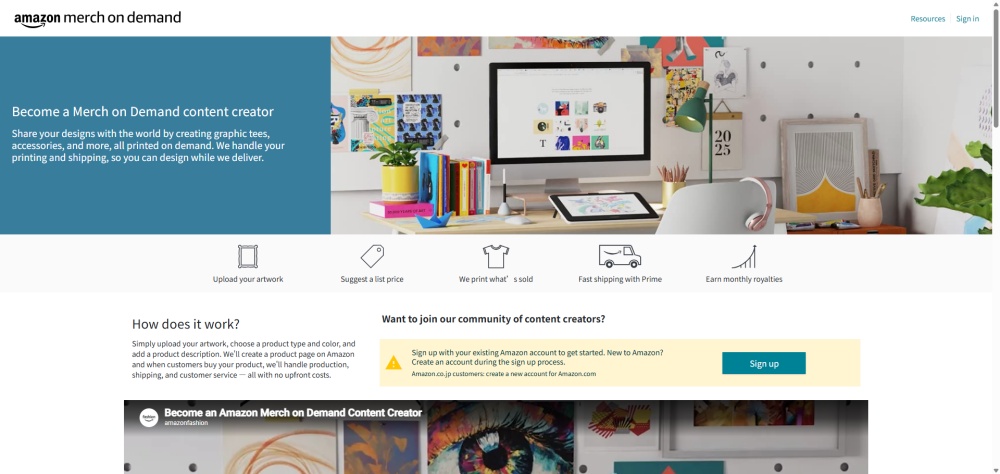
Amazon Merch on Demand allows creators to sell eligible designs on Amazon without maintaining inventory or building an independent online store. The process is straightforward. You submit your artwork, choose the product type and colors, and set your list price. Amazon creates the product page and takes care of production, shipping, and customer service. You earn royalties based on the sale. Amazon also states that Merch on Demand does not require an upfront investment for the merchandise itself. This makes it appealing for sellers who primarily want to create designs and let Amazon handle fulfillment.
There is one important difference from a typical POD store. You are working within Amazon's program and marketplace rather than running your own storefront, so the platform controls much of the customer experience.
3. eBay
eBay can also be used to sell POD products without a website, although its model is slightly different from Etsy or Redbubble.
The platform allows dropshipping when orders are fulfilled directly by a wholesale supplier. However, eBay makes it clear that sellers remain responsible for safe delivery within the advertised timeframe and for the buyer's overall satisfaction. Buying an item from another retailer or marketplace after receiving an eBay order and having that retailer ship it to the customer is not allowed under eBay's dropshipping policy.
For POD sellers, this distinction matters. Your fulfillment setup needs to comply with eBay's policies, and your shipping times need to be realistic in the listing. Because eBay covers many product categories, it can be useful when your POD catalog goes beyond apparel.
4. TikTok Shop
TikTok Shop gives sellers another way to sell POD products without sending shoppers to an external website. The appeal is its combination of content and shopping. Products can be promoted through TikTok videos and LIVE Shopping, allowing viewers to discover products while engaging with the content itself. TikTok's current U.S. seller guidance also places specific requirements on product promotional videos and LIVE content, so sellers should review the latest rules before building a strategy around video commerce.
This model can work particularly well for designs connected to trends, communities, creators, or visually interesting products. The tradeoff is that TikTok Shop is more operationally demanding than some artist marketplaces. Sellers need to pay attention to platform requirements, content quality, fulfillment, and customer experience.
5. Redbubble
Redbubble is built around independent artists rather than traditional ecommerce stores. You upload your artwork, apply it to available products, and publish it through your Redbubble shop. Customers can discover those products on the Redbubble marketplace, while products are produced after an order is placed and shipped by third-party producers. Redbubble currently promotes more than 70 product types across categories such as apparel, accessories, and home products.
That makes Redbubble a practical option for artists who want to focus mainly on creating designs instead of managing a standalone store. It can also be a good starting point when you want to test different niches before investing more time into your own ecommerce brand.
6. TeePublic
TeePublic has a similar artist-focused model, but its identity is especially closely tied to graphic merchandise. The company describes itself as a marketplace rather than a manufacturer. TeePublic facilitates the transaction between artists and customers, while third-party fulfillers manufacture and ship physical products.
For sellers, that means you can publish your artwork without setting up your own website or handling production yourself. As with any marketplace, original artwork matters. TeePublic's terms require users to upload content they created themselves or are authorized to use.
7. Zazzle
Zazzle is another option for creators who want to sell without building their own ecommerce website. Compared with platforms focused mainly on T-shirts, Zazzle has a much broader emphasis on customizable products.
Its current catalog includes categories such as invitations, stationery, home decor, apparel, accessories, gifts, stickers, and business products. Its creator ecosystem is particularly relevant to sellers who want to build designs around personalization and specific occasions.
For example, a single design concept could be adapted for wedding stationery, party products, wall decor, or personalized gifts. That makes Zazzle worth considering when your POD business is not limited to graphic apparel. For a POD seller, Etsy is especially useful when your designs target specific niches or buying occasions rather than broad generic products.
Sell POD Products Through Pop-Up and Quick-Launch Stores
Marketplaces are not the only way to sell POD without a website. Another approach is to use a hosted storefront. Instead of building a store with Shopify or another ecommerce platform, you use a POD service that provides the storefront, product pages, and checkout for you. This creates a different business model.
Printify Pop-Up Store
Printify Pop-Up Store is one of the clearest examples of a POD storefront built for people who do not want to create a traditional website.
Printify describes it as a hosted online store that can be launched without upfront costs. Sellers receive a dedicated store link that they can share with customers. When an order is placed, Printify handles the payment flow, production, shipping, and customer support according to its Pop-Up Store terms and policies.
The important distinction is that Printify Pop-Up Store is not the same as having your own Shopify site. You get a ready-made selling environment, while Printify provides much of the infrastructure behind it. This can be especially useful for a limited collection, a creator merch drop, or a campaign where you want to start selling quickly.
Printful Quick Stores
Printful Quick Stores takes a similar approach. It allows sellers to create a simple online storefront directly through Printful without building a separate website or marketplace store. You can add your designs, publish products, set pricing, and share the store link with customers.
There is an important current limitation. Printful says Quick Stores are available only to merchants who reside in the United States and have a valid U.S. tax residence. Customers also need a U.S. shipping address because international deliveries are not currently supported through Quick Stores. So it can be convenient, but it is not suitable for every seller or customer base.
Fourthwall
Fourthwall is designed with creators and communities in mind. It provides a no-code storefront where sellers can display POD products and share one store link with their audience.
Fourthwall says sellers can launch without upfront costs or inventory, while the platform handles fulfillment. It also provides a storefront builder and supports custom domains, which gives creators more branding flexibility than some basic quick-store solutions. This model makes particular sense for YouTubers, influencers, streamers, and creators who already have an audience and want to turn that audience into merch sales.
Spring / TeeSpring
Spring is another creator-focused option for selling POD products without building a traditional ecommerce website.
Its current platform provides free creator stores, social integrations, and a catalog of more than 180 physical products. Spring says creators can connect social channels and that it handles production, shipping, and customer support.
That makes the platform especially relevant when your audience already lives on social media. Instead of building a standalone website first, you can create a store and promote it directly to your followers.
Spreadshop
Spreadshop provides a free storefront where sellers can create and sell POD products without managing inventory themselves.
The platform currently advertises more than 300 products and handles printing and shipping after an order is placed. Sellers set their own retail prices and earn the difference between the base price and their selling price. Spreadshop also provides a hosted storefront rather than requiring you to build a full ecommerce site from scratch.
In 2026, Spreadshop also introduced a new storefront design with mobile-optimized layouts and updated product pages for new shops.

How to Start a Print-on-Demand Business Without a Website
Step 1: Choose Your Selling Model
First decide whether you want to use a marketplace or a hosted storefront. A marketplace such as Etsy or Redbubble can help you reach shoppers who are already browsing for products. A service such as Printify Pop-Up Store or Fourthwall is more suitable when you have an audience or marketing channel that you can use to drive traffic.
You can also use both models over time. For example, you might use Etsy to test products while maintaining a separate branded storefront for customers who discover you through social media.
Step 2: Pick a Niche and Product
Avoid launching dozens of unrelated products at once. Choose a specific audience and start with a small product range that makes sense for that audience. Depending on your niche, that could mean T-shirts, hoodies, mugs, stickers, tote bags, phone cases, or personalized gifts.
A focused catalog also makes it easier to create better product images and descriptions.
Step 3: Create Your Designs
Original designs are the foundation of a POD business. Your designs should have a clear audience and a reason for someone to buy the product. Before publishing, make sure you have the right to use every image, phrase, logo, character, or other protected element in your artwork.
This is especially important on marketplaces where intellectual property violations can result in content removal or account restrictions.
Step 4: Set Your Price and Publish
Your selling price needs to leave enough room for both your POD costs and platform fees. A simple starting formula is:
Selling Price − Product Cost − Platform Fees = Potential Profit
Do not look only at the base product cost. Shipping, payment processing, marketplace fees, advertising fees, taxes, and refunds can all affect your actual margin. Once you know your target margin, publish a small group of products and pay attention to what customers actually respond to.
Step 5: Bring Traffic to Your Products
A common misconception is that starting a POD business without a website means you do not need marketing. You still need customers. Marketplace sellers can work on marketplace SEO, product titles, tags, images, and seasonal demand. Sellers using a hosted storefront may rely more heavily on TikTok, Instagram, Pinterest, YouTube, email marketing, or an existing community.
The good news is that you do not need to master everything at once. One strong traffic source can be enough to validate an idea before you expand.
Start Selling POD Without Building a Website First
You do not need a fully developed ecommerce website to test a print-on-demand idea.
A marketplace can give you a place to list products and reach shoppers, while a hosted storefront can give you a simple way to sell directly to an audience. The important part is choosing a model that matches how you expect customers to find your products.
Once you have chosen your selling channel, the next step is finding a POD supplier that gives you the product selection, pricing, design tools, and fulfillment options your business needs.
Start creating with PeaPrint and turn your designs into products without carrying inventory.
FAQs
What is the best platform to sell POD without a website?
There is no single platform that fits every POD business. Etsy can make sense for sellers focused on custom and personalized products, while artist marketplaces such as Redbubble and TeePublic are geared toward original artwork. Creator-focused storefronts such as Fourthwall and Spring are more useful when you already have an audience to bring to your store.
Can I sell POD products on Etsy without my own website?
Yes. You do not need a separate website to sell on Etsy. However, your POD products must follow Etsy's current Creativity Standards, and production partners need to be disclosed when applicable. Etsy allows POD fulfillment for products based on the seller's original designs or buyer personalization.
Do I need Shopify to start a POD business?
No. Shopify is one way to build a more customizable ecommerce store, but it is not required. You can begin with an existing marketplace or a hosted POD storefront and move to a more advanced ecommerce setup later.