Are AOP Hoodies More Profitable Than Tees for Black Friday?
Every year around this time, I see the exact same panic in POD seller groups.
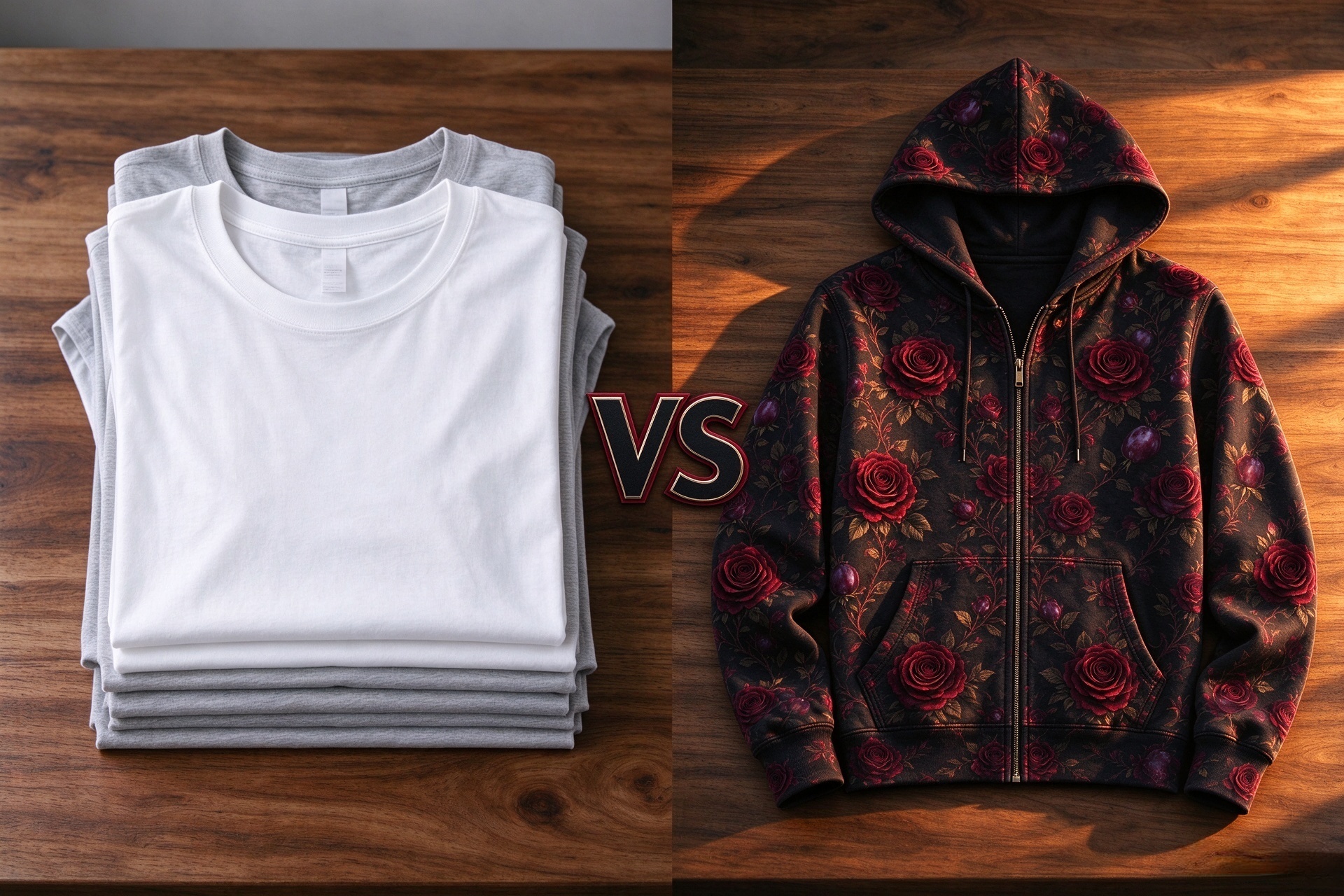
Everyone is scrambling to find the next big graphic for print on demand shirts. They’re churning out basic tees, slapping a design on the chest, and then getting crushed in a price war because someone else is selling a similar shirt for $2 less.
I get it. T-shirts are the default. But if you’re staring down the barrel of Black Friday and you want to actually make a profit—not just generate revenue—you need to stop treating all products the same.
Here’s a question I want you to honestly ask yourself: Are AOP hoodies actually more profitable than tees for Black Friday?
The short answer is: Yes, usually. But the why matters, because if you mess up the execution, a hoodie is just a more expensive mistake.
Let’s break it down.
The real comparison (Tees vs. Hoodies)
I’m not going to give you fake numbers. But let’s look at the structural difference between an AOP (all over print) hoodie and a standard tee.
A basic tee is a traffic driver. It’s a low-barrier purchase. A buyer might see a funny slogan and grab it for $25. But after product cost, shipping, platform fees, and the inevitable Black Friday discount, your margin is razor-thin. You have to sell a lot of them.
An all over print hoodie, on the other hand, changes the psychology of the buyer.
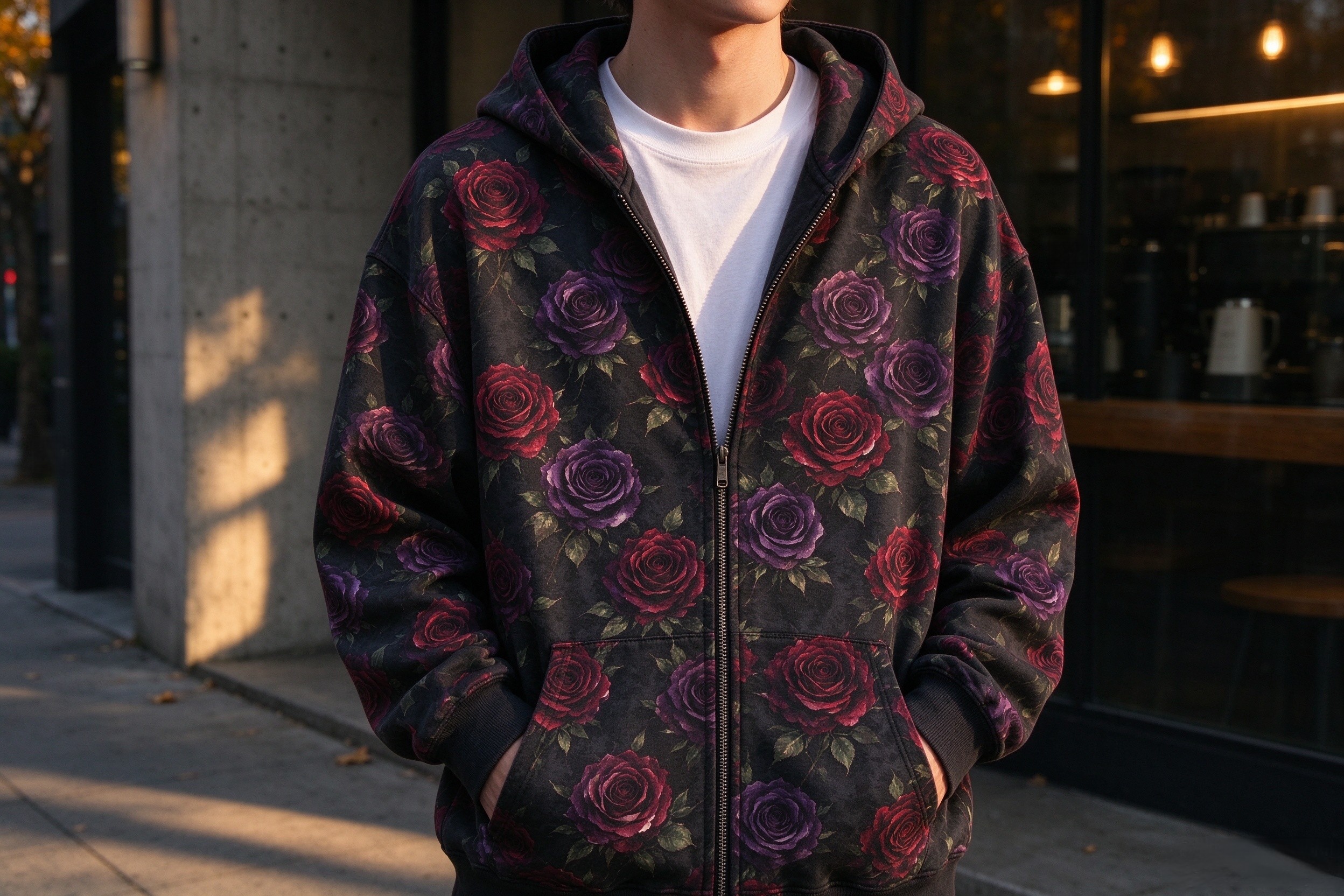
They aren’t buying it because they need a shirt. They are buying it because it looks like a piece of wearable art. The perceived value is drastically higher. When someone sees a full-coverage, vibrant design on a heavy hoodie, they don’t compare it to a $25 tee. They compare it to a $70 streetwear brand.
That gives you something vital on Black Friday: pricing power.
What makes AOP hoodies a better profit carrier?
To understand why all over print is different, you have to understand the process.
It’s not DTG. It’s not screen printing. It’s dye sublimation.
The design is printed onto paper, then heat and pressure turn the dye into gas. That gas permanently bonds with the polyester fibers in the fabric. The pattern isn’t sitting on top of the fabric; it’s inside the fabric.
Because the garment is printed before it’s cut and sewn (the Cut & Sew process), the pattern runs seamlessly from collar to hem, across the sleeves and side seams. No cracking. No fading.
This is the part where most sellers ruin their profit. You can’t just take a JPEG that looks good on a t-shirt and stretch it across a hoodie. It will look terrible at the seams, and the buyer will return it.
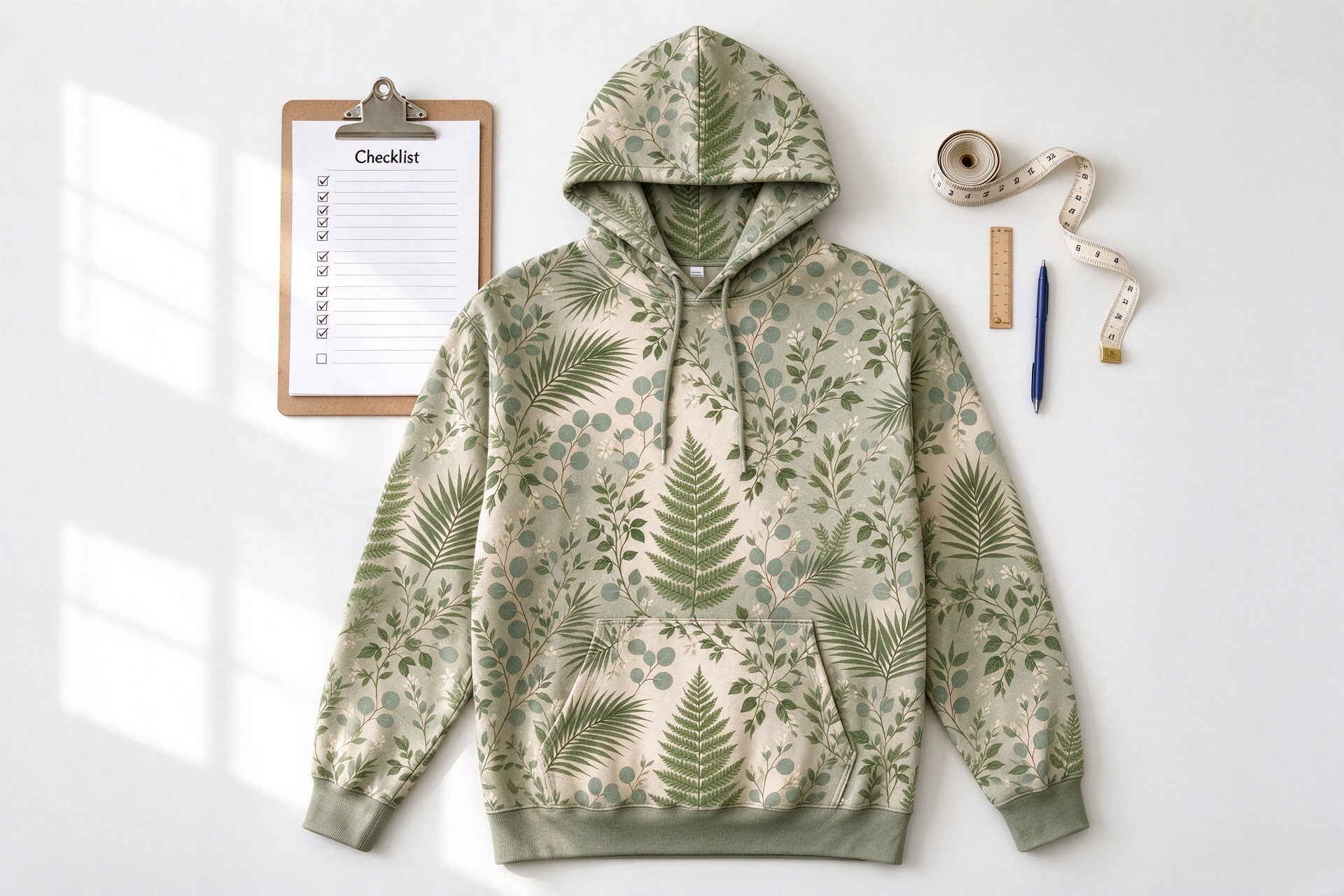
If you want to know how to make all over print shirts and hoodies actually work, you need to respect the file specs:
- 300 DPI minimum (or it looks blurry).
- CMYK color mode (or the colors will shift).
- Safe zones (keep vital elements away from the zipper and pockets).
- Bleed (extend the design so there are no white edges after cutting).
The design trap (Don't skip this)
I’ve seen sellers skip the sample step because they “know” their design looks good on a screen. Then the hoodie arrives, the contrast is wrong, or the side seam cuts right through the middle of their main graphic.
That’s not a design problem. That’s a testing problem.
You can’t fake a good AOP hoodie. You have to test it.
Cost, price, and the discount trap
Let’s do the math.
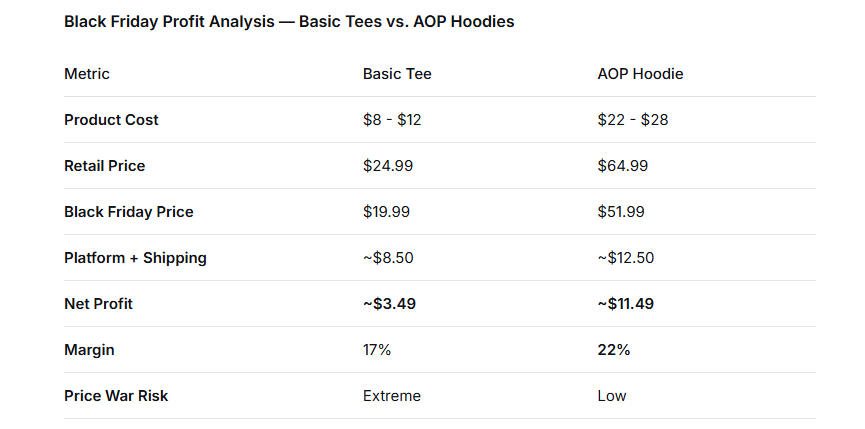
Cost = product + shipping + platform fee + promotion.
Then calculate your discounted revenue—not your list price.
If an AOP hoodie costs you $22 in product, $6 in shipping, and you’re paying platform fees plus a small ad budget, your real cost might be $32–36. If you list at $65 and discount 20%, you’re at $52. That’s still a positive margin.
But if you try to sell a basic tee at $25 and discount 20%, you’re barely covering your costs. You’re working for free.
Starting prices are not final variant prices. Always check the Peaprint product page for the exact blank, size, and color you’re quoting.
A validation record you can actually use
I’m not going to give you a fake case study with numbers I made up. Instead, here’s a template you can fill in with your own test.
Validation record: CASE-AOP-BF-001 (template — fill with real store data)
- Background: Small Etsy/Shopify seller, limited Black Friday budget, no inventory.
- Challenge: Unsure about seam alignment, dark-base color performance, and discounted profit on AOP hoodies.
- Plan: Order one sample per carrier. Test two designs across two color bases. Keep price and mockup scene fixed.
- Validation items: Color accuracy, seam alignment, fabric hand-feel, post-wash result, production days, total landed cost.
- Decision rule: Quality pass + positive discounted margin before scaling.
- Result: To be filled after sample testing.
- Limitation: One shop’s sample test is not market-wide sales proof.
That’s the honest version. You run the test, you fill the result.
How I’d structure the Black Friday test
- Pick two AOP hoodie designs and two AOP tee designs. Same master artwork where possible.
- Order one sample per design and color base. Check seams, zipper area, and print clarity.
- Calculate discounted cost before you list. Don’t list first and do math later.
- List on your store with clear mockups. Show the full garment, not just a chest crop.
- Run a small ad test only on listings that get natural clicks or favorites.
- Expand only the winning master design to more carriers.
That last step is where most sellers go wrong. They expand before they have a signal. Then they have ten products and no data.
Why Peaprint fits this test
I’m biased, obviously. But here’s the practical part:
- AOP is Peaprint’s core capability, not a side offering.
- One-piece production means you can test without inventory.
- One-piece and multi-piece unit prices are consistent under current policy, so your sample cost isn’t penalized.
- Global production sites help with delivery coverage.
- Etsy and Shopify integration means once a test works, you can connect the store and fulfill without manual order handling.
None of that guarantees sales. It just lowers the cost of finding out.
FAQ
Q: Can AOP print on cotton?
A: No. Dye sublimation requires polyester or a high-poly blend. Cotton doesn’t bond with the dye the same way.
Q: Will AOP crack like a screen print?
A: No. The dye is inside the fiber, not a surface layer.
Q: Is an AOP hoodie profitable for Black Friday?
A: It can be a higher-value carrier, but you need to validate sample quality, landed cost, and discounted margin. Search volume alone doesn’t answer that.
Q: How many samples should I order?
A: At least one per carrier and color base you plan to sell. If you’re testing two hoodie designs on two bases, that’s four samples. It’s not cheap, but it’s cheaper than refunds.
Q: Can I start with one piece?
A: Yes. Peaprint supports one-piece production. Use it to test, not to scale blindly.
The part I keep coming back to
Black Friday content is full of “best sellers” and “must-have products.” Most of it is noise.
The sellers who do well aren’t the ones who predicted the winning product. They’re the ones who tested a small set, checked the numbers, and expanded what worked.
So if you’re looking at your products and wondering whether to focus on tees or hoodies, remember: you’re not trying to win a keyword contest. You’re trying to find a carrier where the design, the cost, and the buyer’s perceived value line up.
Test one hoodie. Test one tee. Check the seams. Run the math.
Then decide.
Explore Peaprint’s AOP hoodies and tees, and order a sample before you commit Black Friday budget.