Retro Halloween Shirts—Vintage Black Cat & Pumpkin Designs
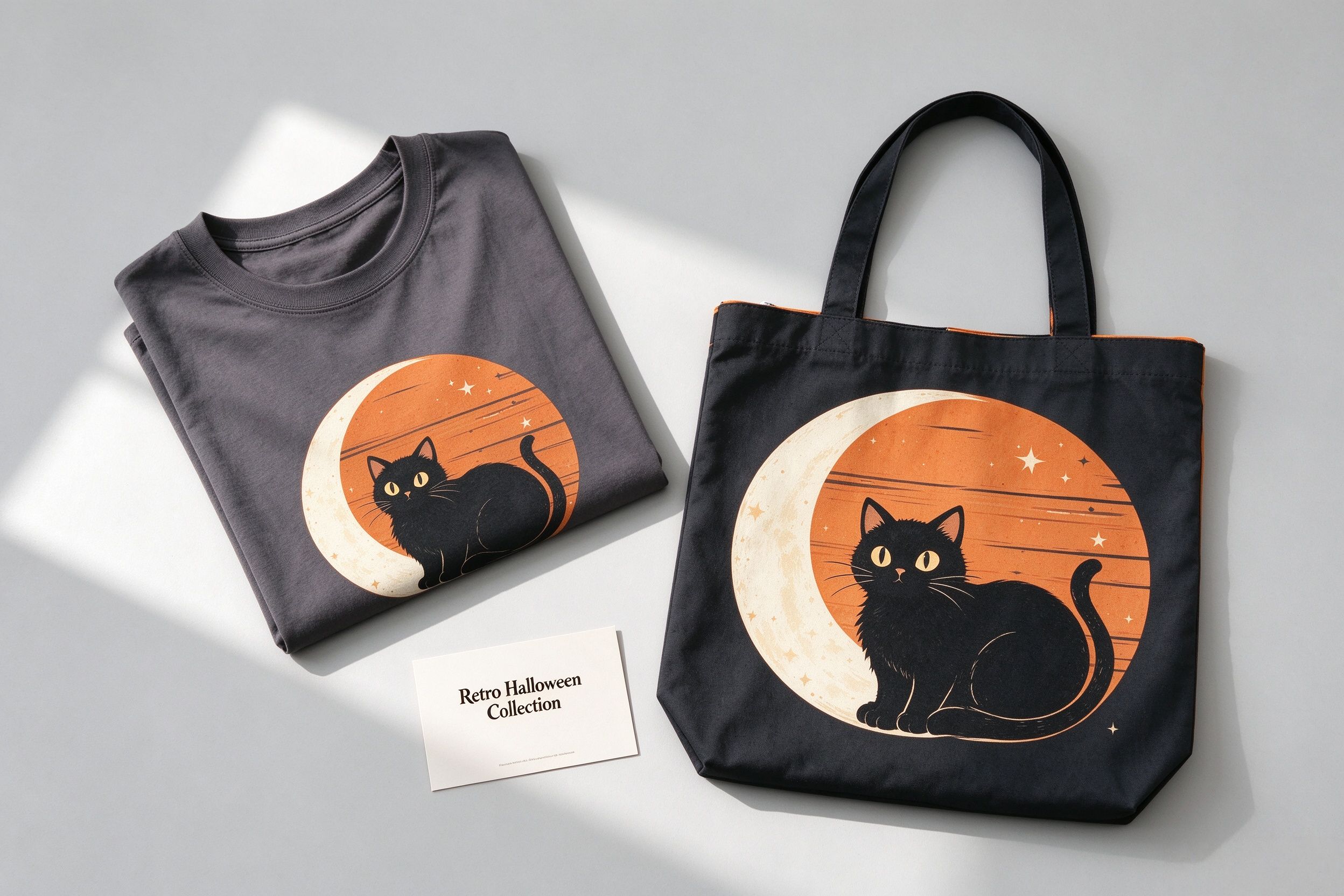
Most sellers treat Halloween like a one-night party.
You design something spooky, you list it in September, you sell a few, and then November 1 hits — and that listing goes quiet until next year.
That's the normal way to do it. And it's fine. It works.
But there's a better way.
The strongest signal in PeaPrint's 2026 Halloween trend report isn't just "retro is popular." It's that retro Halloween shirts can keep selling after October 31 — as long as you don't put "Happy Halloween" on them.
That changes everything about how you should design, price, and extend this product line.
Let me explain.
Why Retro Halloween Is the Strongest Current-Season Signal
PeaPrint's report looked at Etsy US and English-language stores, targeting the 18–34 audience.
And when they looked at which Halloween direction had the strongest current-season evidence, one sample stood out:
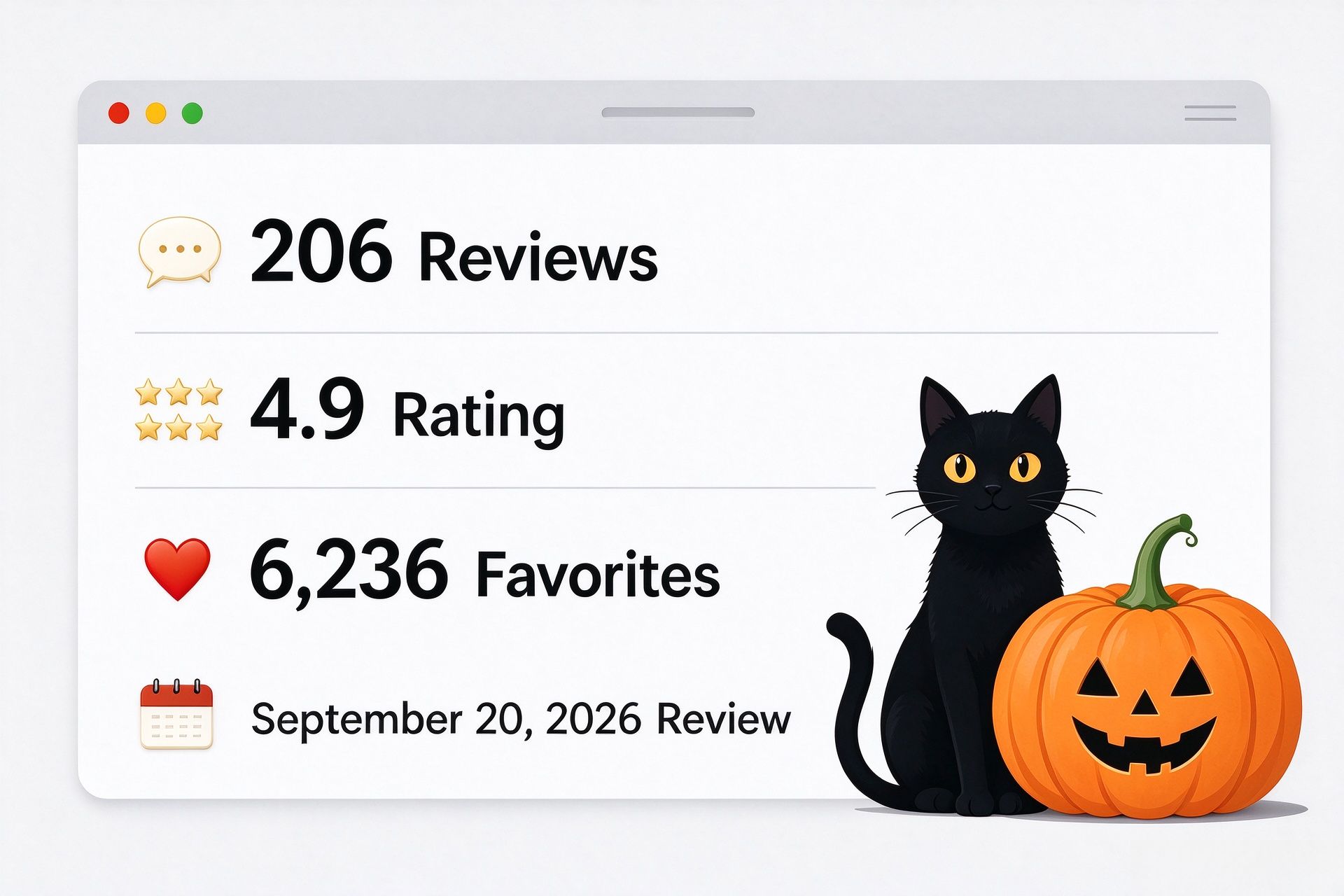
SubArtsy's retro Halloween tee.
Here's what the data showed:
- 206 item reviews
- 4.9 rating
- 6,236 favorites
- 20+ views in the last 24 hours
- A review dated September 20, 2026
That last detail matters most.
A lot of listings have hundreds of reviews — but those reviews are from 2023 or 2024. That's historical validation. It tells you the design worked once. It doesn't tell you whether it's working now.
SubArtsy's listing has a review from this month. That's current momentum. Different thing entirely.
The report also flagged eRank's 2026 nostalgia trend as a supporting signal. Retro aesthetics are rising across multiple categories, not just Halloween.
So you have two independent signals pointing the same direction:
- A platform-level trend (eRank nostalgia)
- A product-level signal (SubArtsy's recent activity)
That's the strongest evidence tier you can get without backend order data.
The Core Argument: Retro Halloween Isn't a Holiday Product
Here's where most sellers get it wrong.
They see "Halloween" in the trend report and immediately think: seasonal, one month, pump it out fast.
But retro Halloween isn't really a Halloween product.
It's a vintage aesthetic product that happens to use Halloween motifs.
Think about it:
- A black cat with a crescent moon? That's not Halloween-specific. That's a gothic everyday design.
- A smiling pumpkin with a retro arched heading? That's nostalgic Americana.
- A distressed orange-and-cream color palette? That's a fall aesthetic, not a holiday costume.
The buying reason isn't "I need a Halloween shirt for October 31."
The buying reason is "this looks good and I want to wear it."
And that reason doesn't expire on November 1.
So the design rule is simple:
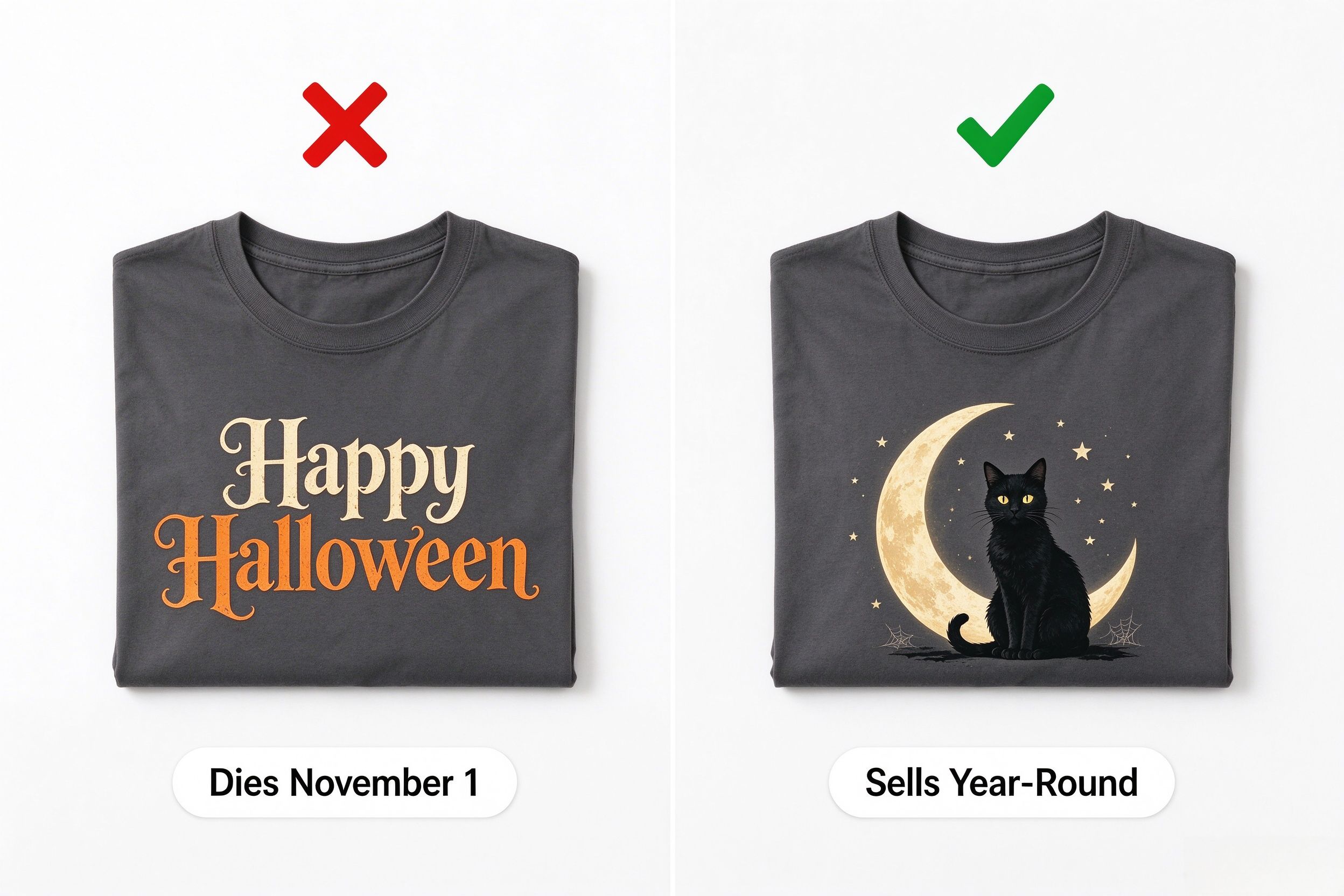
If your design says "Happy Halloween" or "Trick or Treat," it dies on November 1.
If your design says nothing, or only uses motif-level elements, it can sell through November, December, and into next fall.
That's the whole opportunity.
Retro Halloween Design System
Now let's get practical.
If you want to build a retro Halloween line that sells beyond October, here's the design system the report recommends.
Art Elements
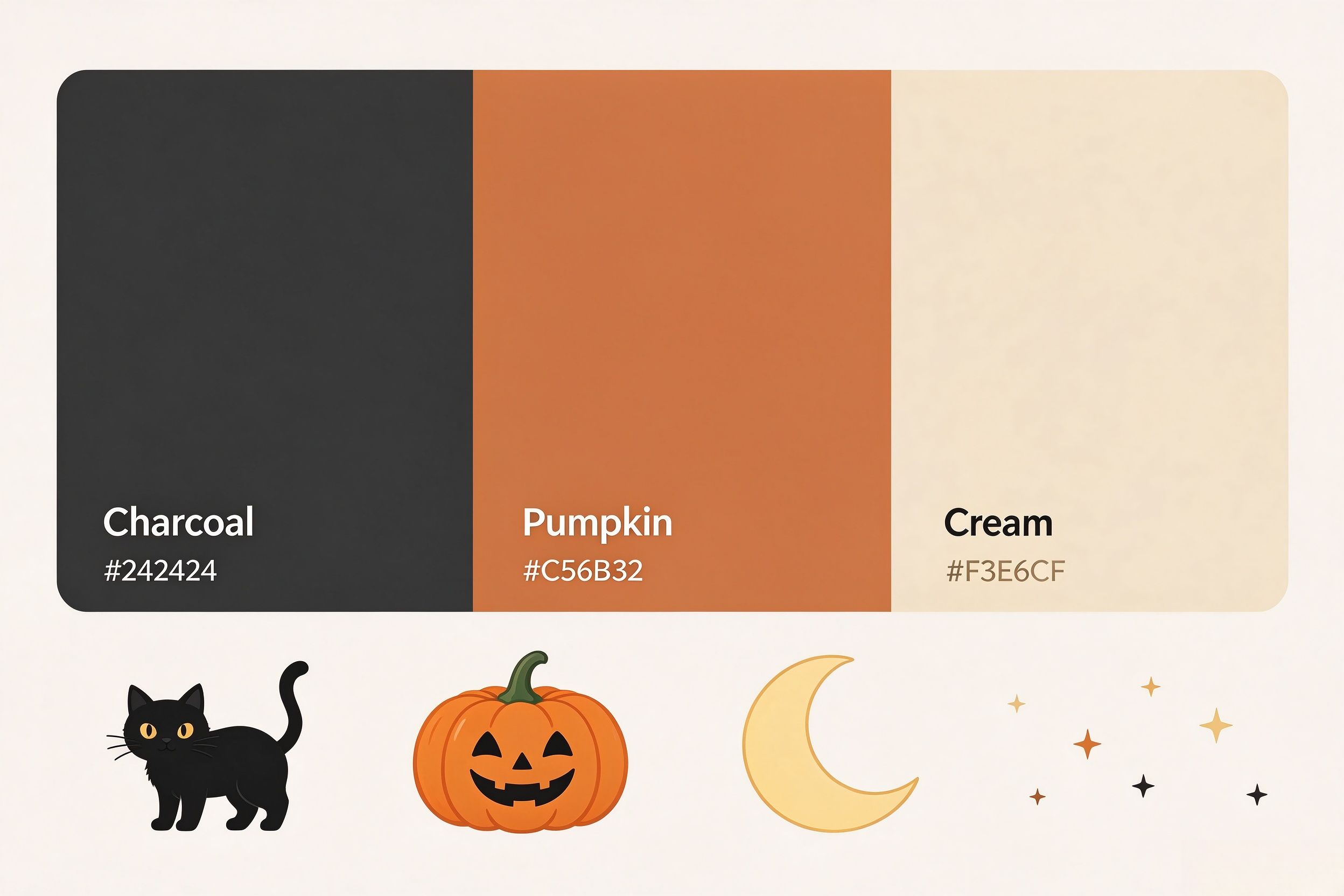
- Original black cats — not clip art, not traced. Draw your own silhouette or pose.
- Smiling pumpkins — the vintage kind, not the scary kind. Rounded, friendly, simple.
- Crescent moon — small, decorative, not the focal point.
- Sparse stars — just a few, scattered loosely. Not a starfield.
The composition principle is: one main character, one supporting element, a few small accents.
Don't crowd the design. Retro works because it's clean.
Color Palette
The report specifies three colors:
- Charcoal #242424 — base color for dark tees or totes
- Pumpkin #C56B32 — the warm orange that reads "fall" without reading "costume"
- Cream #F3E6CF — the off-white that keeps the design from feeling too dark
You can also invert it: cream base, charcoal art, pumpkin accents. That's the light version.
Both work. Test both.
Layout
The report suggests an arched heading composition:
- A curved text line at the top (like an old poster)
- One main character in the center
- Sparse stars or dots around the edges
This layout is flexible. You can swap the character (cat, pumpkin, ghost) and keep the structure.
That means one master layout → multiple designs with minimal rework.
Distressed Texture
Retro designs often use a distressed or faded texture to look vintage.
Here's the trap: if you over-distress, the print becomes illegible on fabric.
The report's guidance is clear: keep distressed edges legible. The texture should suggest age, not destroy the artwork.
Also: don't describe your product as "vintage" or "genuine vintage." Describe it as "vintage style." That keeps you accurate and avoids customer complaints.
Building the Product Line on PeaPrint
Now you have the design system. Where do you put it?
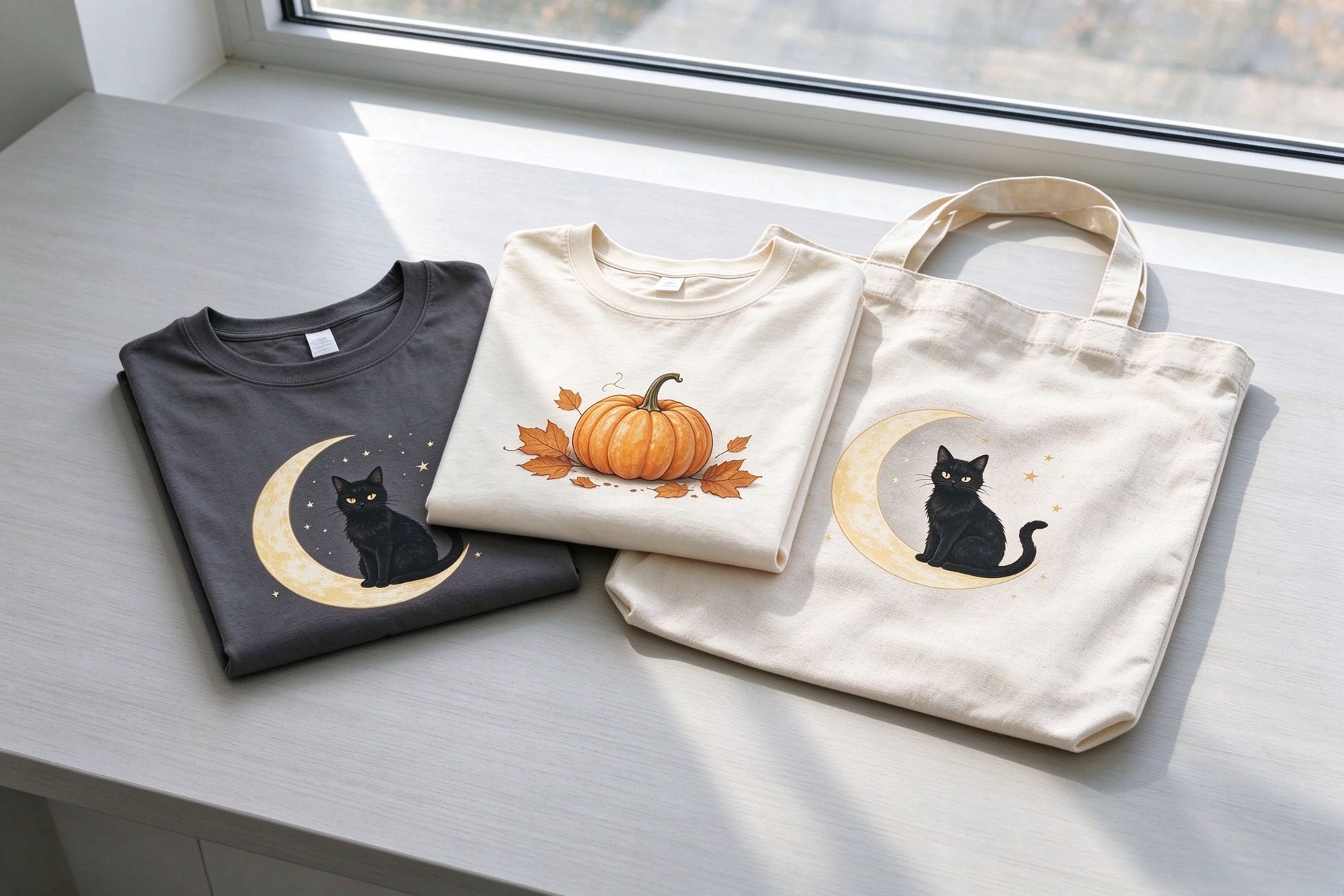
The report recommends starting with two carriers:
- Relaxed tees
- Dual-sided totes
Both are confirmed PeaPrint products. The dual-sided tote is specifically mentioned in the report as verified.
Why These Two First?
- Tees are the entry product. Low commitment for buyers, easy to test.
- Totes are the AOV booster. They cost less to produce than a hoodie, but they sell at a price point that adds margin to every order.
Start with one master design. Apply it to both carriers.
That gives you two listings from one artwork.
Using PeaPrint's Design Tool
PeaPrint's design tool lets you upload your artwork and preview it on the product in real time.
For retro Halloween, here's the workflow:
- Create your master design at the correct resolution (300 DPI minimum)
- Upload it to PeaPrint
- Select your carrier (tee or tote)
- Adjust positioning — for the tote, make sure the design works on both sides
- Generate mockups for your listings
Sampling Checklist
Before you list anything, order a sample.
Here's what to check:
- Distressed texture on dark fabric — does the cream art show up clearly on charcoal?
- Tote seam alignment — if the design crosses the seam, does it line up?
- Print clarity at actual size — does the arched heading read at 12 inches wide?
If the sample fails, fix the design before you promote it.
Listing and SEO
Now you have a product. How do you list it?
Title Structure
The report gives a specific example:
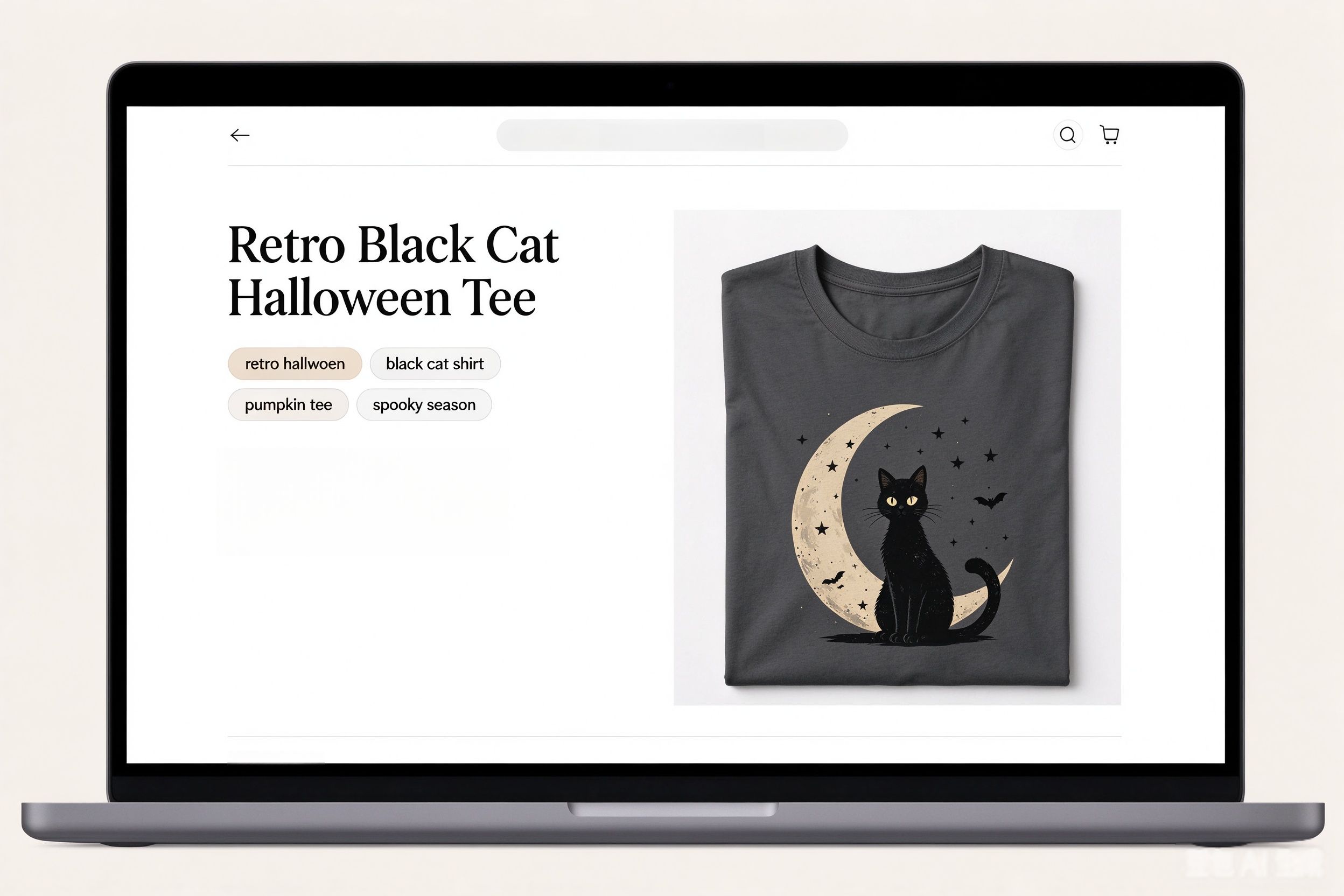
Retro Black Cat Halloween Shirt, Vintage Style Pumpkin Tee
That's the pattern:
- Primary keyword first (retro black cat halloween shirt)
- Secondary keyword second (vintage style pumpkin tee)
- Comma-separated, under 140 characters
Don't stuff keywords. Write it like a buyer would search.
Tag Strategy
The report suggests these tag seeds:
- retro halloween
- black cat shirt
- pumpkin tee
- spooky season
Use all 13 tags. Mix broad and specific:
- 3–4 broad: retro halloween, halloween shirt, spooky season, fall shirt
- 3–4 specific: black cat tee, vintage pumpkin shirt, retro ghost tee, nostalgic halloween
- 3–4 audience/scenario: campus outfit, weekend party, fall aesthetic, vintage style tee
Initial Test Plan
The report recommends:
Two original characters × two base colors = four listings
So:
- Character 1 (black cat) on charcoal base
- Character 1 (black cat) on cream base
- Character 2 (pumpkin) on charcoal base
- Character 2 (pumpkin) on cream base
Four listings. Same layout structure. Different characters and colors.
That gives you clean comparison data.
Pricing and Margin Snapshot
I'm not going to give you exact numbers, because pricing depends on your costs, your shipping, and your market.
But here's the framework:
Tees:
- Production cost + shipping + platform fees + your margin = retail price
- Most retro Halloween tees land in the $26–32 range
- At that price, you have room for healthy margin
Totes:
- Lower production cost than tees
- Sell at $18–24
- Use as an add-on: "Buy the tee, add the tote for $15"
The tote isn't a hero product. It's an AOV tool.
FAQ
What makes retro Halloween different from regular Halloween designs?
Regular Halloween designs are holiday-specific — they say "Happy Halloween" or feature scary imagery. Retro Halloween uses vintage aesthetics and motif-level elements (black cats, pumpkins, moons) that can sell beyond October 31.
Can I really sell a Halloween design in November?
Yes — if the design doesn't say "Happy Halloween" or "Trick or Treat." A black cat with a crescent moon is a fall aesthetic, not a holiday product. It can sell through November and into winter.
How many listings should I start with?
The report recommends four listings: two characters × two base colors. That gives you enough data to see which character and which color performs better.
What PeaPrint carriers should I use for retro Halloween?
Start with relaxed tees and dual-sided totes. Both are confirmed PeaPrint products. The dual-sided tote is specifically verified in the report.
How do I avoid making my design look cheap?
Keep distressed edges legible. Don't over-texture. Use a clean composition with one main character and sparse accents. And always order a sample before listing.
What if my sample doesn't look right?
Fix the design before promoting it. Common issues: too much distress on dark fabric, seam misalignment on totes, or the arched heading not reading at actual size.
So, What's the Real Opportunity Here?
Most sellers will design a retro Halloween shirt, list it in September, sell a few in October, and then forget about it.
That's fine. It works.
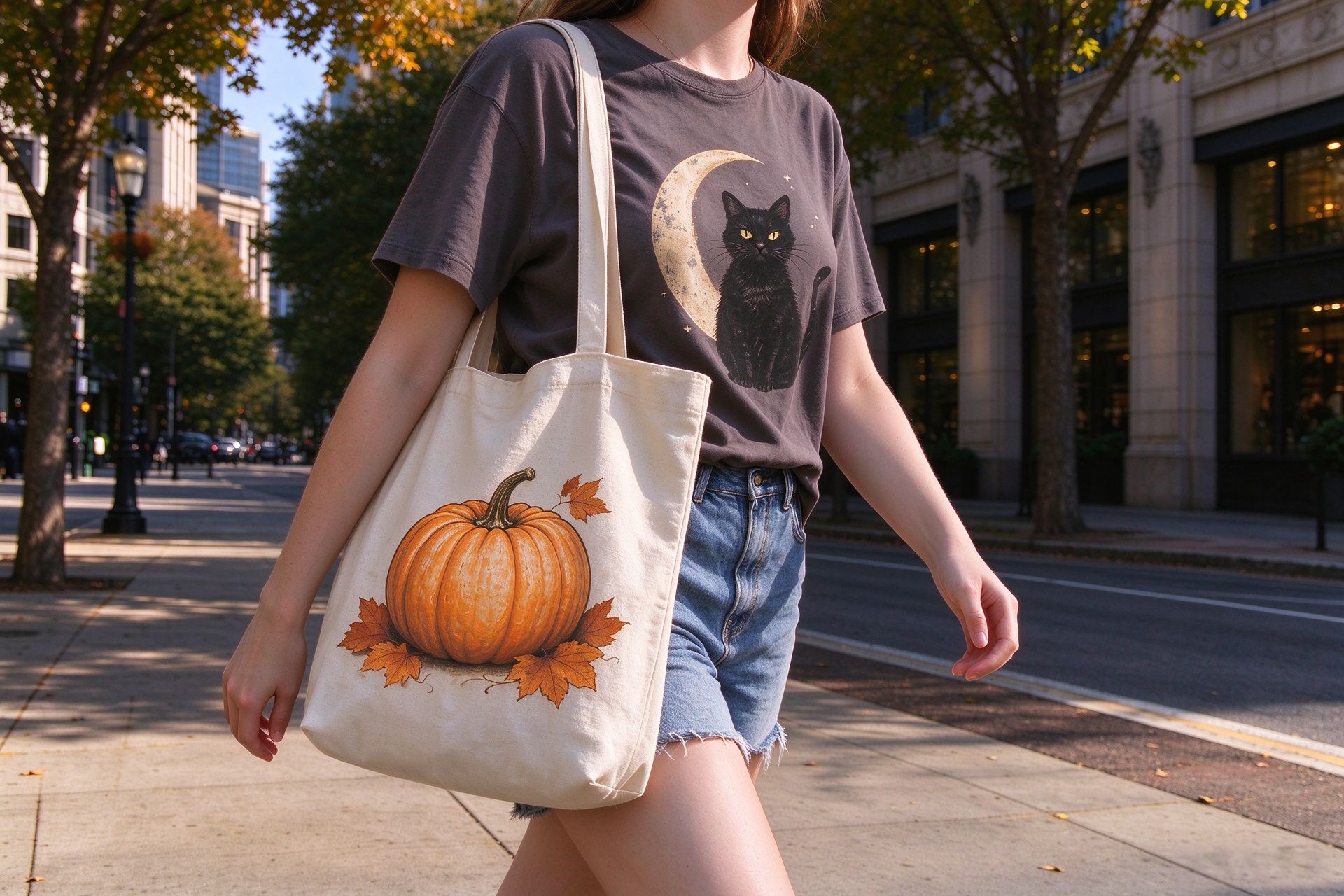
But the sellers who understand that retro Halloween is a fall aesthetic — not a holiday product — will keep selling it through November, December, and beyond.
They'll remove the date. They'll keep the motif. They'll extend the lifecycle.
That's the difference between renting traffic and building an asset.
And it starts with one design decision: don't write "Happy Halloween" on it.