Bookish Halloween Shirts—Reading Ghost & Coffee Designs
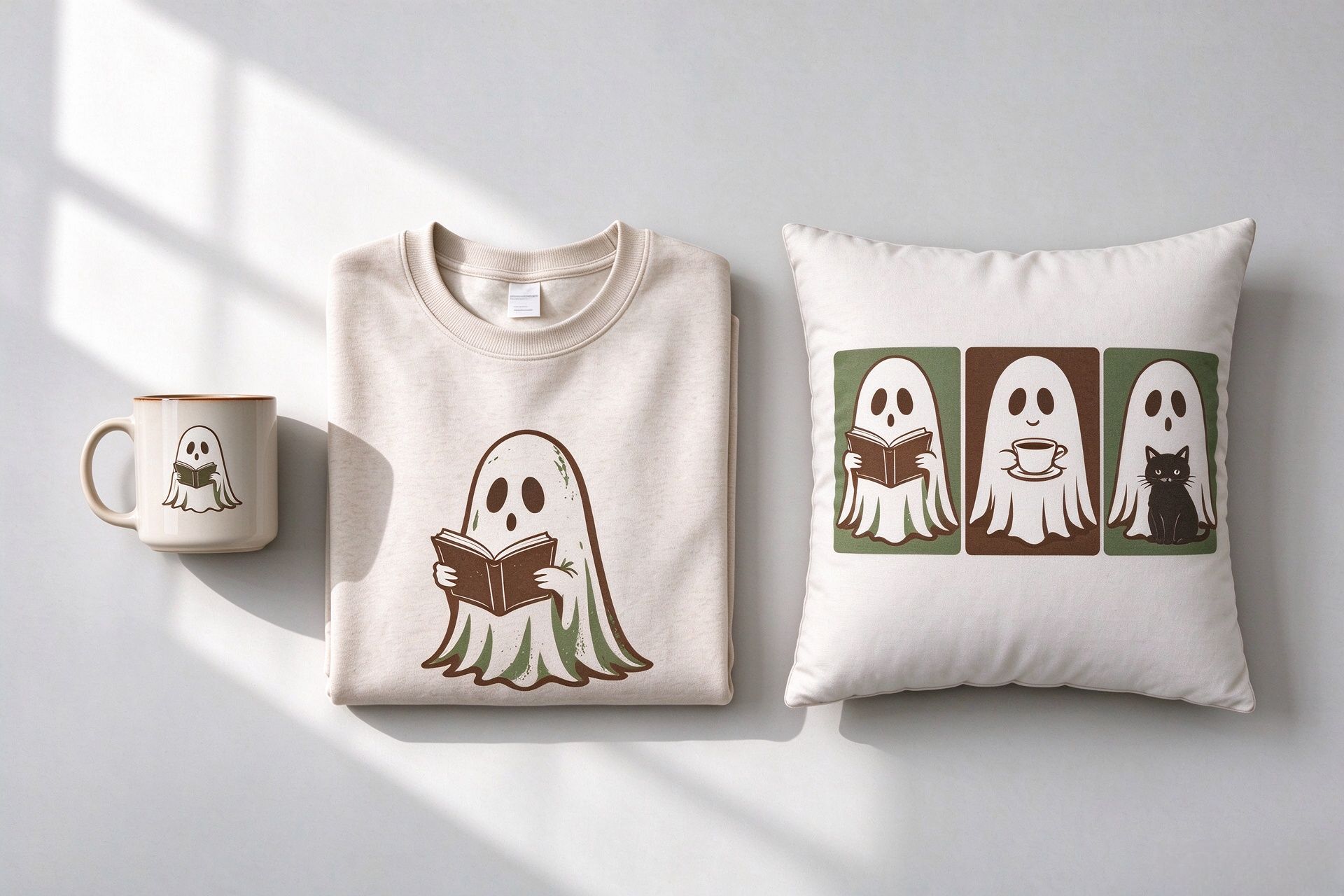
Every Halloween trend report has a loud section and a quiet section.
The loud section is where everyone goes. Pumpkins, witches, bats, orange and black, "Trick or Treat." That's the obvious stuff.
The quiet section is where the actual opportunity usually lives.
In PeaPrint's 2026 Halloween trend report, that quiet section is bookish ghost designs.
It doesn't shout. It doesn't have the strongest current-season signal. But it has something almost no other Halloween direction has: a reason to buy that exists outside of Halloween.
And that changes how you should think about the entire product line.
Let me explain.
Bookish Ghost Evidence: Historical Validation vs. Current Momentum
PeaPrint's report looked at Etsy US and English-language stores, targeting the 18–34 audience.
Two bookish ghost listings came up:
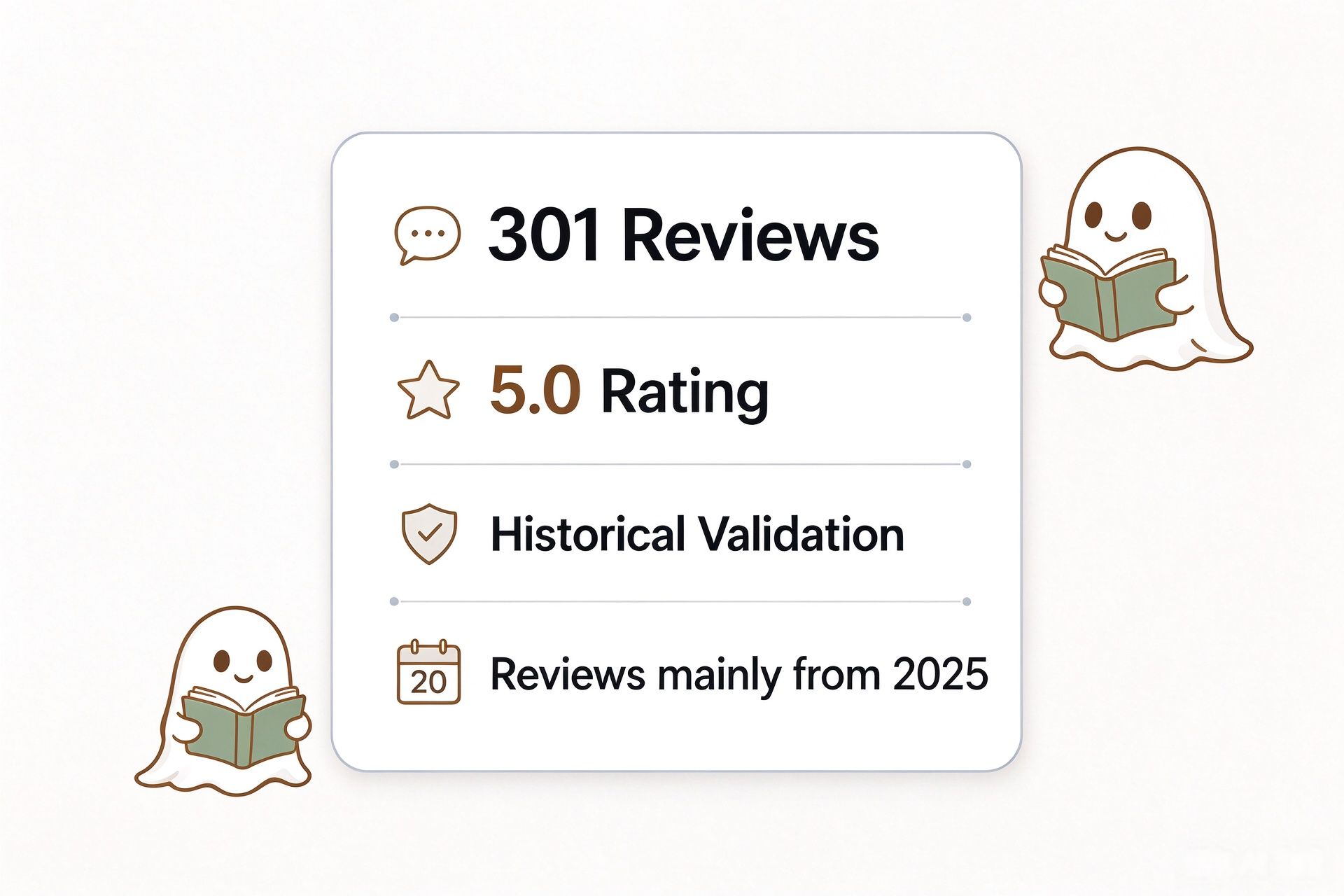
PoppyRosePrintCo's reading ghost tee:
- 301 item reviews
- 5.0 rating
- Displayed reviews are mainly from 2025
PetitRueDesigns' reading ghost sweatshirt:
- 16 item reviews
- 4.9 rating
- Reviews from 2024–2025
Now, here's how to read that correctly.
Neither listing has a current review the way SubArtsy's retro tee does. PoppyRosePrintCo's 301 reviews are a historical base. They prove the design concept worked. They don't prove it's working right now.
PetitRueDesigns is even weaker evidence — 16 reviews is a small sample, and it's spread across two years.
So bookish ghost is not the strongest current-season signal in the report.
But that's exactly why it's interesting.
Because the reason people buy a bookish ghost shirt has nothing to do with October 31.
It has to do with the fact that they're a reader.
And readers don't stop being readers on November 1.
The Core Argument: Bookish Ghost Isn't a Halloween Trend
Here's where most sellers get it wrong.
They see "ghost" in the design and immediately file it under Halloween.
But a ghost reading a book is not a Halloween product.
It's a reader identity product that happens to use a ghost as the visual device.
Think about it:
- A ghost holding a stack of books? That's a book lover. It could be sold in October, but it could also be sold in January, in April, during back-to-school season.
- A ghost drinking coffee with a book open? That's a cozy lifestyle design. It works in fall, but it also works in winter.
- A ghost curled up with a cat and a novel? That's a cat-and-book-person design. It has nothing to do with Halloween.
The buying reason isn't "I need a Halloween shirt."
The buying reason is "I love books and this speaks to me."
And that reason doesn't expire on November 1.
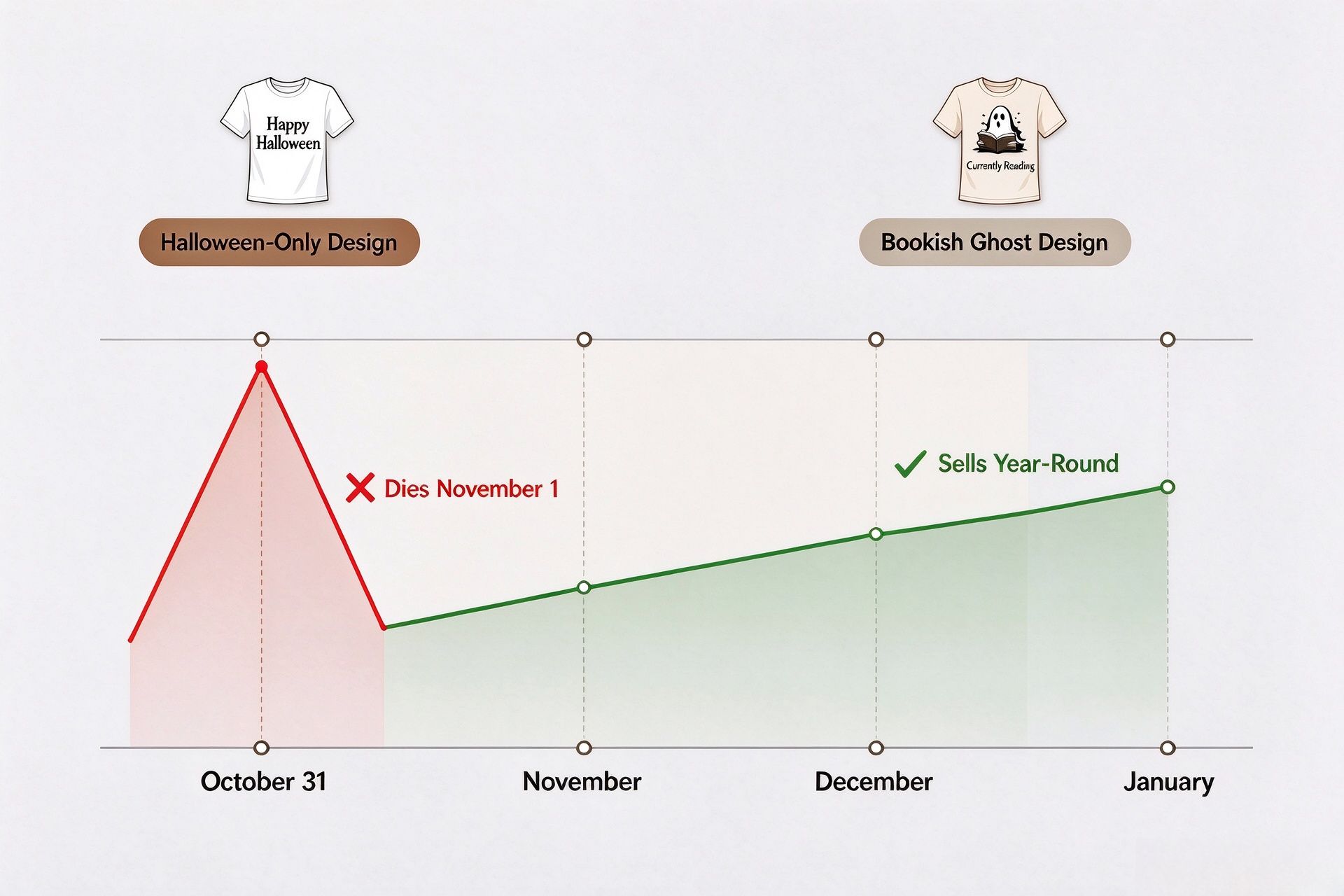
So the opportunity isn't "sell bookish ghosts during Halloween."
The opportunity is "use Halloween as the launch window, then keep selling the same design all year."
The only thing you have to do is remove the Halloween-specific language.
No "Happy Halloween." No "Trick or Treat." No jack-o'-lanterns. No bats.
Just the ghost, the books, and the reader identity.
That's the whole play.
Bookish Ghost Design System
Now let's get practical.
If you want to build a bookish ghost line that sells beyond October, here's the design system the report suggests.
Art Elements
Three directions work well:
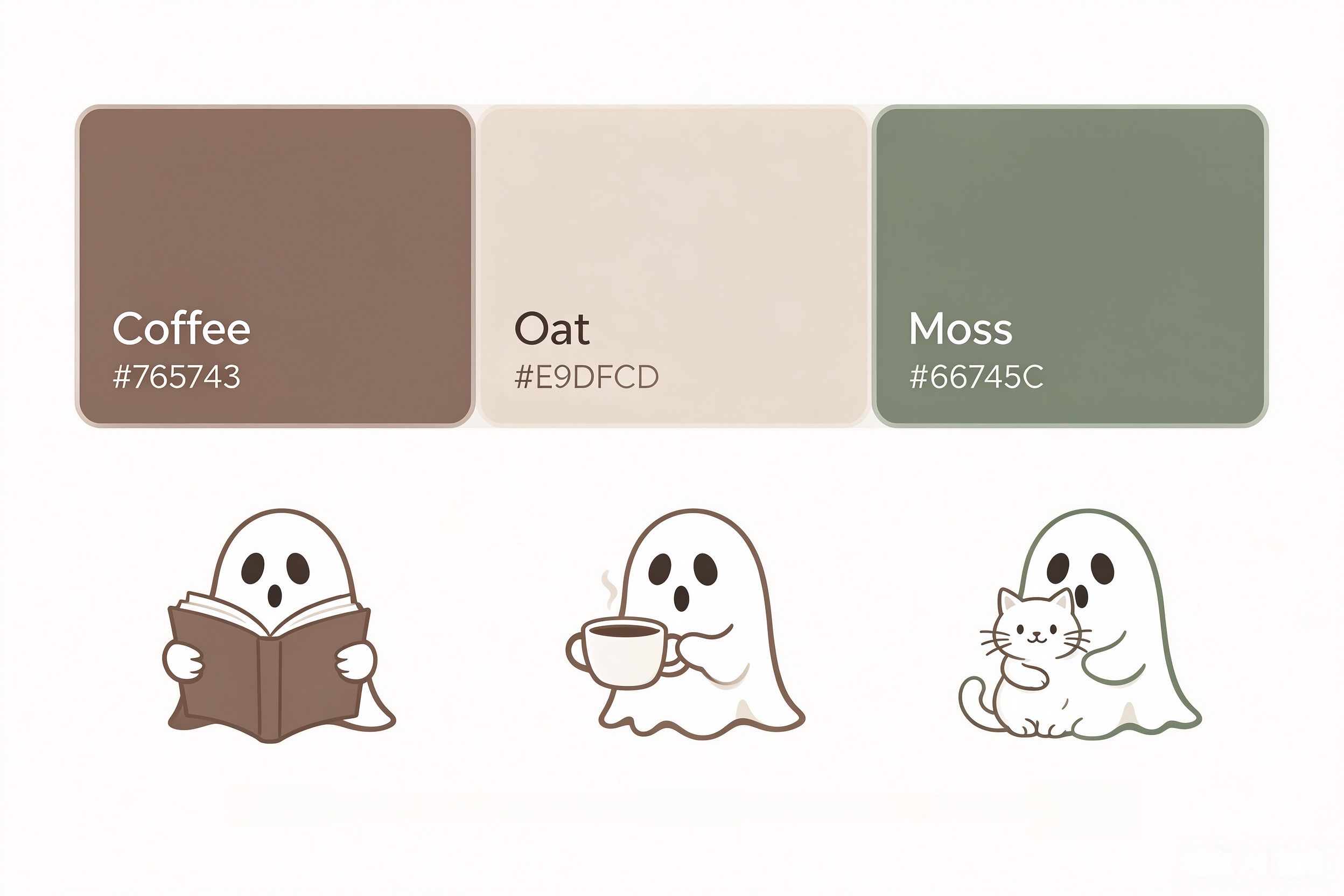
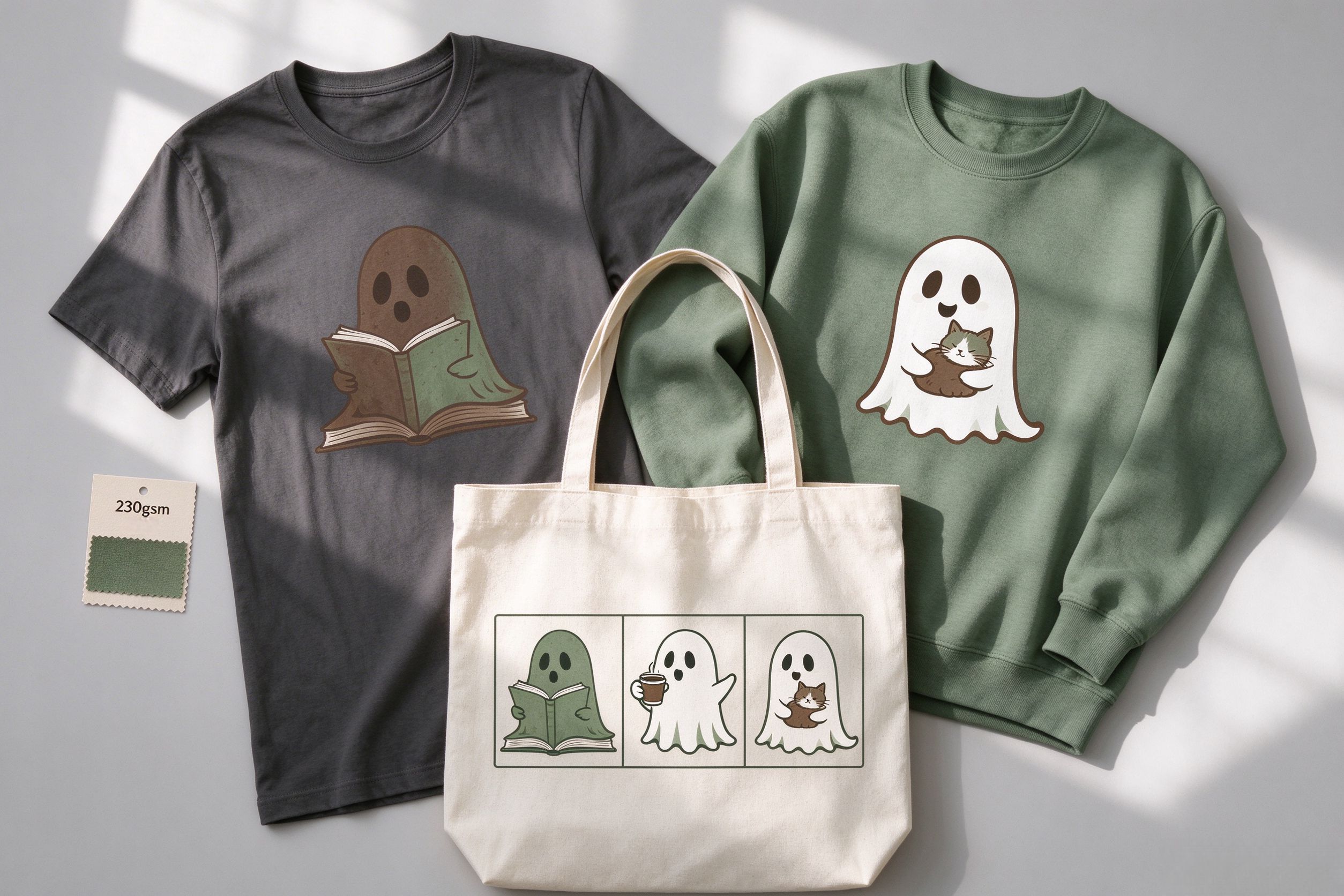
- Ghost reading a book — the core motif. Simple, recognizable, instantly readable.
- Ghost holding a coffee cup — the lifestyle extension. Adds a "cozy" layer.
- Ghost cuddling a cat — the audience crossover. Appeals to both book lovers and cat owners.
You can also use a three-panel layout — three ghosts in slightly different poses across the design. This is a format that's easy to produce variations of, because you're not redesigning the ghost each time. You're just changing the pose.
Or you can use a club emblem layout — a circular badge with the ghost in the center and text around the edge (like "Book Club" or "Currently Reading"). This works well for a niche audience like a book club or library community.
The composition principle is the same as retro Halloween: one main element, simple supporting details, clean negative space.
Don't over-design it. Bookish ghost works because it's cozy, not because it's busy.
Color Palette
The report specifies three colors:
- Coffee #765743 — the warm brown that reads "cozy" and "bookish"
- Oat #E9DFCD — the soft neutral that keeps the design from feeling cold
- Moss #66745C — the muted green that adds depth without competing
You can invert the palette for a light version: oat base, coffee and moss accents.
Both work. Test both.
Layout
The report suggests two layout approaches:
Three-panel action layout:
- Three ghosts in a row or a triangle
- Each ghost doing a different activity (reading, drinking coffee, holding a cat)
- Sparse decorative elements around the edges
This layout is flexible. You can swap the activities, the props, or the number of ghosts, and still keep the same structure.
Club emblem layout:
- A circular badge or shield
- The ghost in the center
- Text around the edge (like "Book Club" or "Reading Is My Therapy")
- Small decorative elements inside the circle
This layout works well for specific audiences — book clubs, libraries, reading challenges.
What Not to Do
Don't use Halloween-exclusive elements.
No jack-o'-lanterns. No bats. No "Happy Halloween" text. No orange-and-black color schemes.
The whole point is that this design can sell year-round. If you put Halloween language on it, you kill that.
Also: don't describe your product as "Halloween only" in your listing. Describe it as "bookish" or "reader" or "cozy." Let Halloween be the seasonal discovery window, not the product identity.
Building the Product Line on PeaPrint
Now you have the design system. Where do you put it?
The report recommends starting with three carriers:
- Tees
- Sweatshirts
- Reading totes
All three are confirmed PeaPrint products.
Why These Three First?
- Tees are the entry product. Low commitment, easy to test.
- Sweatshirts are the profit carrier. They sell at a higher price point, and the AOP option lets you use the three-panel layout across the full garment.
- Reading totes are the AOV booster. They're a natural fit for the bookish audience — tote bags are already a book lover accessory.
Start with one master design. Apply it to all three carriers.
That gives you three listings from one artwork.
Two Scenarios to Test
The report suggests testing two distinct scenarios:
Scenario 1: Book Club
- Ghost reading a book
- Club emblem layout
- Text like "Book Club" or "Currently Reading"
- Targets: book clubs, library communities, reading challenges
Scenario 2: Coffee and Books
- Ghost holding a coffee cup with a book open
- Three-panel action layout
- Targets: cozy lifestyle, BookTok, coffee lovers who read
Test both. See which scenario gets more clicks and saves.
Using PeaPrint's Design Tool
PeaPrint's design tool lets you upload your artwork and preview it on the product in real time.
For bookish ghost designs, here's the workflow:
- Create your master design at 300 DPI minimum
- Upload it to PeaPrint
- Select your carrier (tee, sweatshirt, or tote)
- Adjust positioning — for the sweatshirt, make sure the three-panel layout aligns with the seams
- Generate mockups for your listings
Sampling Checklist
Before you list anything, order a sample.
Here's what to check:
- Three-panel alignment on AOP sweatshirts — if the design crosses a seam, does it line up?
- Print clarity on dark fabric — if you're using a charcoal or dark green base, does the oat and coffee art show up clearly?
- Tote seam alignment — if the design crosses the seam, does it line up?
- Ghost legibility at actual size — does the ghost read as a ghost, or does it look like a blob?
If the sample fails, fix the design before you promote it.
Listing and SEO
Now you have a product. How do you list it?
Title Structure
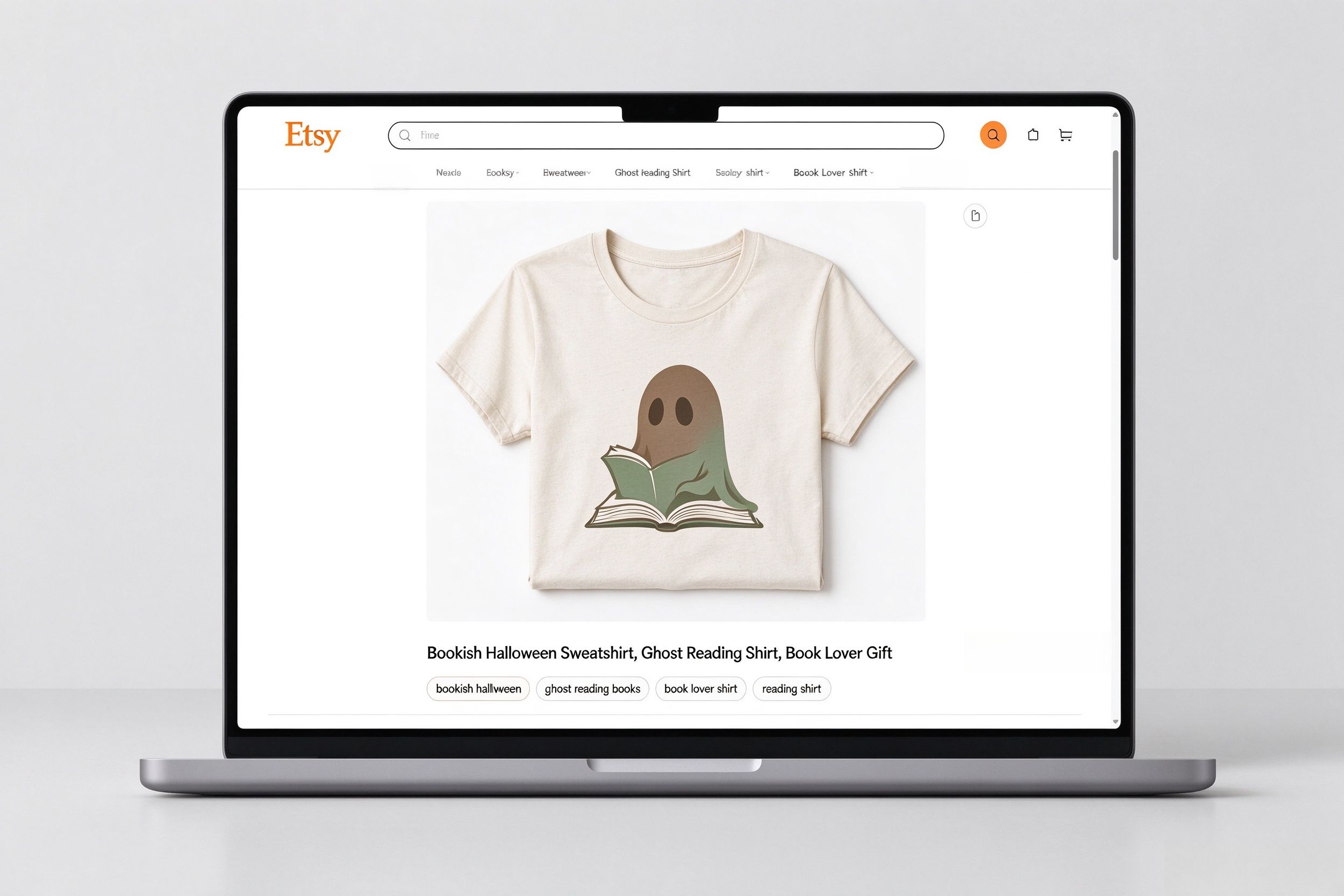
The report gives a specific example pattern:
Bookish Halloween Sweatshirt, Ghost Reading Shirt, Book Lover Gift
That's the pattern:
- Primary keyword first (bookish halloween sweatshirt)
- Secondary keyword second (ghost reading shirt)
- Audience keyword third (book lover gift)
- Comma-separated, under 140 characters
Don't stuff keywords. Write it like a buyer would search.
Tag Strategy
Use all 13 tags. Mix broad and specific:
3–4 broad:
- bookish halloween
- ghost reading
- book lover shirt
- reading shirt
3–4 specific:
- ghost reading books
- bookish sweatshirt
- library shirt
- book club shirt
3–4 audience/scenario:
- book lover gift
- bookish gift
- reading gift
- cozy bookish
Community Targeting
This is where bookish ghost designs really differentiate themselves.
The report specifically mentions targeting:
- Book clubs — they buy in groups. A single design can lead to multiple sales.
- Libraries — library staff, library lovers, library events.
- BookTok — the reading community on TikTok is huge and highly engaged.
When you write your listing description, speak to these communities directly.
Instead of "cute ghost shirt," say "for the reader who always has a book in their bag."
Instead of "Halloween ghost design," say "for book clubs, library lovers, and anyone who reads past their bedtime."
That language converts.
Initial Test Plan
The report recommends:
Two scenarios × two base colors = four listings
So:
- Book Club scenario on oat base
- Book Club scenario on charcoal base
- Coffee and Books scenario on oat base
- Coffee and Books scenario on charcoal base
Four listings. Same layout structure. Different scenarios and colors.
That gives you clean comparison data.
From Reading Ghost to Year-Round Bookish Products
This is the most important section.
If you only read one part of this article, read this.
The whole reason bookish ghost designs are interesting is that they don't have to die on November 1.
You just have to remove the Halloween-specific language.
Here's how:
Step 1: Keep the core motif.
The ghost reading a book is not a Halloween design. It's a bookish design. Keep it.
Step 2: Remove the holiday language.
If your design says "Happy Halloween" or "Trick or Treat," remove it. Replace it with bookish language: "Currently Reading," "Book Club," "One More Chapter."
Step 3: Adjust the color palette if needed.
The coffee-oat-moss palette works year-round. You don't need to change it.
Step 4: Extend the design to other products.
Once you have a design that works on a tee, a sweatshirt, and a tote, you can apply it to other bookish products: bookmarks, reading pillows, book sleeves.
Step 5: List it under bookish keywords, not Halloween keywords.
This is critical. If you want the design to sell in January, it needs to be discoverable in January. Use keywords like "bookish shirt," "reader gift," "book lover sweatshirt" — not just "halloween ghost shirt."
That's how you turn a seasonal trend into a year-round product.
FAQ
What makes bookish ghost different from regular Halloween designs?
Regular Halloween designs are holiday-specific — they say "Happy Halloween" or feature scary imagery. Bookish ghost uses a ghost motif combined with reading and coffee elements, which makes it a reader identity product that can sell year-round.
Can I really sell a ghost design in November?
Yes — if the design doesn't say "Happy Halloween" or "Trick or Treat." A ghost reading a book is a bookish aesthetic, not a holiday product. It can sell through November, December, and into next year.
How many listings should I start with?
The report recommends four listings: two scenarios × two base colors. That gives you enough data to see which scenario and which color performs better.
What PeaPrint carriers should I use for bookish ghost?
Start with tees, sweatshirts, and reading totes. All three are confirmed PeaPrint products.
How do I target book clubs and libraries?
Use language in your listing that speaks directly to those communities. "For book clubs," "library lover gift," "currently reading." Those phrases convert better than generic "cute ghost shirt."
What if my sample doesn't look right?
Fix the design before promoting it. Common issues: three-panel misalignment on AOP sweatshirts, ghost legibility at actual size, or print clarity on dark fabric.
So, What's the Real Opportunity Here?
Most sellers will design a bookish ghost shirt, list it in September, sell a few in October, and then forget about it.
That's fine. It works.
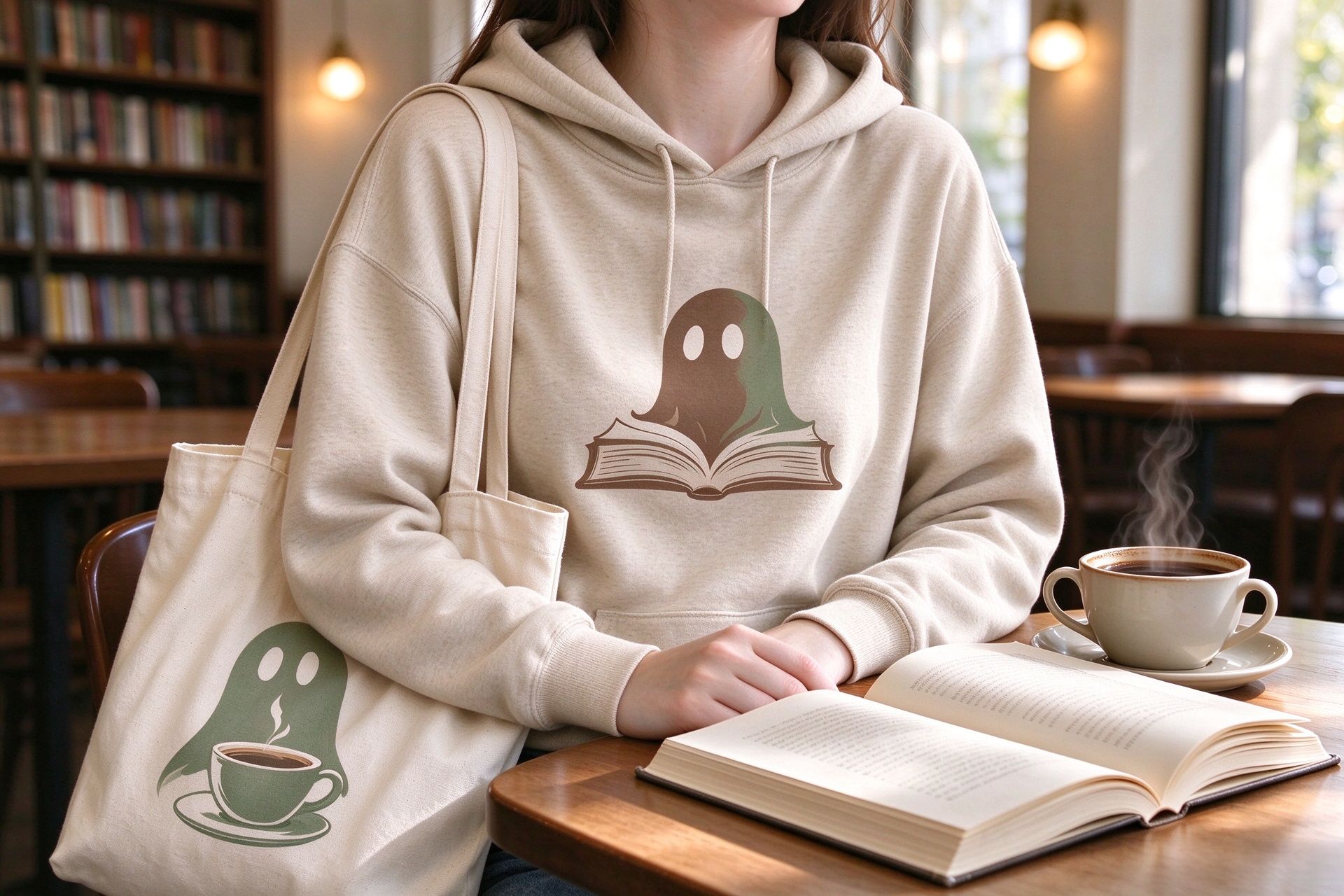
But the sellers who understand that bookish ghost is a reader identity product — not a Halloween product — will keep selling it all year.
They'll remove the holiday language. They'll keep the ghost. They'll extend the lifecycle.
That's the difference between a seasonal trend and a year-round product.
And it starts with one design decision: make it about reading, not about October 31.