How Custom All Over Print Clothing Stands Out in a Saturated Market
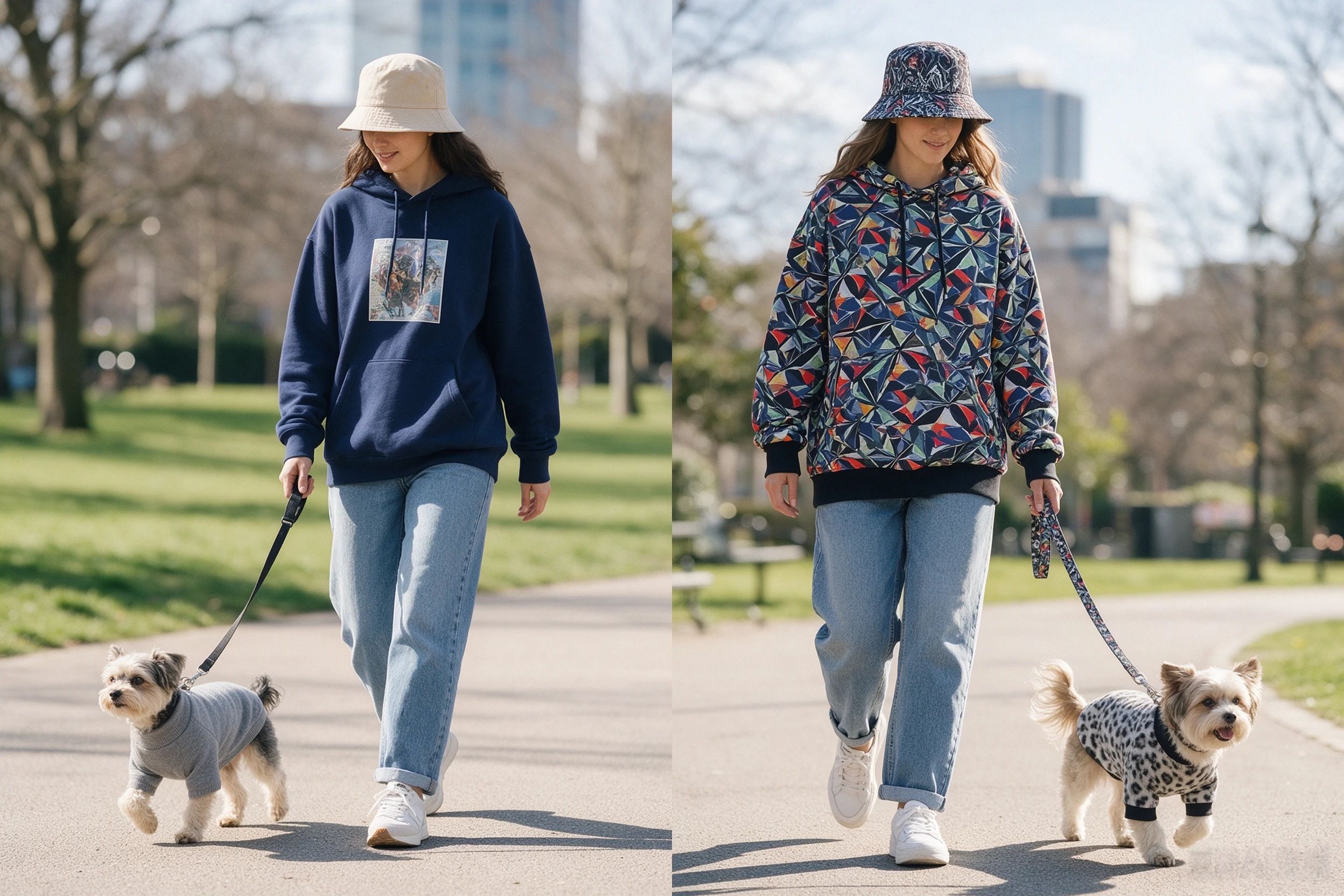
If you sell print on demand, you already know the problem with basic t-shirts. Everyone sells them. The designs are usually small chest prints. The colors are limited. And the only way to compete is to drop your price lower than the next seller. That's a race you can't win.
But there's a different path. Custom all over print gives you a way to break out of the price war entirely. Instead of competing on price, you compete on visual impact. Instead of selling a basic product, you sell a piece of wearable art.
This guide shows you exactly how to use all over print clothing to differentiate your brand, attract better customers, and build a business that doesn't rely on racing to the bottom.
Why All Over Print Is Your Ultimate Differentiation Tool
The basic t-shirt market is completely saturated. Search for any popular niche on Etsy, and you'll find thousands of listings with the same small chest prints in the same standard colors. When products look the same, buyers choose based on price. That's how you end up selling a t-shirt for $18 and making $3 in profit.
Custom all over print breaks that cycle. Here's the data you need to know:
| Metric | Standard T-Shirt | AOP T-Shirt |
| Print Coverage | 10% (chest only) | 100% (front, back, sleeves) |
| Retail Price | $20–$30 | $30–$55 |
| Perceived Value | Low — basic apparel | High — wearable art |
| Competition | Very high | Moderate |
| Social Shareability | Low | High |
An AOP t-shirt typically sells for 40% to 60% more than a standard chest-print t-shirt. Why? Because the design covers the entire garment. It's not just a logo on a shirt. It's a completely different visual experience.
There's also a consumer trend called "Printmaxxing." Buyers are moving away from minimalism and toward more pattern, more color, and more self-expression. They want products that feel bold and intentional. AOP delivers exactly that.
The market data backs this up. The global AOP sportswear market is projected to grow at a CAGR of 14% through 2026. This isn't a small niche. It's a fast-growing segment of the apparel industry, and most print on demand sellers are still ignoring it.
How AOP Changes the Game
When you use all over print clothing, you're not just printing on a different area of the shirt. You're changing the entire product.
A standard t-shirt with a chest print looks like a t-shirt with a logo. An AOP t-shirt looks like a designed garment. The pattern wraps around the body. It flows across the sleeves. It creates a cohesive, immersive look that you simply can't achieve with a small placement print.
That visual difference is what allows you to charge more. And it's what makes your product shareable on social media.
The Four Dimensions of AOP Differentiation
You can use AOP to stand out in four different ways. The most successful sellers use more than one.
1. Visual Differentiation
A standard print covers maybe 10% of a shirt. An all-over print covers 100% of it. That's a massive visual difference. When someone wears an AOP garment, people notice. It's not a shirt with a design. It's a design that happens to be a shirt.
This also makes your products more shareable. People take photos of bold, unique clothing. They post them on Instagram and TikTok. That free exposure is something a basic chest-print t-shirt will never generate.
2. Pricing Differentiation
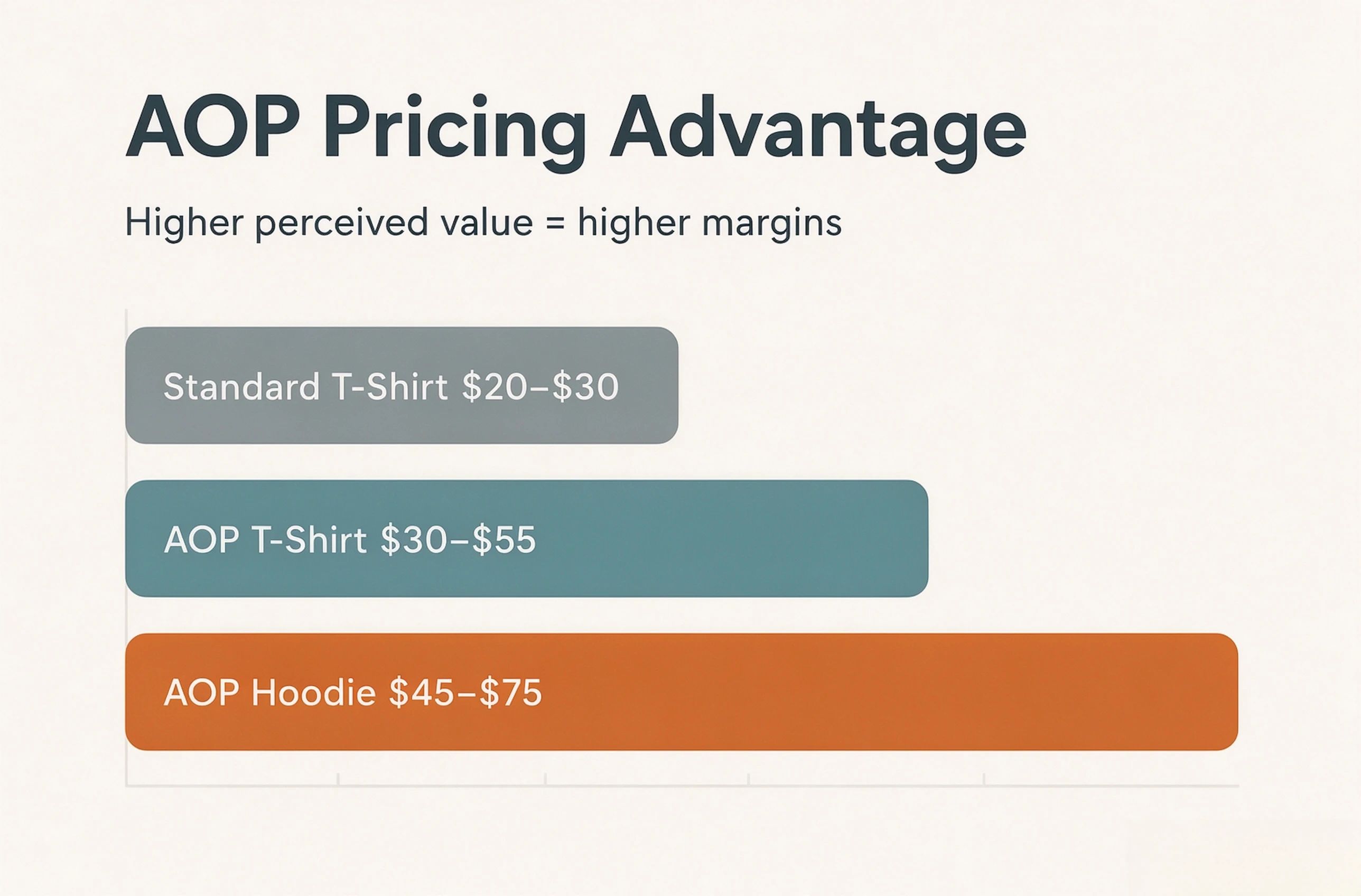
Look at the price ranges for different product types:
| Product Type | Price Range | Market Condition |
| Standard T-Shirt | $20–$30 | Red ocean — price war |
| AOP T-Shirt | $30–$55 | Premium niche |
| AOP Hoodie | $45–$75 | High-margin zone |
When you move into AOP, you stop competing on price and start competing on design.
3. Audience Differentiation
AOP attracts a different type of buyer. These are people who want to stand out, not blend in. They're willing to pay more for something that feels unique.
This includes Gen Z and Millennial shoppers. Research shows that 63% of them are willing to pay more for customized products. It also includes brand owners and creators who need differentiated products for their own audiences.
4. Category Differentiation
Most sellers are fighting over the same categories: basic t-shirts, basic hoodies, and embroidered hats. You can differentiate by taking AOP into less crowded categories.
Instead of a standard t-shirt, sell an AOP t-shirt. Instead of an embroidered hat, sell an AOP bucket hat. Look for blue ocean categories like AOP tote bags, AOP leggings, and AOP swimwear. These are areas where competition is low and visual impact is high.
AOP Differentiation Strategies by Business Model
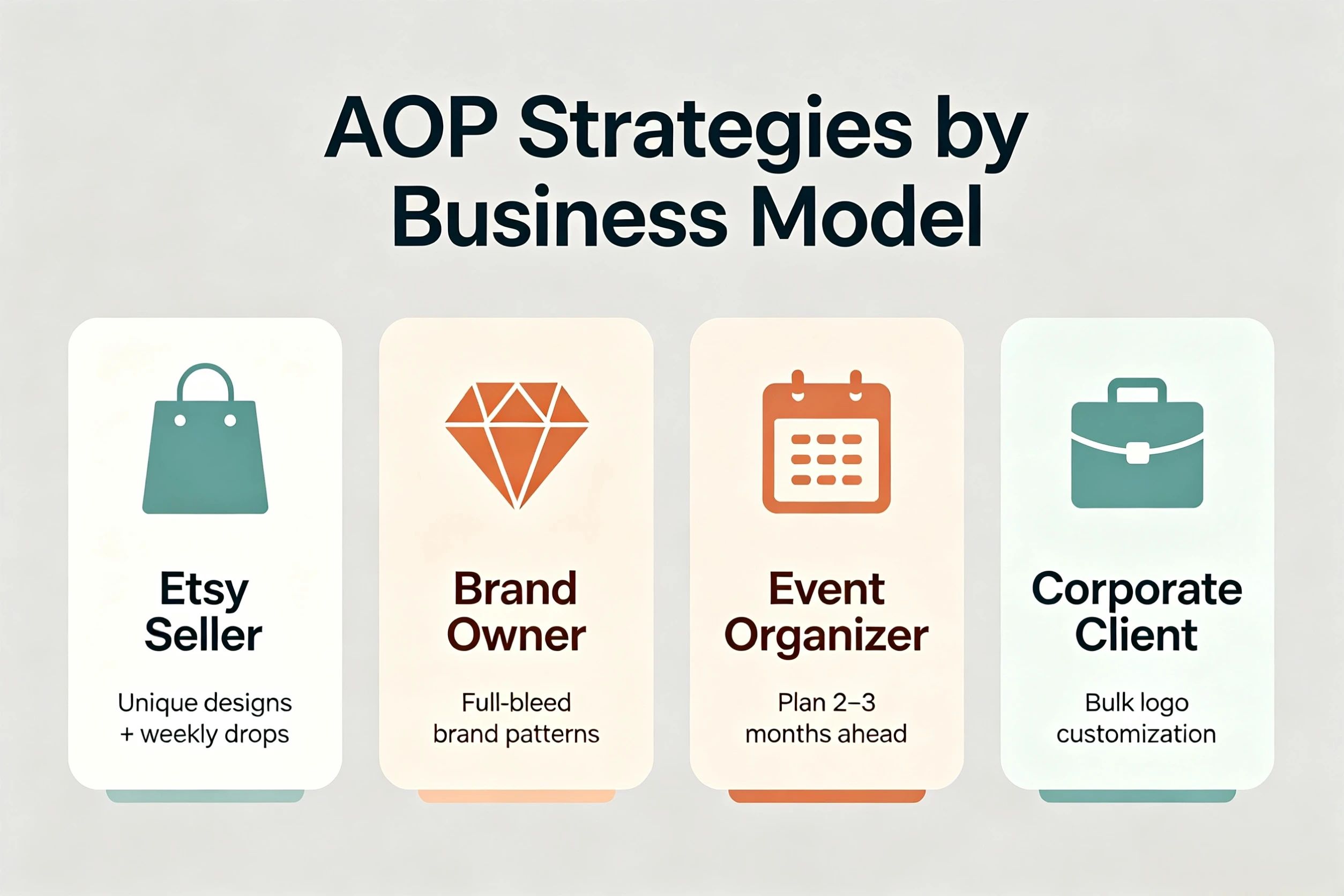
Different sellers need different strategies. Here's how to apply AOP based on your business model.
| Business Model | AOP Differentiation Strategy | Key Action |
| Etsy Seller | Unique designs + limited editions | Weekly drops, social media showcases |
| Brand Owner | Full-bleed brand patterns + full product line | Build a visual identity system |
| Event Organizer | Full-bleed event theme designs | Plan 2–3 months in advance |
| Corporate Client | Full-bleed logo display + team customization | Leverage bulk order pricing |
For Etsy sellers, the key is speed and novelty. You want to release new designs regularly and show them off on social media. For brand owners, consistency is more important. You want a recognizable visual style that carries across every product. For event organizers, timing is everything. You need to plan ahead so your AOP apparel arrives before the event. For corporate clients, AOP turns a standard logo into a full-branded experience.
5 Steps to Execute Your AOP Differentiation Strategy
Here's a practical roadmap you can follow.
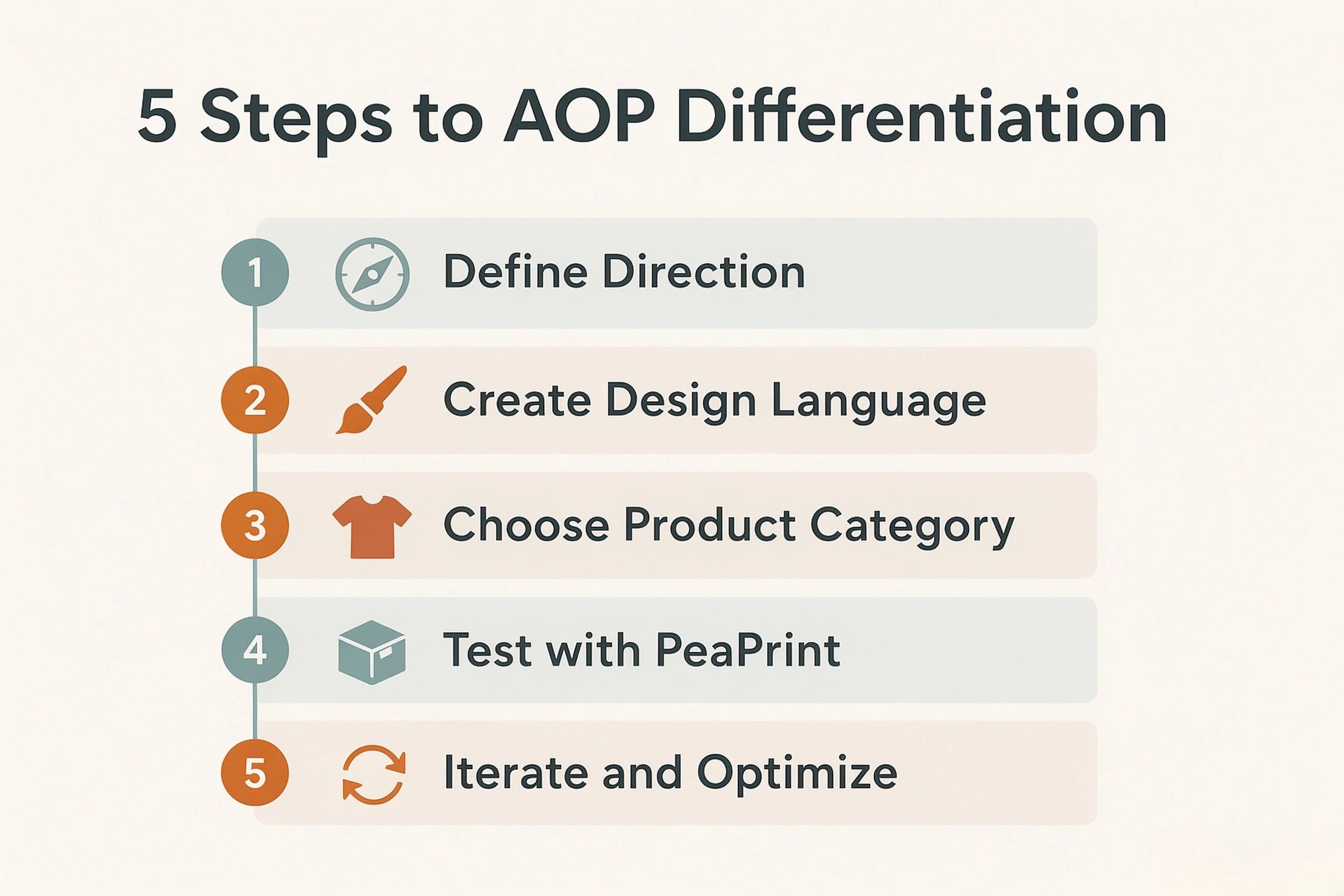
Step 1: Define Your Differentiation Direction
Are you competing on visuals, pricing, audience, or category? You don't have to pick just one, but you should know which one is your primary focus. If you're a small Etsy seller, visual differentiation is usually the fastest path. If you're a brand, audience and category differentiation might matter more.
Step 2: Create a Unique Design Language
Don't copy what's already selling. Build a design style that's yours. It could be a specific color palette, a recurring motif, or a signature illustration style. The goal is for someone to see your product and know it came from you.
Step 3: Choose the Right Product Categories
Start with one or two categories. AOP t-shirts and AOP hoodies are the most popular starting points because they have the highest demand. But don't be afraid to test AOP tote bags or AOP leggings. Lower competition means easier ranking.
Step 4: Use PeaPrint to Test Quickly
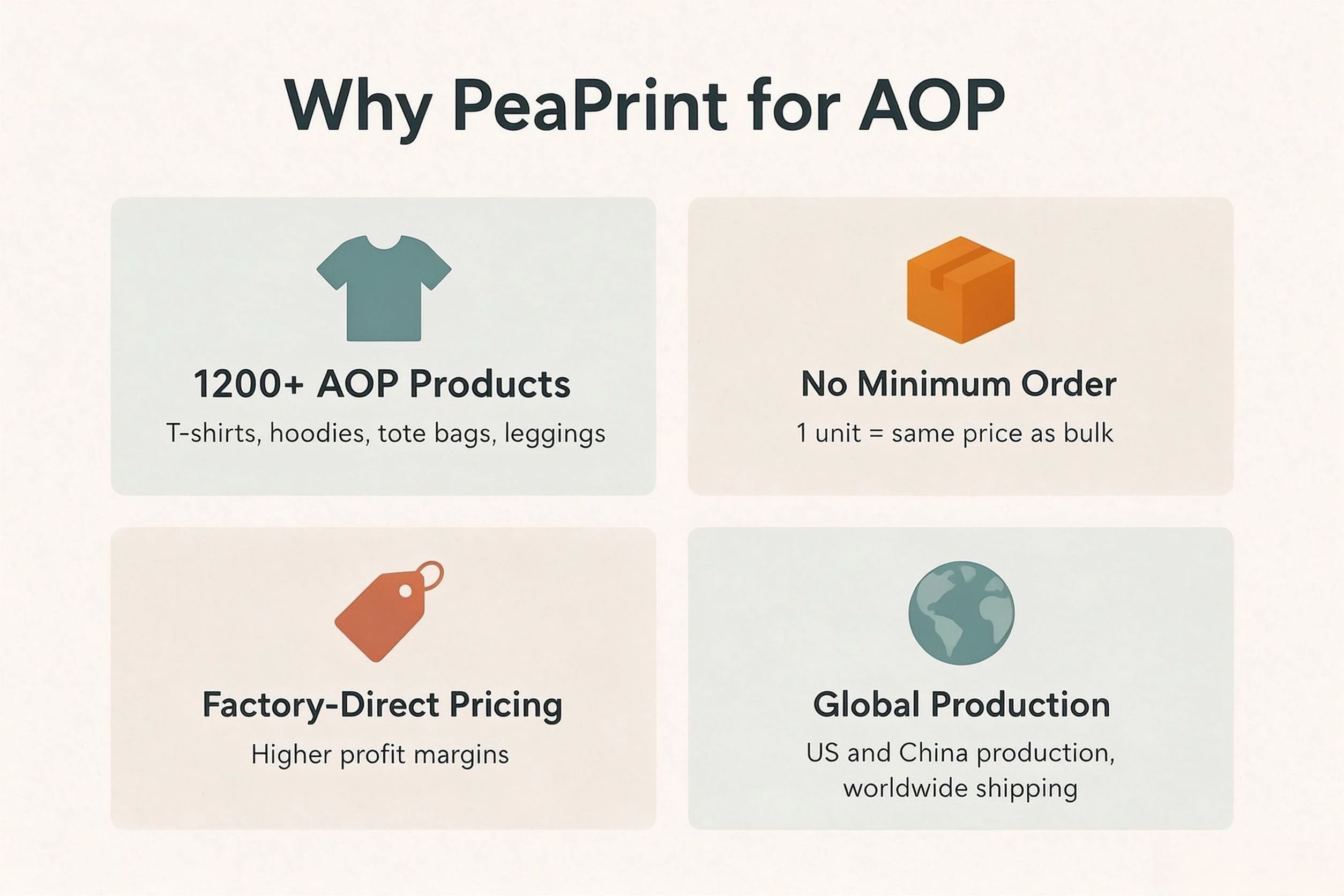
This is where PeaPrint changes the game. You can order just one unit. And here's the best part: the price for one unit is exactly the same as the price per unit for multiple units. You can test five different designs by ordering five single samples, and your cost per sample is identical to what it would be in bulk.
That means zero risk. You don't have to guess which designs will sell. You order one, test it, and scale what works.
Step 5: Iterate and Optimize
Pay attention to what sells. Double down on the designs that get the most clicks and favorites. Drop the ones that don't. Keep refining your design language based on real market feedback.
Real-World Success Cases
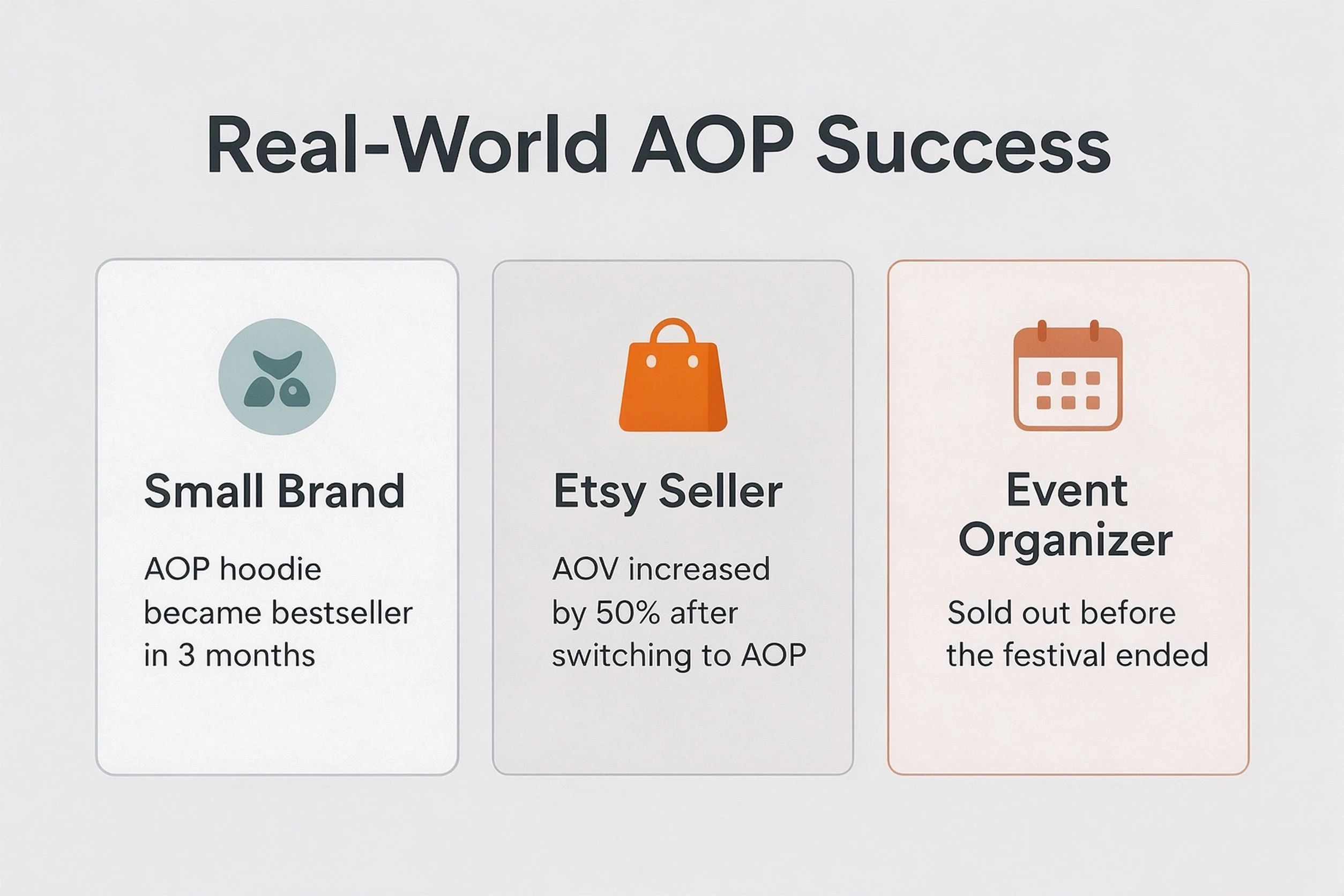
Case 1: A small brand using AOP hoodies to build recognition.
A new apparel brand started with a single AOP hoodie design featuring a bold, original pattern. Within three months, the hoodie became their bestseller. They expanded into AOP sweatpants and AOP tote bags using the same pattern, and the consistent visual identity made the brand instantly recognizable.
Case 2: An Etsy seller standing out with full-bleed designs.
An Etsy seller was stuck selling basic t-shirts in a crowded niche. They switched to custom all over print and started releasing one new AOP design per week. Within two months, their AOP listings were ranking higher than their old basic t-shirts, and their average order value increased by 50%.
Case 3: An event organizer using AOP to unify visuals.
A music festival organizer needed apparel that matched the event's branding. They used AOP to create full-bleed designs that covered entire hoodies and t-shirts. The result was a cohesive visual identity that made attendees feel like part of the event. They sold out before the festival ended.
Why PeaPrint Is Your AOP Differentiation Partner
PeaPrint is built for sellers who want to differentiate. We offer:
- A full AOP product line. T-shirts, hoodies, tote bags, leggings, and more.
- No minimum order quantity. You can order a single unit to test a design. And the price for one unit is exactly the same as the per-unit price for multiple units. That means zero-risk testing. You can test multiple designs at the same cost.
- Price advantages. Factory-direct pricing means lower production costs and higher profit margins for you.
- Global production and fulfillment. We have production sites in the US and China, with most orders produced in China and shipped worldwide for reliable global delivery.
Frequently Asked Questions
What is custom all over print?
Custom all over print is a production method where a design covers the entire surface of a garment or product, rather than just a small area. It uses a dye sublimation process that bonds the ink to the fabric at a molecular level. The result is a seamless, vibrant pattern that won't crack, peel, or fade.
Is all over print clothing more expensive than standard printing?
The production cost for AOP is usually higher than a basic chest print. However, the retail price is also much higher. AOP t-shirts often sell for 40% to 60% more than standard t-shirts. The higher perceived value and visual impact justify the premium price.
Can I test AOP designs without ordering in bulk?
Yes. With PeaPrint, there is no minimum order quantity. You can order a single unit to test a design. And the price for one unit is exactly the same as the per-unit price for multiple units. This means you can test multiple designs with zero risk and zero inventory.
Does AOP work on 100% cotton?
No. The dye sublimation process requires synthetic fibers, specifically polyester. Most AOP garments use 100% polyester or a high-polyester blend. If you try to print AOP on 100% cotton, the colors will be dull and will wash out over time.
How do I start using AOP for my business?
Start by defining your differentiation direction. Then create a unique design. Choose a product category like AOP t-shirts or AOP hoodies. Upload your design to PeaPrint and order a single sample. Once you verify the quality, list it on your store and start selling.
Ready to Differentiate with Custom All Over Print?
The saturated market is a problem only if you sell what everyone else is selling. Custom all over print gives you a way out. It lets you compete on visuals instead of price. It lets you attract buyers who want something unique. And it lets you build a brand that stands out.
Your next step is simple. Sign up for PeaPrint and create your free account. Upload one AOP design. Order a single sample. See the quality for yourself. Then start building a product line that no one else can copy.
Start using AOP to build your differentiation strategy with PeaPrint today.