12 Print-on-Demand Statistics and Trends to Watch in 2026
Is print-on-demand still worth getting into, and where is the industry headed? These are two of the biggest questions for aspiring entrepreneurs who are still weighing their options and sellers who are already running a business. We've put together a list of print-on-demand statistics and trends for 2026 to help you make informed decisions about custom products, pricing, platform selection, and growth strategies. Ready to dive in? Let's explore the latest data shaping the POD industry.
1. The Global Print-on-Demand Market Is Growing Rapidly
The global print-on-demand market is expected to be worth $32.79 billion in 2026 and reach $252.34 billion by 2035, representing an annual growth rate of around 25.45%. There is no doubt that POD remains one of the fastest-growing segments of e-commerce.
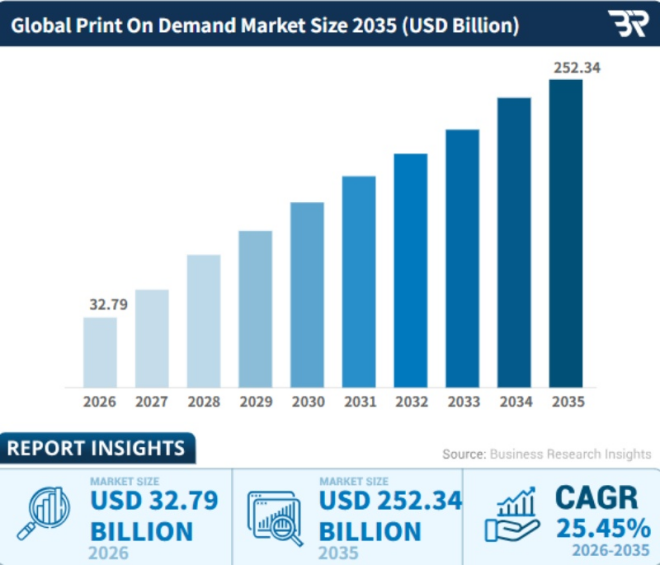
Source: business research insights
Consumer behavior is shifting. More shoppers are looking for personalized, unique products while also expecting faster delivery and less waste. Print-on-demand solutions like PeaPrint can meet all three needs. POD enables customization, and because products are made only after an order is placed, it can lower costs and reduce waste from unsold inventory. For entrepreneurs, this model reduces risk and makes it easier to launch new products quickly in response to changing trends.
2. Major Print-on-Demand Markets Around the World Have Distinct Characteristics
North America is the clear leader in the global POD market. According to market research firms such as Grand View Research and Mordor Intelligence, North America, led by the United States, accounts for approximately 34% to 40% of the global POD market. The region has a mature e-commerce infrastructure and widespread online shopping habits. Leading POD platforms such as Printful, Printify, and Zazzle are headquartered in the U.S. or have key markets there.
Asia-Pacific, particularly China and India, is the fastest-growing market. Strong textile and digital printing supply chains in these countries provide significant cost advantages. Supported by lower costs, rising internet penetration, mobile shopping, and broader e-commerce adoption, Asia-Pacific has one of the highest compound annual growth rates globally, with projections ranging from 24% to 28% or higher.
Europe is a leader in sustainability. Driven by strict environmental regulations and a focus on carbon emissions, the region is at the forefront of adopting sustainable materials, eco-friendly inkjet technologies, and localized green microfactories. For sustainable brands, Europe represents both an opportunity and a challenge.
3. Demand for Personalized Products Is a Major Driver of POD Market Growth
According to Fortune Business Insights, the global personalized gifts market is expected to reach $35.95 billion in 2026 and grow to $64.51 billion by 2034, at an annual growth rate of around 7.58%.
Consumers increasingly prefer meaningful, personalized products over mass-produced items from traditional retailers. Categories such as custom apparel, accessories, and personalized home decor are seeing rapid growth.
With POD, products are made to order, so sellers don't need to manufacture in bulk or hold inventory in advance. Once a product or design starts generating consistent orders, you can also consider keeping a small amount of stock on hand. Because custom products often carry emotional significance, they can help strengthen customer loyalty and encourage repeat purchases.
4. More Consumers Are Choosing Sustainable Products
Sustainable products are moving from a niche trend into the mainstream. The global sustainable clothing market is currently valued at about $12.44 billion and is projected to reach $27.96 billion by 2034, growing at roughly 11% annually. This points to steadily rising demand for eco-conscious products, with sustainability increasingly becoming a factor in purchasing decisions.
This shift is reflected not only in market size but also in consumers' willingness to pay. Data shows that 80% of consumers say they're willing to pay more for sustainable products, with an average premium of about 9.7%. Meanwhile, 46% say they're already buying more sustainable products to reduce their environmental impact.
However, consumers' environmental awareness does not mean they are willing to compromise on product quality for a "green" label. When making purchases, they still care about materials, durability, and whether sustainability claims are credible. For POD sellers, rather than relying on vague terms like "eco-friendly" or "green," it is better to highlight specific product attributes, such as the percentage of organic or recycled materials, along with relevant certifications. Choosing products with clear sustainability attributes and presenting their materials and certifications transparently on product pages can help sellers better meet this growing demand.
5. According to Ahrefs, "Print on Demand" Gets More Than 111,000 Searches a Month Worldwide
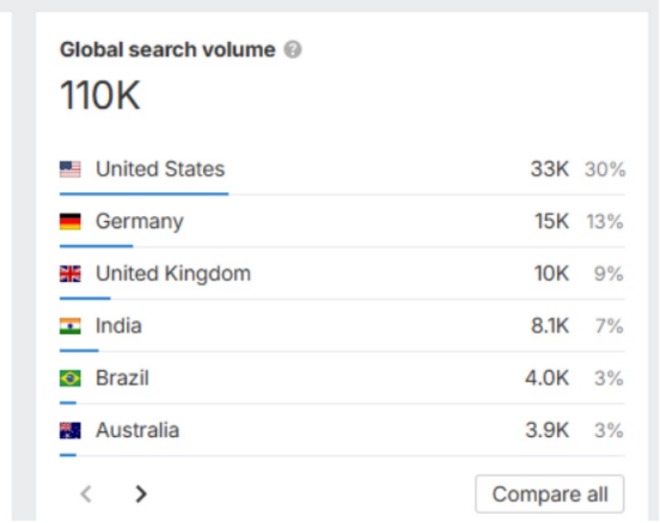
According to Ahrefs, the keyword "print on demand" gets 110,000 monthly searches on Google, with the United States accounting for about 30% and ranking as the country with the highest search volume. These figures suggest that many sellers are exploring this business model and that demand for customized products is growing.
Building a brand through traditional manufacturing can be risky, so more entrepreneurs are turning to print-on-demand. To succeed, you need a clear market position and strong products.
6. Most POD Sellers Have Profit Margins of 20% to 40%
Most POD sellers have an average profit margin of around 20%, while high-performing sellers can reach 40%. These margins can help cover payment processing and marketing costs while leaving room for profit.
Margins vary by product and niche. Basic products may have margins of just 10%, while certain niche markets can reach 50% or more. With PeaPrint, you can purchase a hoodie for $40, including shipping, and sell it for $55-$70. Our pricing can give you profit margins roughly 10%-15% higher than those offered by competitors in most categories.
7. The Most Popular POD Categories Are Apparel, Followed by Home Decor, Drinkware, and Accessories
Based on current market performance, custom apparel accounts for about 39.7% of the overall POD market. These categories have remained popular because they are everyday products people use frequently, buy as gifts, or refresh often, and they offer plenty of room for customization.
Within apparel, T-shirts, activewear, leggings, and hoodies remain popular. T-shirts are a go-to choice for testing new ideas thanks to their low barrier to entry, established demand, and wide range of design possibilities.
Meanwhile, home decor is one of the fastest-growing POD categories and is expected to continue growing quickly in the coming years. Products such as wall art, throw pillows, and blankets lend themselves to personalized designs and serve a range of use cases, including home styling, seasonal decorating, and gift-giving. Drinkware and accessories also have steady demand and are well suited to niche products built around holidays, hobbies, identity, and personal expression.
However, popular categories usually come with more intense competition. Apparel has the largest market share, but it is also one of the most crowded areas for POD sellers. Rather than chasing only the highest-volume products, look for opportunities in less competitive niches, such as pet products and baby clothing.
8. Etsy Has 5.7 Million Active POD Sellers
Etsy is home to a large number of POD sellers and is one of the major platforms for selling print-on-demand products. Its production partner policy allows sellers to work with external manufacturers, making it possible to offer custom apparel, home decor, and accessories without handling fulfillment themselves.
The large number of sellers means there's a sizable market, but also intense competition. To stand out, you need to find your niche and earn customers' trust through distinctive designs and product quality. Despite the competition, Etsy remains a common starting point for many new entrepreneurs. PeaPrint integrates directly with Etsy, so you can connect your shop and sync orders automatically.
9. PayPal Is the Preferred Payment Gateway for POD Stores
PayPal accounts for 45% of the global payment market and is a preferred payment method among consumers worldwide. Apple Pay, Shop Pay, and Google Pay are also popular payment options. Some shoppers say they will not buy from stores that do not support PayPal, making it close to essential when choosing a payment gateway. Offering several trusted payment options can also directly improve conversion rates.
10. 59% of Online Sales Worldwide Are Made on Mobile Devices
Over the past decade, advances in e-commerce technology have helped consumers develop mobile shopping habits, and online shopping has become the preferred way to shop for many people. Globally, 60% of e-commerce sales come from mobile devices, and this share is expected to reach 67% by 2030.
This means many customers discover your store, browse products, and check out on phones and tablets. Your POD store therefore needs to be mobile-optimized. Even if your site looks great on desktop, mobile shoppers may encounter slow loading times or a broken layout. These issues can significantly lower conversion rates.
11. Generative AI Is Closing the Gap Between Small Businesses and Better-Funded Brands
Within the POD industry, generative AI is turning tasks that once required significant time, labor, and funding into processes that can be completed efficiently with computing power and well-crafted prompts. This technological shift is breaking down resource barriers that have long favored large brands. Reports show that AI workflows can increase sales by as much as 16.3%, with the strongest effects in customer service and search.
For example, AI chatbots can handle customer questions that small teams may not have the capacity to answer, helping businesses save significantly on operating costs and redirect budgets to where they are needed most.
With image-generation tools such as Midjourney and effective prompt engineering, small independent teams can create commercially viable designs and high-quality product mockups within minutes, enabling them to test products frequently at almost no cost.
12. Only 24% of POD Stores Are Still Operating After Three Years
A 24% survival rate may sound low, but it is fairly common for small businesses. As competition intensifies and operating costs rise, survival rates tend to fall over time. Starting a POD business is relatively easy, but keeping it running profitably can be much harder. Success requires more than launching new products; you also need to make sound business decisions based on market changes, keep track of consumer preferences, and build a brand that people recognize and trust.
According to PeaPrint seller data, placing a sample order within the first two days after launch and publishing at least five products within 30 days puts you ahead of 80% of POD stores. If you keep your store active for a month and make your first sale, you can rank among the top 10%.
Final Thoughts
These print-on-demand statistics show that POD has become a competitive but opportunity-rich part of the e-commerce industry.
First, the POD market is growing rapidly, with North America leading and Asia-Pacific catching up. Apparel and home decor remain the most popular POD categories, with substantial demand. At the same time, more sustainability-conscious buyers are entering the market and are willing to pay a premium for eco-friendly products.
For anyone entering the POD industry today, it is essential to focus on a distinctive niche, use AI effectively to reduce costs, and make sure your store stands out from the competition.
Ready to start your business? Join PeaPrint and earn your first dollars with print-on-demand!